
By Calli | Licensed Chiropractor & Esthetician | March 30, 2026
One of my longest-standing chiropractic patients — I’ll call her Dana — spent four years being told her thyroid was “fine.” Four years of gaining weight she couldn’t explain, losing handfuls of hair in the shower, feeling so cold she wore a jacket in July, and waking up more exhausted than when she went to bed. Her TSH, her doctor said every time, was within normal range. So the thyroid wasn’t the problem.
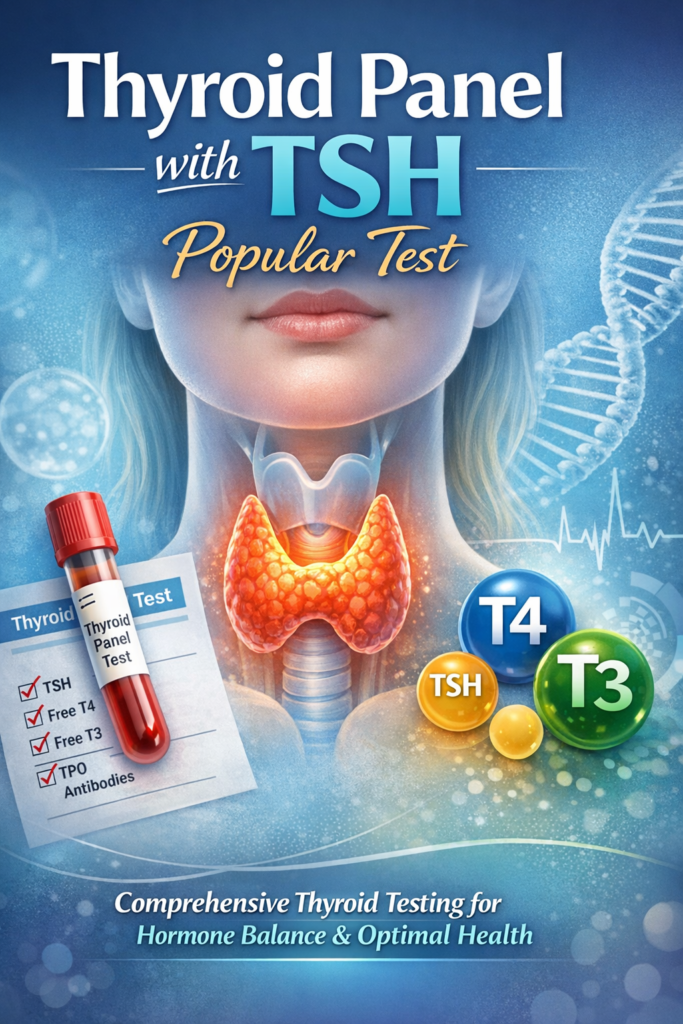
When Dana finally got a full thyroid panel — TSH, Free T3, Free T4, Reverse T3, and TPO antibodies — the picture looked completely different. Her Free T3 was at the very bottom of the reference range. Her Reverse T3 was elevated. And her TPO antibodies were significantly high — a clear marker for Hashimoto’s thyroiditis, an autoimmune thyroid condition that had apparently been developing for years while her TSH sat in the “normal” zone.
Four years. One incomplete test. An entirely missed diagnosis.
“A TSH result alone is like checking the oil light on your dashboard and calling it a full engine inspection.”
This is Part 3 of my Stop Guessing Your Health blood work series. Today we’re going deep on the thyroid — what a complete panel actually measures, why the standard TSH test misses so much, what thyroid dysfunction looks like on your skin and in your body, and how to order comprehensive testing yourself without a physician’s referral.
IN THIS GUIDE
1. Why TSH Alone Is Not a Thyroid Test
TSH — thyroid stimulating hormone — is produced by the pituitary gland in the brain. It signals the thyroid to produce hormones. When doctors check “your thyroid,” they almost always check TSH only — and if it falls within the broad reference range of approximately 0.4 to 4.0 mIU/L, the thyroid is declared normal and the conversation ends.
Here is the clinical problem with that: TSH tells you what the pituitary is asking the thyroid to do. It does not tell you what the thyroid is actually producing. It does not tell you whether the hormones being produced are converting properly into their active form. And it does not tell you whether an autoimmune attack on the thyroid tissue is actively underway.
You can have a completely normal TSH and still have significant thyroid dysfunction — because the dysfunction is happening downstream from where TSH is measuring. This is not a fringe position. It is basic thyroid physiology that is chronically undertested in standard primary care settings.
Why This Gap Exists:
- TSH is cheaper and simpler to run — it’s the standard panel most insurance covers without question
- Full thyroid panels require more specialized testing that many general practitioners don’t routinely order
- Symptoms of low thyroid function overlap heavily with depression, burnout, and aging — which are easier to attribute the symptoms to than ordering additional labs
- Reference ranges are built on population averages — people at the low end of “normal” T3 often feel terrible but are statistically included in the normal population
Calli’s Tip
If your doctor has ever told you your thyroid is “fine” based on TSH alone — ask them specifically: “Was Free T3, Free T4, and TPO antibodies included?” If the answer is no, you have not had a complete thyroid evaluation. Period.
2. What a Complete Thyroid Panel Measures
Here is every marker that belongs in a comprehensive thyroid evaluation — and what each one is actually telling you.
TSH (Thyroid Stimulating Hormone)
The starting point — but not the endpoint. High TSH suggests the pituitary is working overtime to push an underperforming thyroid. Low TSH suggests the thyroid may be overproducing. But TSH can look normal while everything downstream is off, which is why it cannot be used in isolation.
Free T4 (Thyroxine)
T4 is the primary hormone produced by the thyroid gland itself. “Free” T4 measures the unbound, biologically available portion — the only part that can actually enter cells and be used. Low Free T4 with normal TSH is a pattern that can be missed entirely by TSH-only testing and often indicates the thyroid is underproducing even while the pituitary signal appears normal.
Free T3 (Triiodothyronine)
T3 is the active thyroid hormone — the form that your cells actually use to regulate metabolism, body temperature, heart rate, mood, and energy. Most T4 must be converted to T3 in the liver, kidneys, and gut before it can be used. This conversion process can be impaired by chronic stress, inflammation, nutrient deficiencies, and gut dysbiosis — meaning your T4 can be adequate while your Free T3 is low. Low Free T3 is often the direct cause of hypothyroid symptoms in people who test “normal” on TSH and T4 alone.
Reverse T3 (RT3)
Reverse T3 is an inactive form of T3 that the body produces as a stress response — it blocks T3 receptors without activating them, effectively putting the brakes on metabolism. When someone is under significant chronic stress, severely calorie restricting, dealing with chronic illness, or in a state of systemic inflammation, the body shunts T4 conversion toward Reverse T3 instead of active T3. Elevated Reverse T3 with low Free T3 — sometimes called “thyroid resistance” — produces all the classic hypothyroid symptoms with a completely normal TSH.
TPO Antibodies (Thyroid Peroxidase Antibodies)
This is the Hashimoto’s marker. Elevated TPO antibodies indicate the immune system is producing antibodies that attack the thyroid enzyme responsible for hormone production. Hashimoto’s thyroiditis is the most common cause of hypothyroidism in the developed world — and it can be present for years or decades before TSH shifts outside the normal range. Catching it early through antibody testing allows for dietary, lifestyle, and supplementation interventions that can meaningfully slow the autoimmune progression.
Thyroglobulin Antibodies (TgAb)
A second autoimmune thyroid marker. Some people with Hashimoto’s have elevated TgAb with normal TPO — making this a valuable addition to the panel for a complete autoimmune thyroid picture.
Calli’s Tip
High-dose biotin — even at 5,000 mcg, which is completely standard in hair and skin supplements — directly interferes with thyroid hormone assays. It can cause falsely elevated Free T3 and Free T4 results or falsely suppressed TSH. Stop all biotin supplementation for a minimum of 72 hours before your thyroid blood draw. This is not optional if you want accurate results.
3. How Thyroid Dysfunction Shows Up in Your Skin and Body
The thyroid is involved in virtually every metabolic process in the body — which is why dysfunction produces such a wide and seemingly unrelated symptom picture. Here’s how I recognize thyroid patterns clinically, from both a chiropractic and esthetics perspective.
Hypothyroid Patterns (Low Thyroid Function):
- Persistent fatigue that is unresponsive to sleep — a heavy, leaden exhaustion distinct from normal tiredness
- Unexplained weight gain or inability to lose weight despite caloric deficit
- Cold intolerance — feeling cold when others around you are comfortable, cold hands and feet even in warm environments
- Constipation and slowed digestion
- Hair loss — classically diffuse thinning across the scalp, and loss of the outer third of the eyebrows (a well-known hypothyroid sign)
- Dry, rough, thickened skin that doesn’t respond to moisturizer — caused by reduced skin cell turnover and impaired sebum production
- Brain fog, poor memory, slow cognitive processing
- Depression and flat affect
- Muscle weakness and joint pain — a pattern I see frequently in my chiropractic clinic that resolves significantly when underlying thyroid dysfunction is addressed
- Slow heart rate and low blood pressure
On the Skin Specifically — The Esthetician’s View:
In my esthetics practice, hypothyroid skin has a very distinct presentation: it’s dry but not in the way that responds to hydrating products. The texture is rough and almost thickened — caused by the accumulation of glycosaminoglycans (water-binding proteins) under the skin surface, combined with dramatically slowed skin cell turnover. The complexion is often pale or slightly yellowish, with a puffiness around the eyes and face that clients often attribute to allergies or sleep. Eyebrows are thinning from the outer corners. No amount of exfoliation or moisturization fully resolves this — because the driver is metabolic, not topical.
Calli’s Tip
If you are losing the outer third of your eyebrows — the section from the arch outward — that is a classic clinical sign of hypothyroidism that has been documented in medical literature for over a century. It is not normal hair thinning. It is a specific pattern that warrants thyroid testing. I mention it in almost every esthetics consultation where I see it, and I’ve been right far more often than I’ve been wrong.
4. How to Order a Full Thyroid Panel Without a Doctor
You do not need a physician’s referral to access a comprehensive thyroid panel. HealthLabs.com offers a complete thyroid panel that includes TSH, Free T3, Free T4, and TPO antibodies — the full picture that most standard doctors’ offices don’t run — and you can order it directly from home, walk into any of their 4,500+ partner labs nationwide, and have results within 1–3 business days.
Complete Thyroid Panel
TSH · Free T3 · Free T4 · TPO Antibodies
No doctor visit · No insurance · Results in 1–3 business days
👉 Order the Complete Thyroid Panel at HealthLabs.com
5. Reading Your Results — What to Actually Look For
Lab reference ranges for thyroid hormones are broad — and “within range” does not mean optimal. Here are the patterns I look for when reviewing a thyroid panel.
TSH Optimal Range vs. Lab Range:
Most labs flag TSH as abnormal only outside 0.4–4.0 mIU/L. Many functional medicine practitioners consider the optimal range to be closer to 1.0–2.5 mIU/L. A TSH of 3.8 is “within range” but may be clinically significant for a symptomatic patient — especially combined with low Free T3.
The T3 Conversion Problem:
Look at Free T3 relative to Free T4. If T4 is mid-range but T3 is at the low end — poor T4-to-T3 conversion is likely. This pattern often responds to addressing the root drivers: selenium deficiency (selenium is required for the conversion enzyme), zinc deficiency, chronic stress, gut inflammation, or liver congestion. A blood panel gives you the pattern. Then you address the cause — not randomly, but with data.
Elevated TPO Antibodies:
Any elevation above the reference range warrants attention, regardless of where TSH currently sits. Hashimoto’s is a progressive autoimmune condition — catching it at the antibody stage, before significant thyroid tissue destruction has occurred, is the ideal window for intervention. A strict gluten-free diet, selenium supplementation, and stress management have all shown benefit in reducing TPO antibody levels in published research. But none of that is accessible without first knowing your antibody status.
Calli’s Thyroid Panel Checklist — Before You Draw
- 👉 Order the Complete Thyroid Panel at HealthLabs.com
- Stop biotin supplements 72 hours before draw — critical for accurate thyroid results
- Morning draw preferred — TSH has a diurnal rhythm and is highest in the morning
- Request TSH + Free T3 + Free T4 + TPO antibodies — not TSH alone
- Note any current supplements or medications to share with your provider
- Bring results to a functional medicine or integrative provider for interpretation
Coming Up Next on CalliGlowAlign
Part 4: Vitamin & Mineral Testing — Why Your Supplements Might Not Be Working
Vitamin D, B12, ferritin, magnesium, zinc — the nutrients everyone is supplementing, and the blood tests that tell you whether you actually need them. Deficiency and excess both have consequences. Here’s how to know which side you’re on.
👉 Bookmark this page or subscribe to be notified when it goes live.
You’ve spent long enough being told you’re fine. A complete thyroid panel takes one blood draw and 10 minutes. It can change four years of unanswered questions into a clear, actionable path forward.
— Calli
DC, LE | Chiropractor & Licensed Esthetician
I don’t do generic advice. Everything I write, I’ve tested, applied in my clinic, and would stake my license on. If it’s here — it works.
Disclaimer: This content is for educational purposes only and does not constitute medical advice. I am a licensed chiropractor and esthetician, not a medical doctor. Always consult a qualified healthcare provider before ordering lab tests or making changes to your supplement routine.
This post contains affiliate links. As a partner with HealthLabs.com, I may earn a commission if you order through my link, at no additional cost to you. I only recommend services I personally research and clinically stand behind. My opinions are always entirely my own.
Related Articles