
By Calli | Licensed Chiropractor & Esthetician | March 30, 2026
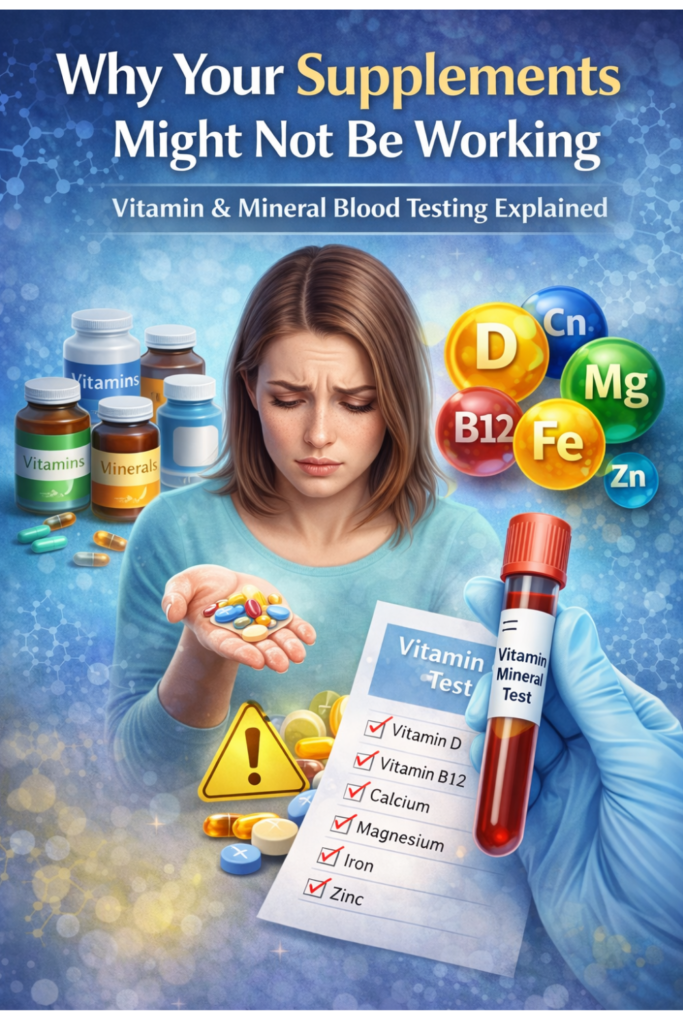
A few months ago, a patient walked into my office holding a receipt from her last supplement order. Four hundred and twelve dollars. Vitamin D 10,000 IU. Iron. B12 sublingual drops. Zinc. Magnesium. Hair, skin, and nails formula with 5,000 mcg of biotin. A collagen peptide powder. She had been taking all of them for eight months. Her energy was still terrible. Her hair was still thinning. And her skin — the thing she was most desperate to fix — had actually gotten worse.
When I looked at her blood work — which she had finally ordered through HealthLabs after I explained how simple it was — the picture made immediate sense. Her vitamin D was already at the high end of the range before supplementing, meaning her 10,000 IU daily dose was pushing her toward toxicity territory. Her ferritin was genuinely low, but she had never been told that because it wasn’t included in her standard labs. Her zinc was fine. Her B12 was elevated — not deficient. And the biotin in her hair formula was almost certainly interfering with her thyroid test results from six months ago.
Four hundred dollars a month. Most of it unnecessary. One thing genuinely needed — completely missed.
“A blood test costs less than one month of supplements you might not need. Do the math. Then do the test.”
This is Part 4 of my Stop Guessing Your Health blood work series. Today we’re covering the vitamin and mineral panel — which nutrients actually need to be tested, what deficiency and excess look like clinically, and how to get accurate numbers in your hands without a prescription.
IN THIS GUIDE
1. Why “Eating Healthy” Is Not the Same as Being Sufficient
This is the assumption I challenge most often in my practice: the idea that if you eat a reasonably healthy diet, you’re probably getting what you need nutritionally, and supplementation is just extra insurance. The reality is far more complicated — and the factors that create deficiency despite good diet are common, often unrecognized, and completely invisible without blood testing.
Why Deficiency Happens Despite a Good Diet:
- Absorption issues: Gut inflammation, low stomach acid, dysbiosis, and conditions like celiac disease all impair nutrient absorption regardless of dietary intake — B12, iron, zinc, and magnesium are particularly affected
- Medication depletion: Oral contraceptives deplete B6, B12, folate, zinc, and magnesium. Proton pump inhibitors (PPIs, acid reducers) deplete B12, magnesium, and calcium. Metformin depletes B12. These are extremely common medications with nutritional consequences most prescribers don’t mention
- Soil depletion: Magnesium and zinc content in food has declined significantly over decades due to industrial farming — meaning the same foods that were sufficient for previous generations may not be sufficient now
- Increased physiological demand: Chronic stress dramatically increases magnesium and B vitamin turnover. Athletes burn through iron and zinc faster. Pregnancy increases demands across the board. Your requirements are not static
- Sun exposure limitations: Vitamin D synthesis requires direct skin exposure to UVB radiation — something that indoor work, sunscreen use, and living above the 35th parallel significantly reduce year-round
Calli’s Tip
If you are on oral contraceptives and experiencing fatigue, mood changes, or skin issues — B6, B12, and zinc depletion are among the first things I look at. These depletions are well-documented in the medical literature and rarely discussed at the pharmacy. A targeted blood panel gives you the actual picture in days.
2. Vitamin D — The Most Over-Supplemented, Under-Tested Nutrient
Vitamin D deficiency is genuinely prevalent — especially in people who work indoors, live in northern climates, or have darker skin tones (melanin reduces UV penetration). The consequences of deficiency are real: immune dysregulation, mood disorders, bone density loss, impaired calcium absorption, increased inflammation, and poor skin barrier function.
But vitamin D toxicity is also real — and it is significantly underrecognized because most people have been told vitamin D is safe to take in high doses. It is fat-soluble, which means excess accumulates in tissues. Toxicity symptoms — nausea, excessive thirst, kidney stones, hypercalcemia, cardiac arrhythmias — can develop at sustained high doses over months. The therapeutic window is meaningful, and you cannot determine where you fall within it without a blood test.
What to Test:
25-Hydroxy Vitamin D (25-OH D) — this is the standard serum measurement of vitamin D status. It reflects both dietary intake and sun synthesis. Most functional medicine practitioners aim for an optimal range of 50–80 ng/mL — higher than the standard lab deficiency cutoff of 20 ng/mL but within the safe zone. Toxicity risk begins to increase above 100 ng/mL.
What Vitamin D Deficiency Looks Like on the Skin:
As an esthetician, I associate vitamin D deficiency with slow wound healing, increased skin sensitivity and reactivity, worsened inflammatory conditions like eczema and psoriasis, and a general dullness and lack of radiance that doesn’t respond well to topical brightening products. Vitamin D receptors are present throughout the skin — it plays a direct role in cell proliferation, immune regulation in the skin barrier, and melanin regulation. Deficiency at the skin level is not subtle once you know what you’re looking at.
Calli’s Tip
Test your vitamin D before adjusting your dose — and retest 90 days after any change. Vitamin D levels take approximately three months to stabilize after a dosage change, which is why testing immediately after starting or stopping supplementation gives you misleading data. The 90-day rule is your testing standard.
3. Ferritin — The Iron Marker Almost Nobody Tests (But Everyone Should)
This is the one that frustrates me most in clinical practice. Serum iron is commonly included in standard lab panels. Ferritin — the protein that stores iron in tissues and is the most sensitive marker for true iron status — almost never is. And they tell very different stories.
You can have a normal serum iron while your ferritin is critically low — a pattern called iron depletion without anemia. This means your body has been pulling iron out of storage to maintain serum levels, and your reserves are nearly gone. Standard labs would tell you your iron is fine. Your ferritin would tell you the truth.
What Low Ferritin Looks Like:
- Significant hair shedding and diffuse thinning — ferritin is one of the most well-established drivers of telogen effluvium (stress-related hair loss), and levels below 50–70 ng/mL are associated with impaired hair follicle function
- Fatigue and reduced exercise tolerance
- Brittle nails — sometimes with a spoon-shaped curvature (koilonychia) in more significant depletion
- Pale, sallow skin tone
- Restless legs, especially at night
- Shortness of breath on exertion
The Ferritin and Hair Loss Connection — An Esthetician’s Warning:
If you are experiencing significant hair shedding and you have not had your ferritin tested, please do this before spending money on hair growth serums, biotin supplements, or scalp treatments. I have worked with clients who spent months and hundreds of dollars on topical hair treatments when the driver was low ferritin — a completely internal issue that topical products cannot address. Once ferritin is restored to an optimal level (most trichologists recommend above 70 ng/mL for hair growth), shedding typically reduces significantly over three to six months.
Calli’s Tip
Do not supplement iron without confirmed low ferritin on a blood test. Iron is one of the few nutrients where unnecessary supplementation carries real risk — excess iron promotes oxidative stress, can damage the liver over time, and at high levels affects the heart. Test first. Always. This is non-negotiable.
4. B12, Zinc, and Magnesium — What the Blood Actually Shows
Vitamin B12
B12 deficiency is one of the most common and most consequential nutritional deficiencies — and it is also one of the most frequently missed because standard lab reference ranges are set far too low. Many labs flag deficiency below 200 pg/mL, but neurological symptoms of B12 insufficiency can appear at levels below 400–500 pg/mL. Vegans, vegetarians, older adults, people on metformin, and people with low stomach acid or intestinal absorption issues are all at elevated risk.
B12 deficiency presents as fatigue, peripheral neuropathy (tingling or numbness in hands and feet), cognitive changes, mood disruption, and megaloblastic anemia. On the skin, I associate it with hyperpigmentation, especially in skin of color, and a smooth, raw-looking tongue. Testing gives you the actual number — and with B12, where you fall within the range matters enormously.
Zinc
Zinc is essential for immune function, wound healing, DNA synthesis, testosterone production, and — critically for my esthetics patients — skin integrity and sebum regulation. Zinc deficiency is associated with acne, slow wound healing, hair loss, impaired taste and smell, and increased susceptibility to infection. It is also commonly depleted by oral contraceptives, high-stress states, and plant-heavy diets due to phytate interference with absorption.
Here is the clinical nuance: serum zinc does not perfectly reflect total body zinc status, since the body tightly regulates serum levels. But it is still the most practical accessible marker — and combined with symptom pattern, it gives meaningful clinical information. I see zinc supplementation genuinely help acne-prone clients — but only when deficiency is confirmed first.
Magnesium
Magnesium is involved in over 300 enzymatic reactions in the body. Deficiency is extremely common — estimated to affect a significant portion of the population — because soil depletion has reduced food sources, chronic stress dramatically increases urinary magnesium losses, and alcohol use depletes it further.
The clinical challenge: serum magnesium is also a poor reflection of total body magnesium status, because 99% of the body’s magnesium is stored intracellularly or in bone. You can have a normal serum magnesium while being significantly depleted overall. RBC (red blood cell) magnesium is a more accurate test — ask specifically for this if magnesium deficiency is suspected. Symptoms of depletion include muscle cramps and spasms, anxiety, poor sleep, constipation, and cardiac arrhythmias.
Calli’s Tip
Magnesium glycinate is the form I recommend most for absorption and tolerability — it’s chelated to an amino acid, which dramatically improves bioavailability compared to oxide or citrate forms. But even with magnesium, where the research is most supportive of general use, testing first gives you a baseline to track improvement against. Supplementing without a baseline is flying blind.
5. How to Order Your Vitamin and Mineral Panel Without a Doctor
HealthLabs.com offers individual vitamin and mineral tests as well as comprehensive nutritional panels that cover multiple markers in a single draw. This is the most efficient approach — one visit to the lab, complete nutritional picture, results within 1–3 business days, no physician referral needed.
Vitamin & Nutritional Testing Panel
Vitamin D · B12 · Ferritin · Zinc · Magnesium
No doctor visit · No insurance · Results in 1–3 business days
👉 Order the Vitamin & Nutritional Panel at HealthLabs.com
Calli’s Vitamin Testing Checklist — Before You Draw
- 👉 Order the Vitamin & Nutritional Panel at HealthLabs.com
- Stop biotin supplements 72 hours before draw — interferes with multiple assays
- Fast 8–10 hours before draw for most accurate iron and glucose markers
- Request ferritin specifically — serum iron alone does not tell the storage picture
- Ask for RBC magnesium if magnesium deficiency is suspected
- Retest vitamin D 90 days after any dosage change — not before
Coming Up Next on CalliGlowAlign
Part 5: Inflammation Markers — The Silent Saboteur Behind Fatigue, Skin Issues, and Joint Pain
CRP, ESR, homocysteine — inflammation blood markers reveal what’s driving chronic symptoms that seem unrelated. As a chiropractor who treats inflammatory joint and muscle conditions daily, this is the panel I consider most underutilized in wellness testing.
👉 Bookmark this page or subscribe to be notified when it goes live.
Stop spending money on supplements built on guesswork. One blood draw gives you the data to spend intentionally — and actually see results.
— Calli
DC, LE | Chiropractor & Licensed Esthetician
I don’t do generic advice. Everything I write, I’ve tested, applied in my clinic, and would stake my license on. If it’s here — it works.
Disclaimer: This content is for educational purposes only and does not constitute medical advice. I am a licensed chiropractor and esthetician, not a medical doctor. Always consult a qualified healthcare provider before ordering lab tests or making changes to your supplement routine.
This post contains affiliate links. As a partner with HealthLabs.com, I may earn a commission if you order through my link, at no additional cost to you. I only recommend services I personally research and clinically stand behind. My opinions are always entirely my own.
Related Articles