
By Calli | Licensed Chiropractor & Esthetician | April 1, 2026
A patient came in two days after returning from a ten-day trip to Italy. She wasn’t sick. The trip hadn’t involved any injury. She hadn’t slept on an uncomfortable bed or overdone it hiking. The problem had started on the flight home — twelve hours from Rome to Los Angeles — and by the time she walked into my clinic, she could barely rotate her torso to back out of a parking space.
I hear a version of this story every single week. And the frustrating part — from a clinical standpoint — is that it is almost entirely preventable. The pain people experience during and after long flights is not bad luck or just “getting older.” It is the entirely predictable result of sitting in a seat that was not designed with your spine in mind, for a duration of time your body was not built to tolerate without intervention.
As a licensed chiropractor, I spend a significant portion of my clinical hours treating post-travel patients. And as someone who takes long-haul flights regularly myself, I have field-tested everything I recommend. This post is the guide I give every patient before a major trip — the clinical explanation for why it happens, and the three specific tools that make a measurable difference.
IN THIS GUIDE
1. Why Airplane Seats Are a Spinal Nightmare — A Chiropractor Explains
Let me tell you exactly what happens to your spine when you sit in a standard economy seat for five hours or more — because once you understand the mechanics, the solutions make complete sense.
Airplane seats are not ergonomic. They are designed to be compact, stackable, and maximally efficient for the airline — not for the health of the person sitting in them. The seat back angle forces your lumbar spine into a prolonged C-curve flexion posture. Your natural lumbar lordosis — the inward curve of your lower back that distributes load across the vertebrae — gets flattened or reversed. Hold that position for five hours and you have created the perfect conditions for disc pressure buildup at L4/L5, deep muscle guarding in the paraspinal muscles, and hip flexor shortening that pulls the pelvis into anterior tilt.
Beyond the lumbar spine, the standard seat back height pushes your head slightly forward — a posture called forward head carriage. For every inch your head moves forward of neutral, the effective weight your cervical spine must support increases by roughly ten pounds. On a twelve-hour flight, your neck muscles are working continuously against that load while you sleep, read, watch a screen, or simply sit. This is why you land feeling like someone spent the flight sitting on your neck.
What Happens After 5 Hours in an Airplane Seat:
- Paraspinal muscle fatigue and guarding: The erector spinae — the muscles that run alongside your spine and keep you upright — begin to fatigue and go into protective spasm after sustained static loading
- Increased intradiscal pressure: Sustained flexion posture significantly increases pressure on the intervertebral discs, particularly L4/L5 and L5/S1 — the same discs most commonly involved in disc herniation
- Cervical facet compression: The small joints in your neck are compressed by forward head posture and worsened dramatically if you fall asleep without neck support
- Reduced circulation in the lower extremities: Sustained hip and knee flexion compresses the popliteal vessels behind the knee and reduces venous return — causing the ankle and calf swelling that almost everyone experiences on long flights
- Thoracic outlet compression: The combination of rounded shoulders and forward head posture compresses the neurovascular bundle at the thoracic outlet — contributing to the arm tingling and hand numbness some passengers experience
Calli’s Tip
Every 90 minutes, stand up and walk to the galley. Do 30 seconds of chin tucks (gently retract your chin straight back — not down) and 20 calf raises. These two movements take less than two minutes and reset your cervical alignment while stimulating venous return in your legs. I recommend this to every patient flying more than four hours. Movement is the single most effective free intervention available on a plane.
2. Essential #1: Ergonomic Travel Neck Pillow
I want to address the standard U-shaped travel pillow first — because almost every airport kiosk sells one and almost no one should be using it for sleep on a plane. The classic U-shaped foam or memory foam pillow sits behind your neck and does virtually nothing to prevent your head from dropping forward or snapping to one side when you fall asleep. It provides the illusion of support without delivering it clinically.
What your cervical spine actually needs during flight sleep is a pillow that maintains neutral cervical alignment — preventing both forward head drop and lateral neck snap simultaneously. When your head drops forward during sleep, the weight of your skull — approximately ten to twelve pounds — creates a lever-arm force on your cervical spine of up to sixty pounds. That is the equivalent of a small child sitting on your neck for hours. The micro-trauma to the posterior cervical muscles, ligaments, and facet joints from a single long-haul flight sleep session without proper support is what causes that “I can’t turn my head” presentation I see in my clinic every week after holiday season.
The solution is a structured ergonomic neck pillow with internal support architecture — one that actively holds your head in neutral rather than simply cushioning it.
💙 Chiropractor Approved
Ergonomic Travel Neck Pillow
Maintains cervical neutral · Prevents head drop · Compact for carry-on
What I pack on every single flight — non-negotiable
👉 Ergonomic Travel Neck Pillow
What I Look for Clinically in a Travel Neck Pillow:
- Structured internal support: Not just foam — the pillow needs internal architecture that actively maintains position when your muscles relax during sleep
- Front closure or chin support: Prevents forward head drop — the most damaging sleep position on a plane
- Adjustable fit: Cervical spine dimensions vary significantly — a one-size pillow is a clinical compromise
- Compact packing: A pillow that ends up in your checked bag because it’s too bulky is a pillow that doesn’t protect you on the flight
Calli’s Tip
On a flight longer than five hours, always pack your neck pillow in your personal item — not your carry-on overhead. You want it accessible before takeoff, not buried above you. Put it on before the flight reaches cruising altitude, before you feel tired. Trying to put it on after you’ve already been sitting in poor posture for two hours is less effective than maintaining alignment from the start.
3. Essential #2: Foot Hammock + Eye Mask + Ear Plug Set
This one surprises people when I recommend it — because most people think of a foot hammock as a comfort item rather than a clinical tool. Let me explain why it’s both.
When you sit in an airplane seat with your feet flat on the floor, your hips and knees are in approximately 90 degrees of flexion for the entire duration of the flight. This sustained hip flexion creates two clinical problems simultaneously: it compresses the psoas muscle — the deep hip flexor that attaches directly to your lumbar vertebrae — and it reduces venous return from your lower extremities by compressing the popliteal vessels behind the knee.
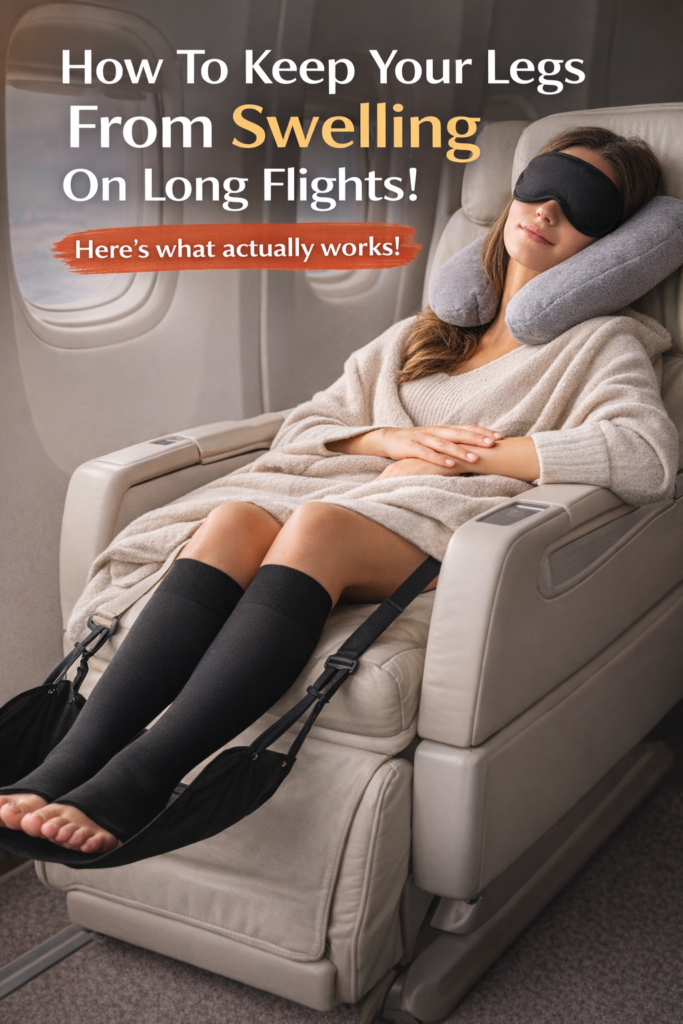
A foot hammock that attaches to the tray table latch in front of you changes the angle. By elevating your feet, it reduces hip and knee flexion angle, decompresses the popliteal vessels, and allows gravity to assist venous return from the calves and ankles. The result is measurably less swelling on arrival and significantly less hip flexor tightness — the tightness that contributes to that “my lower back is locked up” feeling when you finally stand to deplane.
I’ve paired it with an eye mask and ear plug set because sleep quality on a plane is not a luxury — it is a recovery tool. Your nervous system does not decompress during passive wakefulness the way it does during sleep. A quality eye mask that blocks light completely and ear plugs that reduce cabin noise meaningfully are the difference between arriving with a rested nervous system and arriving in a state of sensory fatigue that amplifies every physical discomfort.
💙 Chiropractor Approved
Foot Hammock + Eye Mask + Ear Plug Set
Reduces leg swelling · Decompresses hip flexors · Blocks light and noise
Three problems solved in one compact travel set
👉 Foot Hammock + Eye Mask + Ear Plug Set
Clinical Benefits of Foot Elevation on Long Flights:
- Reduces ankle and calf swelling: Elevating the feet above heart level or even to a neutral position dramatically improves venous return and reduces the fluid accumulation that causes swollen ankles on arrival
- Decompresses the psoas: Reducing hip flexion angle allows the psoas muscle to partially release — reducing the lumbar tension it creates through its spinal attachments
- Reduces DVT risk: While not a substitute for movement, any improvement in lower extremity circulation is clinically relevant on flights over six hours
- Improves overall comfort and sleep quality: A more neutral lower body position reduces the constant low-level discomfort that disrupts sleep on long flights
Calli’s Tip
Put the foot hammock on after the seatbelt sign turns off at cruising altitude — not during takeoff and landing when it may interfere with emergency egress. Even one to two hours of elevated foot position mid-flight makes a noticeable difference in how your legs feel on arrival. Pair it with the eye mask and ear plugs for a true recovery window — your nervous system will thank you when you land.
4. Essential #3: Massage Ball
This is the one that surprises people most — and the one I find myself recommending most enthusiastically, because the clinical application is so practical and the result is so immediate.
A massage ball is a dense, palm-sized ball — typically lacrosse ball density or slightly softer — that you can use to apply targeted myofascial pressure to specific muscle groups during a flight or throughout your trip. The reason I recommend it over a foam roller or other travel massage tools is simple: it fits in a quart-size zip lock bag, weighs almost nothing, and can be used in a airplane seat without disturbing anyone around you.
Here’s how I use it and teach patients to use it on flights: place it between your lower back and the seat back, position it on the paraspinal muscles just lateral to the spine (never directly on the spine itself), and use your bodyweight to apply gentle sustained pressure for 30 to 60 seconds per spot. This technique — called ischemic compression in manual therapy — creates a temporary reduction in blood flow to the muscle tissue followed by a reactive hyperemia (increased blood flow) that helps break the cycle of sustained muscle tension and ischemic pain that builds over hours of static sitting.
You can also use it on your glutes — which become remarkably compressed during long flights — by placing it under one side and shifting your weight onto it. And at your destination, it becomes a full-body recovery tool for hotel room stretching, foot rolling after walking tours, and general muscle maintenance throughout your trip.
💙 Chiropractor Approved
Travel Massage Ball
In-flight back relief · TSA carry-on approved · Use throughout your trip
The smallest tool with the biggest clinical payoff
How to Use It on a Plane:
- Lower back: Place between your lumbar spine and seat back, just to the side of the spine. Hold gentle pressure 30–60 seconds, move one inch up or down, repeat
- Mid back: Same technique, work up the thoracic paraspinals — particularly useful if you feel tightness between the shoulder blades from sustained forward posture
- Glutes: Place under one glute, shift your weight gently onto it, hold 30–60 seconds — releases the piriformis and gluteus medius that get compressed in prolonged sitting
- At your destination: Foot rolling (plantar fascia release), calf rolling, shoulder rolling against a wall — this tool earns its place in your bag every day of your trip
Calli’s Tip
Never place the massage ball directly on your spine — only on the muscle tissue lateral to it. Direct pressure on the spinous processes or vertebral joints is not appropriate for self-treatment. Stay on the paraspinal muscles, one to two finger-widths off the midline on each side. If you feel sharp, shooting, or radiating pain at any point, stop immediately and consult a provider.
5. Final Thoughts: Land Ready — Not Wrecked
The patient I told you about at the beginning of this post — the one who came in unable to back out of a parking space after her Italy flight — she now travels with all three of these tools. She flew to Japan last fall, twelve hours each way, and came back to my clinic for her regular appointment two weeks later. Zero post-flight complaints. Not because her flights were different — but because her approach was.
That is the difference between treating travel pain reactively — showing up in my clinic after the fact — and preventing it proactively with tools that cost less than one chiropractic visit. The investment is small. The payoff is arriving at your destination with a body that is actually ready to be there.
You save for months for a vacation. You plan every detail. Don’t let a poorly supported twelve-hour flight be the thing that sidelines you on day one.
Calli’s Complete Travel Pain Relief Checklist
“Don’t let a 10-hour flight ruin your first day of vacation. The right tools make the difference between landing ready to explore — and landing unable to turn your head.”
- 👉 Ergonomic Travel Neck Pillow — pack in personal item, put on before cruising altitude
- 👉 Foot Hammock + Eye Mask + Ear Plug Set — use after seatbelt sign off
- 👉 Travel Massage Ball — lower back and glutes every 2 hours
- Stand and walk every 90 minutes — chin tucks + calf raises, 2 minutes
- Stay hydrated — electrolytes not just water (cabin humidity is 10–20%)
- Avoid alcohol for the first 4 hours of any flight over 8 hours
Coming Up Next on CalliGlowAlign
My 5-Minute In-Seat Stretching Routine for Long-Haul Flights
A specific chiropractic-based movement sequence you can do without leaving your seat — targeting the exact muscle groups most damaged by prolonged flight posture. Five minutes, no equipment, massive difference.
👉 Bookmark this page or subscribe to be notified when it goes live.
Your body is the one carry-on you can never check. Treat it accordingly.
— Calli
DC, LE | Chiropractor & Licensed Esthetician
I don’t do generic advice. Everything I write, I’ve tested, applied in my clinic, and would stake my license on. If it’s here — it works.
As an Amazon Associate, I earn a small commission from qualifying purchases at no additional cost to you. All products featured are ones I personally use and clinically recommend. My opinions are always entirely my own.
Related Articles