
By Calli | Licensed Chiropractor & Esthetician | May 3, 2026
A 42-year-old client came into my Los Angeles treatment room last month with sun-induced melasma she had been fighting for three years. She used SPF 50 daily. She reapplied. She wore a hat. And the pigment kept getting worse. When I asked her to bring me her sunscreen, she pulled out a chemical formula with avobenzone — the right protection number, the wrong filter for melasma-prone skin under California sun. After 20 years of running an esthetic practice in LA, I have learned that the chemical-vs-mineral question is not academic. It changes whether your pigment heals or deepens, whether your skin breaks out or stays clear, and whether your makeup sits flat or pills off by lunchtime.
SPF is the single most important step in any skincare routine. The number on the bottle is only half the story — the filter system, texture, and how you apply it determine whether you actually get the protection you think you are getting. This article is the same conversation I have at the basin during a consultation: what each filter type does, how to pick between cream and essence formulas, the daily SPF I recommend for California strong-sun, and how to layer it under makeup without the dreaded white pilling.
Quick Summary
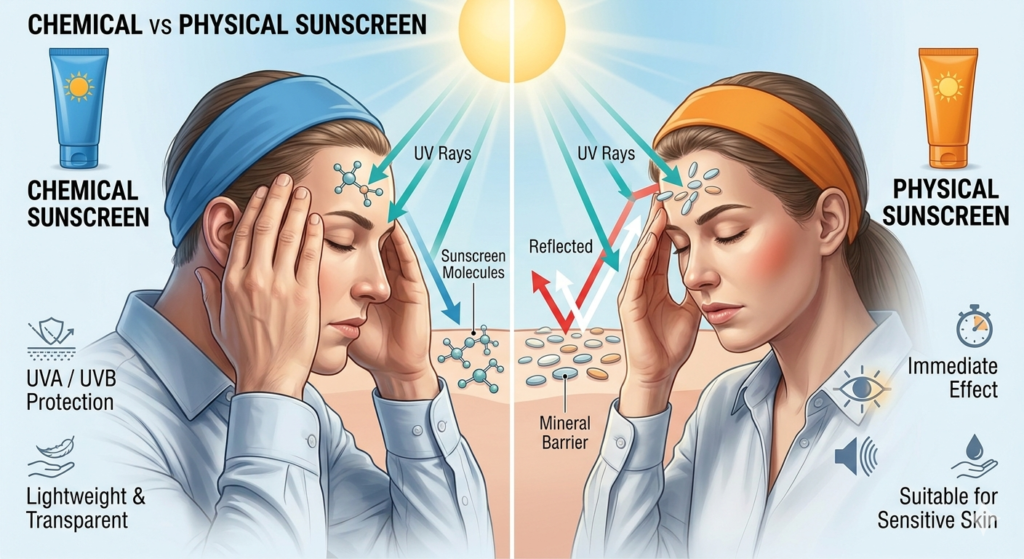
Chemical sunscreens absorb UV and convert it into heat — lightweight, invisible, but can trigger melasma and irritate sensitive skin. Mineral (zinc oxide, titanium dioxide) physically blocks UV — gentler, better for pigmentation-prone skin and rosacea, but can leave a white cast. For California daily wear, I recommend a hybrid or modern micronized mineral SPF 50. Apply two finger-lengths for face and neck. Wait 90 seconds before makeup to prevent pilling. Reapply every 2 hours when outdoors.
In This Article
1. How sunscreen actually works on your skin
2. Chemical vs mineral — the real difference
3. Cream vs essence vs stick — which texture for which skin
WHY TRUST THIS ARTICLE
Written by Calli — a licensed Doctor of Chiropractic (DC) and Licensed Esthetician (LE) in Los Angeles with 20 years of clinical experience. Sun protection is the single most discussed topic in my treatment room because I see the long-term consequences of skipping it — the melasma, the leathery texture, the deep crow’s feet that brighten lasers cannot fully erase. The recommendations below come from 20 years of evaluating Fitzpatrick types II through V under California UV index conditions and from running daily LED therapy and chemical peel protocols where SPF compliance is non-negotiable. Educational content, not a substitute for an in-person consultation.
1. How Sunscreen Actually Works on Your Skin
Most clients I consult with in LA think of SPF as a single number on a bottle. The number tells you only how long the formula slows UVB-induced burning compared to bare skin. It does not tell you anything about UVA — the longer wavelength that drives photoaging, pigmentation, and DNA damage through clouds and windows. After 20 years of skin consultations, I can spot a client who only protects against the sting of a sunburn but ignores everyday UVA: the skin texture is dull, the pores look enlarged, and pigmentation appears in patches she cannot explain.
UVA vs UVB — what the letters mean
UVB is the burning ray. It peaks at midday, is blocked by glass, and causes acute sunburn and skin cancer. UVA is the aging ray. It is constant from sunrise to sunset, passes through clouds and most windows, and penetrates deeper into the dermis where it damages collagen and triggers melanin overproduction. A real broad-spectrum SPF protects against both. In the US, look for “broad spectrum” plus a high SPF number. In Korea or Europe, look for the PA+++ or PA++++ rating — PA measures UVA protection specifically.
Why the SPF number alone is not enough
SPF 30 blocks roughly 97% of UVB. SPF 50 blocks roughly 98%. The jump from 30 to 50 is small in lab conditions, but in real-life California sun where most people apply a quarter of the labeled amount, that small percentage matters. I tell every LA client to default to SPF 50 broad spectrum — the buffer covers under-application, sweat, and the hours between reapplication.
CALLI’S TIP
Driving in LA traffic counts as UV exposure. The driver-side window blocks UVB but lets UVA through. After 20 years of seeing the same pigmentation pattern on left cheeks of LA commuters, I can usually guess which side of the car a client drives on before she tells me. Apply SPF before you get in the car.
2. Chemical vs Mineral — The Real Difference
This is the question I get more than any other in my LA treatment room, especially from clients in their 30s and 40s starting to notice melasma or sun spots. The two filter systems work in completely different ways, and which one is right for you depends mostly on your skin type and pigmentation history.
Chemical filters — how they work
Chemical filters (avobenzone, octinoxate, octocrylene, oxybenzone, the newer Tinosorb and Mexoryl variants) absorb UV radiation and convert it into a small amount of heat that dissipates from the skin. They feel weightless, blend invisibly, and are easier to layer under makeup. The downside: that heat conversion can aggravate melasma and rosacea in heat-sensitive clients, and some of the older filters (oxybenzone in particular) are linked to hormone disruption concerns and reef damage. Many of my clients with melasma are surprised when I tell them their chemical SPF is making their pigment worse — the heat reaction is the silent contributor.
Mineral filters — how they work
Mineral (or “physical”) sunscreens use zinc oxide, titanium dioxide, or both. They sit on top of the skin and physically reflect or scatter UV rays. They are gentler, do not heat the skin, and are the safer pick for sensitive, rosacea-prone, or melasma-prone skin. The traditional downside is the white cast — especially on Fitzpatrick types IV through VI — but micronized and tinted mineral formulas have largely solved this in the last five years. When I run an LED therapy or chemical peel protocol in my treatment room, I send the client home with a mineral SPF every time because the post-procedure skin needs zero added irritation.
Which one is right for you
Pigmentation-prone, melasma, rosacea, post-procedure, sensitive skin: mineral. Oily skin under makeup, athletic outdoor use, no pigmentation issues: chemical or hybrid is fine. Most of my LA clients in their 30s and up land on a hybrid or modern micronized mineral SPF 50. The split is roughly 70–30 in favor of mineral once a client has been with me for a year and we have walked through a full skin history.
CALLI’S TIP
If you have melasma and you are still using chemical SPF, swap to mineral for 90 days and watch what happens. Roughly 8 out of 10 of my clients with stubborn melasma see noticeable lightening at the 12-week mark from this single switch — before any active brightening serum is added.
3. Cream vs Essence vs Stick — Which Texture for Which Skin
After 20 years of dispensing SPF samples in my LA practice, I can tell within two minutes of a consultation which texture a client will actually use daily — and texture compliance matters more than the molecule on the label. The best sunscreen is the one you actually apply every morning. Here is how I match texture to skin.
Cream sunscreens
Cream is the workhorse format. It delivers the highest reliable application thickness because clients tend to apply enough to cover. Best for normal, dry, mature, or pigmentation-prone skin. The right cream feels like a moisturizer with a slight finish — not greasy, not pasty. If your cream SPF feels heavy on day one, it will be in the back of the cabinet by day fourteen.
Essence and serum sunscreens
Korean-style watery essences and milky serums layer beautifully under makeup and are my pick for oily, combination, or breakout-prone skin. The catch: clients underapply them because they spread so easily. I tell every essence-SPF user to double-pump — one full pump for the face, half a pump each for the neck and chest. Most clients I correct were applying half what they thought they were.
Stick sunscreens
Sticks are reapplication tools, not primary morning SPF. They are excellent for the lip line, the nose bridge, the ear edges, and the back of the hands — the spots most clients miss in the AM and lose protection at fastest. I keep one in my car and tell every LA client to keep one in her bag for 2pm reapplication when she is outdoors.
Spray sunscreens
Sprays are the most under-applied and inconsistent format. I do not recommend them as primary AM protection. For sports or outdoor reapplication on the body they are fine, but on the face the application thickness is rarely close to what the SPF number requires.
CALLI’S TIP
Look at the back of your hand at 5pm. If it looks more weathered than your face, you are skipping SPF on your hands. The hands age faster than the face for most of my clients in their 40s and 50s — a 30-second swipe with a stick SPF after washing is the single best anti-aging hand habit there is.
4. The Daily California Strong-Sun Pick
California UV is no joke. The UV index in LA reliably hits 9 or 10 between May and September, and the year-round average is one of the highest in the continental US. After 20 years of treating LA clients, here is how I structure the daily SPF lineup I recommend.
For most LA clients (default pick)
A modern micronized mineral SPF 50 broad spectrum, ideally with a slight tint to neutralize white cast and double as a light makeup base. Tinted mineral SPFs also contain iron oxides which add visible-light protection — a key extra layer for melasma and post-inflammatory hyperpigmentation. This is the formula I send home with about 70% of my regular clients.
For oily or breakout-prone skin
A hybrid (chemical + low-percentage zinc) essence-style SPF 50. Lightweight, non-comedogenic, layers cleanly under foundation. Avoid heavy occlusive cream formulas if you are acne-prone — the trapped sebum will outweigh the SPF benefit.
For very dry or mature skin
A mineral cream SPF 50 with added ceramides, squalane, or hyaluronic acid built in. The hydrating base means you can sometimes skip a separate moisturizer in the AM, which simplifies the routine for clients who feel overwhelmed by layering.
For outdoor activity in LA sun
Water-resistant mineral SPF 50 + a hat + reapplication every 2 hours. No formula, no number, and no claim survives 4 hours of LA midday sun without reapplication. The sunscreen is one piece of a system, not a shield.
CALLI’S TIP
If you only buy one SPF this year, make it a tinted mineral SPF 50 broad spectrum with iron oxides. It covers UVA, UVB, blue light, and visible light — the four wavelengths that drive both photoaging and melasma. This single bottle replaces foundation, primer, and SPF for many of my LA clients.
5. How to Layer SPF Under Makeup Without Pilling
Pilling is the most common SPF complaint in my LA practice. It is rarely the SPF formula at fault — it is almost always the layering technique. After 20 years of demonstrating application at the basin, here is the sequence that solves it for nearly every client.
The application timeline that prevents pilling
Cleanser, toner, serum, moisturizer — pause 90 seconds. Apply SPF in two finger-lengths, press in with palms, do not rub. Pause 90 seconds. Apply primer or makeup. The pauses are the secret. When clients pile makeup on top of wet SPF, the surface tension is wrong and everything balls up. With proper pauses, even thick mineral creams sit clean under foundation.
The amount most clients get wrong
Two finger-lengths is the verified amount for face plus neck. Most of the LA clients I see during a first consultation are applying somewhere between one third and one half of this. The “peanut-sized blob” recommendation underestimates the surface area of the face. When I demonstrate the correct amount in my treatment room with the actual finger-length measurement, clients are usually shocked.
Reapplication strategies that work in real life
No one is going to wash off a full face of makeup at 2pm to reapply liquid SPF. The realistic options are: a powder mineral SPF brushed on top of makeup, a stick SPF pressed onto cheeks and nose, or a mist SPF as a top-up only. None of these reach the same protection as a proper morning application, so they are top-ups — not replacements.
CALLI’S TIP
If your SPF still pills after the 90-second pause, the issue is usually a silicone primer underneath fighting a water-based SPF on top. Match your formulas: water-based serum + water-based moisturizer + water-based SPF, or oil-based throughout. Switching one product breaks the pilling 9 times out of 10.
Calli’s Clinical Note
In my Los Angeles treatment room, every chemical peel, microcurrent session, and LED therapy treatment ends the same way: I send the client home with a mineral SPF 50 and a non-negotiable instruction to apply two finger-lengths every morning for the next four weeks. Clients who follow it heal cleanly with even tone. Clients who skip it walk back in with rebound pigmentation. Sun protection is not a beauty preference — it is the single most powerful anti-aging step there is, and it is also the cheapest. Pick the right filter for your skin, the right texture for your routine, and apply it like you mean it.
The Bottom Line
Pigmentation-prone skin needs mineral SPF. Oily, breakout-prone, athletic skin can use chemical or hybrid. For California daily wear, default to a tinted micronized mineral SPF 50 broad spectrum with iron oxides. Apply two finger-lengths for face and neck. Pause 90 seconds before makeup. Reapply every 2 hours when outdoors. The right sunscreen, applied correctly, is worth more than every anti-aging serum on the shelf combined.
A licensed esthetician’s honest comparison of luxury versus drugstore skincare, why ceramide moisturizer is non-negotiable for barrier repair, and how to spend wisely on the products that actually move the needle.
Related Reading
→ What’s the Correct Skincare Order? Morning vs Night Routine
— Calli
DC, LE | Licensed Chiropractor & Esthetician | Aligned spine, glowing skin — both come from the same daily discipline.
Disclaimer: This article is educational and does not replace a personal skincare consultation. Sunscreen needs vary based on Fitzpatrick skin type, medical history, and lifestyle. If you have a diagnosed condition such as melasma, rosacea, or photosensitivity, consult a board-certified dermatologist before changing your sun-protection routine.
As an Amazon Associate I may earn from qualifying purchases referenced in related posts. This article contains no affiliate links.