
By Calli | Licensed Chiropractor & Esthetician | April 27, 2026
A patient walked into my LA clinic rubbing her right shoulder and said a sentence I hear three times a week: “Dr. Calli, I have been to physical therapy for four months and my shoulder still hurts every time I reach the top shelf.”
She had done the band exercises, icing, anti-inflammatories, even a cortisone injection. Yet the moment she sat back down at her laptop for an eight-hour workday, the biomechanical disaster that created her pain silently reset itself. Shoulder impingement is one of the most misunderstood pain patterns I see — and the missing piece is almost never what your doctor handed you at discharge.
If your shoulder hurts when you raise your arm overhead, reach behind your back, or sleep on your side, and the pain keeps coming back, you are likely dealing with impingement. The good news: it responds beautifully — but only when you stop expecting passive treatments to fix an active postural disease.
“I have done physical therapy three separate times for the same shoulder. It always feels better for two weeks, then comes right back. What am I doing wrong?”
You are not doing anything wrong — you are just missing the home-care half of the equation. Below, I break down what shoulder impingement actually is, why clinical visits alone cannot resolve it, and the exact movement and posture strategy I teach every patient to do at home, every day.
IN THIS GUIDE
Quick Summary
Shoulder impingement happens when the space between your acromion and humeral head narrows, pinching the rotator cuff tendons. Modern desk-and-phone posture is the silent driver. Clinical treatment manages the inflammation, but only daily mobility work, posture correction, and self-care can fix the underlying mechanics for good.
Why Trust Calli
Calli is a dual-licensed Doctor of Chiropractic and Esthetician in Los Angeles. Every recommendation in this article reflects current biomechanical evidence and her clinical work with hundreds of impingement cases.
1. What Shoulder Impingement Syndrome Actually Is
The Tiny Space That Decides Everything
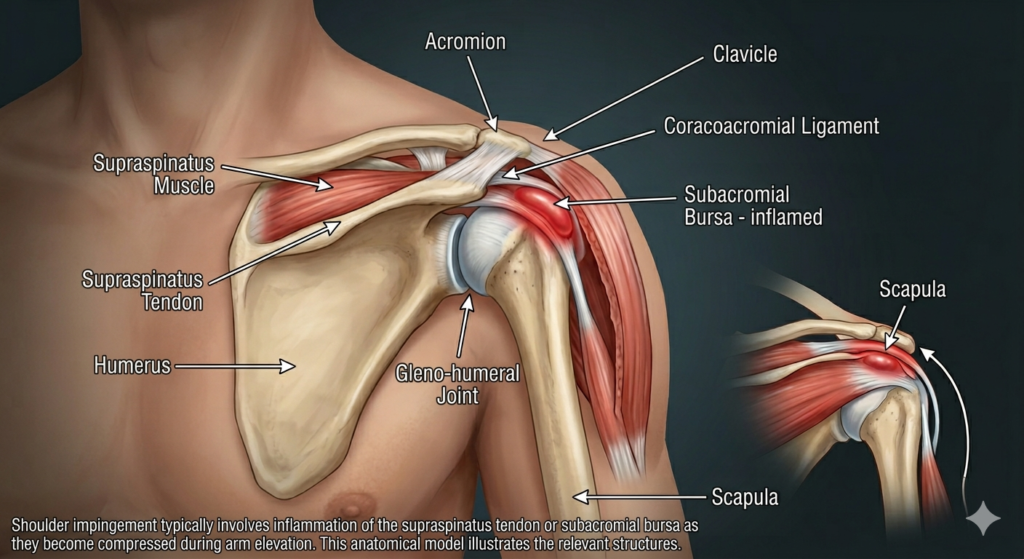
Your shoulder is the most mobile joint in the human body, and that mobility comes at a price: very little bony stability. The head of your humerus glides beneath a bony shelf called the acromion. Between those two bones runs a narrow corridor called the subacromial space — and threading through it are heavily-used soft tissues including your supraspinatus tendon, the subacromial bursa, and the long head of your biceps tendon.
When your scapula sits correctly and your thoracic spine is upright, this corridor stays open and your arm glides overhead painlessly. But when your posture collapses forward — rounded shoulders, forward head, slumped upper back — your scapula tilts and the acromion drops. The space narrows, and every arm lift pinches those tendons between two bones. Repeat that thousands of times daily at your laptop and phone, and you have built the perfect setup for impingement.
The Modern Posture Problem
We sit at computers eight to ten hours a day. We hunch over phones every spare minute. We drive with hands out in front of us. We rarely lift our arms overhead and almost never reach behind us. The pectoralis minor, anterior deltoid, and upper trapezius get short and tight. The rhomboids, lower trapezius, and serratus anterior get long, weak, and asleep. The result is a rounded-shoulder posture that mechanically jams the subacromial space closed before you have even lifted your coffee cup.
Calli’s Tip
Try this: stand and slump forward like you are reading your phone, then slowly raise your arm to the side. Notice the catch around 80-100 degrees. Now stand tall, draw your shoulder blades down and back, lift your chest, and raise the same arm. The arc is smooth. That is impingement — and your fix — in real time.
2. Why Clinical Treatment Alone Keeps Failing You
What the Doctor’s Office Can and Cannot Do
Anti-inflammatories and cortisone reduce the chemical inflammation around an irritated tendon. Physical therapy strengthens the rotator cuff and scapular stabilizers. Chiropractic adjustments and manual therapy restore segmental motion to the thoracic spine and shoulder joints. All of these are legitimate, evidence-based, and useful — I deliver several of them myself every day.
But the honest reality is this: a one-hour appointment cannot undo twenty-three hours of bad posture. Your tissues remodel to whatever position they are held in for the longest cumulative time each day. If you spend forty minutes at PT correcting your scapular position and then sit hunched over a keyboard for eight hours, the postural muscle memory from your job wins. Every. Single. Time.
The Missing Piece: Daily Self-Care
Passive care manages symptoms, but active care fixes the cause. The patient who fully recovers is not the one who attends PT three times a week — it is the one who does five minutes of mobility work each morning, resets posture every hour at their desk, and uses self-care tools at home. Without that daily home-care layer, you are renting relief instead of buying recovery.
Calli’s Tip
If your provider is not giving you a home-care plan with specific tools and a daily schedule, ask for one. The best clinical results I see come from patients who treat their five-minute morning routine as non-negotiable as brushing their teeth.
3. The Home-Care Movement Strategy That Finally Works
Three Tools, Five Minutes a Day
My home-care recommendation is intentionally simple because complicated routines do not get done. You need three inexpensive tools — a foam roller, a stretching bar, and a posture corrector — and a five-minute daily window. The foam roller restores thoracic extension. The stretching bar opens the chest and shoulders that have been collapsed inward all day. The posture corrector gives your nervous system a gentle reminder of where your shoulders should sit while it relearns the pattern.
Calli’s Tip
Lay a foam roller lengthwise along your spine, lie down with head and tailbone supported, and let your arms fall to the sides like a snow angel. Two minutes daily delivers more thoracic extension than most people get all week.
💙 Calli’s Pick · Thoracic Mobility
High-Density Foam Roller (36 inch)
Full-length support for spinal extension · Firm-density EVA foam · Doubles as a pilates and recovery tool
A 36-inch roller is the single most-used recovery tool in my home and a staple I prescribe to nearly every desk-job patient.
💙 Calli’s Pick · Back and Shoulder Stretching
Pilates Mobility Stretch Bar
Lightweight bar for guided shoulder and chest stretches · Padded grip · Used in physical therapy and pilates studios
The stretch bar makes shoulder mobility drills foolproof — it is the home-care tool I most wish every patient owned from day one.
💙 Calli’s Pick · Posture Correction
Posture Correction Training Bar
Long stick that rests behind your shoulders · Lightweight wood or aluminum design · Used in PT, pilates, and Korean rehab clinics
Place the bar horizontally behind your shoulders, hold each end with your elbows bent, and your scapulae automatically retract into the correct position. A few minutes a day retrains the pattern your desk job destroys.
4. Daily Posture Habits That Protect Your Shoulder
Core, Joint, and Movement Hygiene
A shoulder does not exist in isolation. It sits on a thoracic spine, on a lumbar spine, on a pelvis stabilized by your core. If your core is weak and your pelvis tips forward, your ribcage flares, your thoracic spine flexes, and your scapula tilts — compressing the subacromial space before you have even moved your arm. Daily core engagement is non-negotiable shoulder care, even though it sounds unrelated.
Set a posture timer every thirty to sixty minutes. When it rings: feet flat, sit tall, gently draw your shoulder blades down and back, tuck your chin, and take three slow breaths into your lower ribs. Fifteen seconds. Done sixteen times a day, this micro-reset alone has resolved mild impingement for many of my patients without any other intervention.
Calli’s Tip
Movement is medicine, but only if it is dosed daily. The patient who does ten minutes every day beats the patient who does an hour once a week — every time. Make the small thing the consistent thing.
Your Complete Shoulder Impingement Home-Care Kit
- 👉 High-Density Foam Roller (36 inch) — Restores thoracic spine extension and opens the chest
- 👉 Pilates Mobility Stretch Bar — Makes guided shoulder and chest mobility drills simple at home
- 👉 Posture Correction Training Bar — Retrains rounded-shoulder posture during desk work
Coming Up Next on CalliGlowAlign
The Five-Minute Forward Head Posture Reset I Do Every Single Morning
Forward head posture is the silent partner to nearly every shoulder, neck, and upper-back pain pattern I see in clinic. Next up, I am sharing the exact morning reset I do every day — five movements, five minutes, zero equipment required.
👉 Bookmark this page or subscribe to be notified when it goes live.
Shoulder impingement does not have to be chronic. Once you understand that the pain is the symptom and posture is the disease, the treatment plan becomes obvious — and it lives mostly in your living room, not in a clinic. Use the tools. Do the daily five minutes. Reset your posture every hour.
Move well. Sit tall. Stretch daily.
— Calli
DC, LE | Licensed Chiropractor & Esthetician | Helping you glow from the inside out and align from the spine down.
Disclaimer: This content is for educational purposes only and does not constitute medical advice. I am a licensed chiropractor and esthetician, not a medical doctor. If you have severe, traumatic, or worsening shoulder pain, please consult a qualified healthcare provider for an in-person evaluation.
As an Amazon Associate, I earn a small commission from qualifying purchases at no additional cost to you. All products featured are ones I personally use and clinically recommend. My opinions are always entirely my own.