
She had been seeing the same dermatologist for six years. Annual skin checks, a retinoid prescription renewed without much conversation, and a referral to a cosmetic dermatologist once when she asked about texture. What she had never had — until she came to me — was someone who spent forty-five minutes looking at her skin, asking about her sleep position, her stress levels, her digestion, and then explaining the connections between those things and what she was seeing in the mirror.
“I didn’t know an esthetician could talk about all of this,” she said.
That confusion is one I encounter constantly, and it is completely understandable. The scope of what each provider does is genuinely unclear to most people who have not navigated both. The short answer is that dermatologists and estheticians operate in overlapping but distinct territory — and for most people managing everyday skin health, texture, aging, and glow, the more useful long-term relationship is often with the esthetician. For everything involving disease, diagnosis, medication, or anything that needs to be biopsied, the dermatologist is non-negotiable.
Here is the longer answer.
What a Dermatologist Actually Does
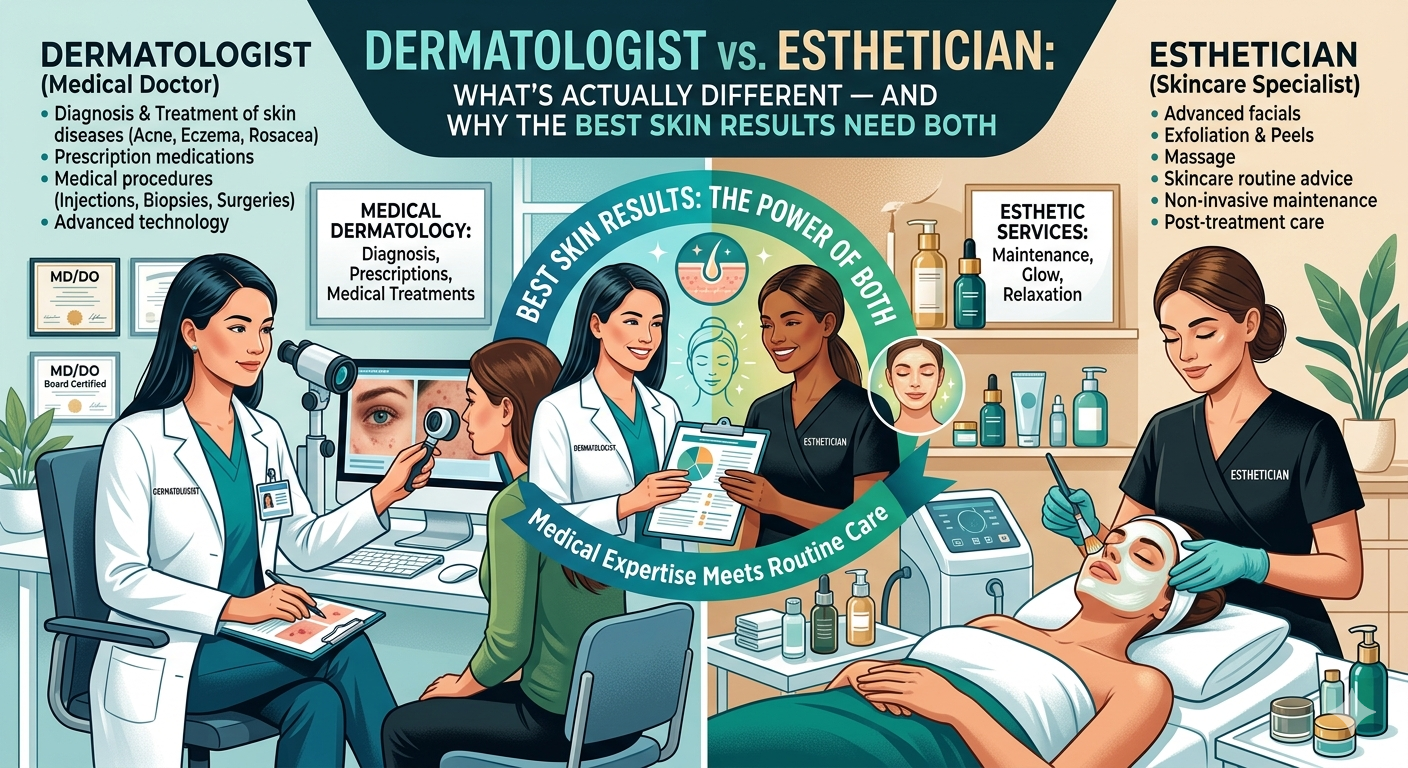
A dermatologist is a medical doctor — four years of medical school, a residency in dermatology, and in many cases additional fellowship training in a subspecialty. Their scope of practice is medical and surgical: they diagnose and treat skin diseases, prescribe medications, perform biopsies, remove skin cancers, and manage chronic conditions like psoriasis, eczema, rosacea, and autoimmune skin disorders. They are the appropriate provider for anything that involves a diagnosis, a prescription, or a procedure that crosses the skin barrier in a medical context.
Cosmetic dermatology — injectables, lasers, chemical peels at the medical grade — is a separate practice area that some dermatologists pursue, and this is where the overlap with the esthetic world becomes most visible. A dermatologist offering cosmetic services has medical training behind those services, which matters for specific treatments and for managing complications. But the time they spend with you, even in a cosmetic context, is typically brief: a treatment visit, not an ongoing skin relationship.
The practical reality for most patients is that dermatology appointments are short, waitlists are long, and the conversation about your skin is often narrowly focused on whatever brought you in. Your dermatologist is not going to spend thirty minutes discussing your morning routine, analyzing how your skin behaves through your cycle, or teaching you to read your own skin. That is not a criticism — it is a scope and time issue. Their training and their practice structure optimize for medical decision-making, not for the kind of skin education that transforms how someone cares for themselves day to day.
What a Licensed Esthetician Actually Does
A licensed esthetician has completed a state-accredited training program — in California, where I practice, that is 600 hours of coursework and practical training covering skin anatomy and physiology, ingredient science, treatment protocols, and contraindications. After passing state board exams, they are licensed to perform non-medical skin treatments: facials, chemical exfoliation, extractions, microdermabrasion, waxing, LED therapy, and other modalities that work on the surface and superficial layers of the skin without crossing into medical territory.
What distinguishes a skilled esthetician from a medical provider is not what they treat — it is how deeply they engage with the individual skin in front of them. A thorough esthetic consultation involves the kind of intake that medicine rarely has time for: sun exposure history, product history, dietary patterns, hormonal context, stress, sleep, water intake, and the subjective experience of how the skin behaves. A good esthetician builds a picture of the skin as a living, responsive organ embedded in a whole person — not just a surface to be treated.
As a licensed esthetician who is also a chiropractor, I bring an additional layer to this: an understanding of how structural and systemic factors — circulation, lymphatic flow, fascial tension, postural patterns — express themselves on the face. Most skin care operates entirely on the surface. I am always looking one level deeper, at what is driving what I see.
The Four Questions That Determine Who You Need
Is there something that might need a diagnosis? A new mole, a changing lesion, a rash with no obvious cause, persistent redness that does not respond to basic changes, hair loss, nail changes — anything that might be a disease process rather than a skin condition goes to the dermatologist first. An esthetician cannot diagnose, biopsy, or prescribe. If there is any question about whether what you are seeing is medically significant, get it ruled out before you pursue esthetic treatment. This is not a close call.
Do you need a prescription? Tretinoin, topical antibiotics, prescription-strength azelaic acid, spironolactone for hormonal acne — these require a prescriber. A dermatologist or primary care physician can prescribe these. An esthetician can work with you on your routine around them, advise on how to layer them, help manage the adjustment phase, and treat the barrier disruption that prescription actives sometimes cause. But they cannot prescribe, and they should not try to substitute for prescription treatment when it is clinically indicated.
Are you dealing with a chronic skin condition? Rosacea, eczema, psoriasis, seborrheic dermatitis, severe cystic acne — these need dermatologic management. An esthetician can be a valuable partner in managing these conditions (gentle facials, barrier support, avoiding triggers, helping with the lifestyle piece), but the primary management should be medical. The esthetician works in support of the dermatologist in these cases, not instead of them.
Are your goals cosmetic and preventive? Texture, tone, dullness, congestion, fine lines, uneven pigmentation, dehydration, sensitivity from over-exfoliation, general aging concerns — this is esthetic territory. A skilled esthetician who knows your skin and works with you consistently over time will produce better outcomes here than a series of disconnected dermatology visits, because the work is cumulative, relationship-based, and calibrated to your specific skin rather than to a general protocol.
Where the Real Value of an Esthetician Lies
Skin is not static. It changes with seasons, hormonal cycles, stress loads, travel, diet shifts, and age. What worked at thirty may actively damage the barrier at forty-five. A product that is fine in summer may cause sensitivity in winter. Most people have no framework for reading these changes or adjusting their approach accordingly — they find a routine and keep it until something goes wrong.
A consistent relationship with a skilled esthetician provides something medicine cannot: an ongoing, educated witness to your skin over time. I have clients who have been seeing me for years. I know how their skin behaves during stressful periods, how it responds to certain seasons, which actives their barrier tolerates and which it does not. When something changes, I notice it quickly, and I can often connect it to something that has changed in their life — before it becomes a bigger problem.
This is also where skin education happens. Most people are over-exfoliating, layering incompatible ingredients, using products designed for a different skin type than they have, or treating a compromised barrier as if it were a resilient one. A competent esthetician spends time teaching. The goal of the relationship, as I practice it, is that you leave every appointment understanding your skin better than when you arrived — not just treated, but educated.
The Hybrid Cases: When You Need Both
Many people need both, and the most effective approach involves both providers working in a coordinated way. A patient managing tretinoin-induced sensitivity benefits from esthetic treatments that support barrier recovery between prescription use. Someone with rosacea being managed medically benefits from esthetic guidance on ingredients and treatments that do not trigger flares. A patient post-laser benefits enormously from esthetic aftercare that optimizes healing.
The breakdown I see most often: patients who have had a dermatology procedure and received minimal aftercare guidance, leading to compromised barrier function, hyperpigmentation, or textural changes that could have been avoided or minimized with proper post-procedure support. Dermatologists are focused on the procedure; what happens in the weeks after is often undertreated. An esthetician who understands post-procedure skin fills that gap well.
Communication between the two providers is ideal. When I have clients seeing a dermatologist for an active condition, I want to know what they are using and why, so that my treatments support rather than interfere. When I notice something that warrants medical evaluation, I refer. The relationship works best when both providers are aware of each other and coordinating — even loosely — rather than operating in parallel silos.
A Note on Skin “Specialists” Who Are Neither
The esthetic industry has a wide range within it. A licensed esthetician with years of experience and ongoing advanced training is not the same as someone who completed a short course and is calling themselves a skin specialist. When choosing an esthetician, look for state licensure, continuing education, a clear consultation process, and the willingness to refer when something is outside their scope. The same is true of providers offering cosmetic services without the underlying credentials — in an industry where the titles are sometimes vague, credentials matter.
The standard I hold for myself: if I see something on a client’s skin that I cannot confidently explain and address within my scope, they hear about it immediately, and I tell them what kind of provider they should see. That is what appropriate scope practice looks like. It is not a limitation — it is how good care works.
— Calli, DC, LE | Licensed Chiropractor & Esthetician, Los Angeles
Medical disclaimer: This article is for educational purposes and describes general scope-of-practice distinctions between dermatologists and estheticians. It does not substitute for medical evaluation. Any skin symptom that may represent a disease process — including changing lesions, unexplained rashes, or persistent skin changes — should be evaluated by a licensed medical provider.
Related: What Is a K-Glass Skin Facial? A Licensed Esthetician Explains