
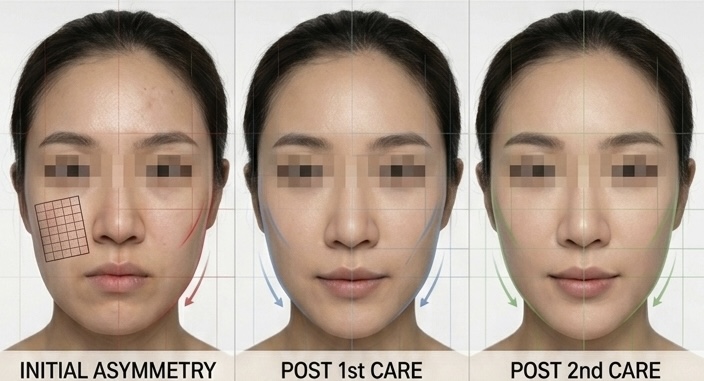
When I have a client under the facial magnification lamp, I am not just looking at pores and pigment. I am looking at the face as a structural document — one side compared to the other, the way the skin drapes, whether the tissue on one side has more tension or more laxity, whether there is a compression pattern at one cheekbone that is not present at its mirror image. After twenty years working as both a chiropractor and a licensed esthetician, this dual view has become automatic for me. And what I see, consistently, is that facial asymmetry that is getting worse over time almost never begins in the face.
She had been a regular client of a very good esthetician for three years. Consistent facials, excellent products, diligent home care. She came to me because her esthetician — frustrated with the asymmetry that kept returning despite every treatment — had referred her out. “She thinks it might be structural,” the client said, the same way people say it when they are not quite sure what it means.
I asked her to look straight ahead. The left side of her face was subtly lower — bot dramatically, but consistently lower across the cheekbone, the lower eyelid, the jawline. She had been attributing it to the side she slept on. She was right that sleeping position was involved, but it was the last stop in a longer chain, not the beginning of it.
Why the Face Cannot Be Separated From the Spine
The face sits at the top of a continuous structural system. Below the skull is the cervical spine, which connects to the thoracic spine, which connects to the rib cage, the shoulders, the lumbar spine, and eventually the pelvis and lower extremities. Fascial continuity runs through this entire system — the connective tissue wrapping that surrounds every muscle, bone, and organ is one continuous sheet, not a collection of separate compartments.
When one part of this system shifts, compensations ripple upward. A pelvic tilt changes lumbar mechanics. Changed lumbar mechanics alter how the thoracic spine stacks. Thoracic changes pull on the cervical spine through the paraspinal musculature. Cervical changes affect skull position. And because the facial soft tissue is anchored to the skull and to the fascial system below it, any consistent tilt or rotation in the structural foundation eventually shows up on the face.
This is not theoretical — it is something I can observe directly. When a patient has a chronic cervical rotation to one side, the skin on that side tends to show earlier compression changes: more pronounced nasolabial folding, slightly thicker, less mobile tissue. The opposite side, which has been chronically stretched, often shows greater laxity and earlier sagging. No topical product addresses this, because the cause is mechanical, not cutaneous.
Three Structural Patterns Behind Progressive Facial Asymmetry
Unilateral chewing dominance. Most people have a preferred chewing side and have no awareness of it. I ask patients to pay attention to which side they instinctively move food to when they take a bite — the answer, for most, comes immediately. Over years, the masseter muscle on the dominant side hypertrophies from repeated heavy use. The masseter is one of the most powerful muscles in the body relative to its size, running from the zygomatic arch (the cheekbone) down to the mandible (the lower jaw). A chronically hypertrophied masseter on one side creates a jawline that is visibly fuller and more defined on that side — while the opposite side appears comparatively hollow.
This is one of the most common sources of jaw asymmetry I see, and it is also one of the most correctable without intervention. Patients who successfully retrain to bilateral chewing — consciously alternating sides for several months — and manual therapy to the overworked masseter often notice visible changes in jaw symmetry before any other intervention.
Sternocleidomastoid shortening on one side. The sternocleidomastoid (SCM) runs from the collarbone and sternum up to behind the ear. When one side chronically shortens — from phone habits, monitor position, or sleeping on the same side nightly — it pulls the entire cervical spine into rotation. The compressed side develops thicker, less mobile tissue over years. The stretched side develops laxity. This is why one cheek looks flatter in photos, not the cheek itself but the rotation.
Pelvic tilt and its upward expression. A consistent lateral pelvic tilt creates a lateral curve in the lumbar spine. The thoracic spine compensates above. The cervical spine compensates above that. By the time you reach the skull, even a small pelvic tilt translates into a consistent head tilt of several degrees — and the facial soft tissue begins to reflect it over time.
What I Look For Under Magnification
Under the magnification lamp, I look at tissue quality on both sides: sebaceous activity, follicle size, skin texture. In patients with significant unilateral compression, the compressed side often shows different sebaceous activity and slightly thicker stratum corneum due to altered microcirculation and lymphatic drainage. Gray and white hair tends to be coarser and more porous. The platysma on the tighter side often shows earlier banding changes, which is one reason forward head posture drives earlier neck aging regardless of skincare.
Lymphatic drainage techniques applied asymmetrically — more drainage on the compressed side, more lifting support on the lax side — can produce visible symmetry improvement that no bilaterally-applied treatment achieves.
When to Seek Evaluation
Facial asymmetry that has been stable for years is almost always anatomical variation, not pathology. Progressively worsening asymmetry over months or years — especially with neck pain, jaw pain, or TMJ signs — warrants a combined musculoskeletal and esthetic evaluation. Sudden or new-onset asymmetry involving muscle function changes requires immediate medical evaluation.
— Calli, DC, LE | Licensed Chiropractor & Esthetician, Los Angeles
Medical disclaimer: This article is for deducational purposes and does not substitute for a clinical evaluation. Sudden or new-onset facial asymmetry involving muscle function requires immediate medical evaluation.
Related Articles