
By Calli | Licensed Chiropractor & Esthetician | June 7, 2026
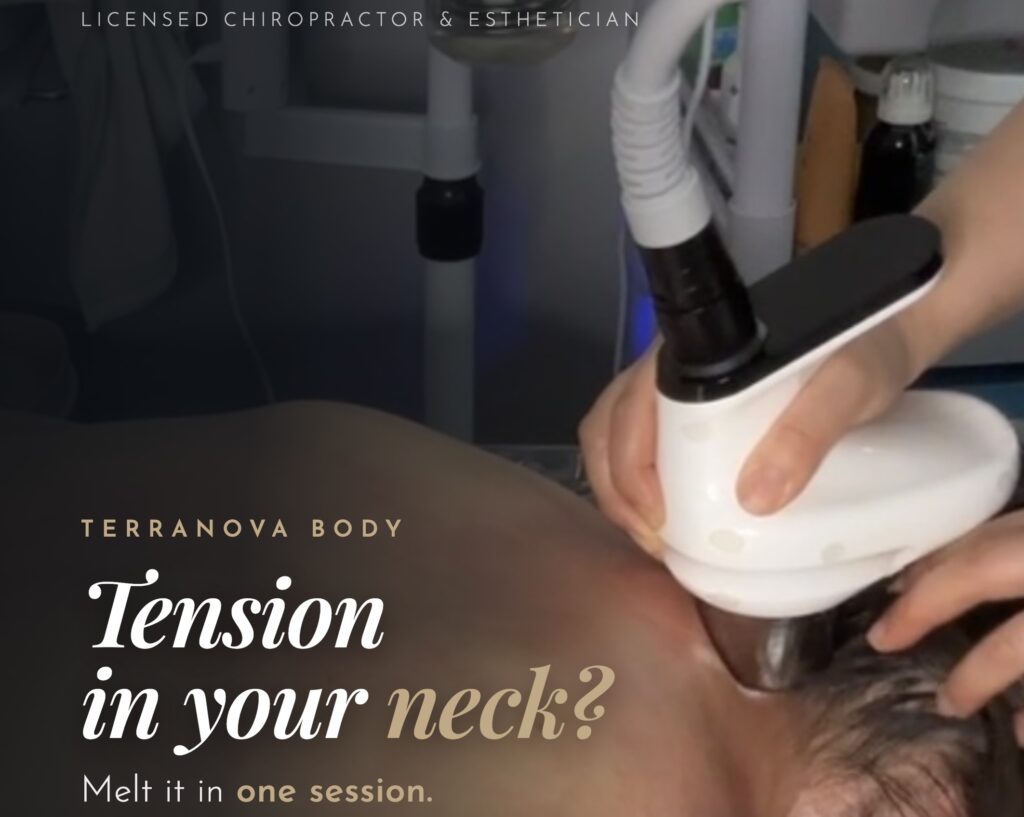
She was a patient first, then became an esthetic client. Chronic trapezius tension — the kind that builds up over years of sitting at a screen with shoulders elevated — had given her a neck that felt permanently braced. After her second Theranova session targeting the upper trapezius and posterior cervical region, she texted me the next morning: “I slept last night like I haven’t in two years. I don’t know what you did but I need another one.” That kind of response is not unusual. The combination of heat, microcurrent, and decompression that Terranova delivers reaches tissue that hands simply cannot — and the result is a depth of release that clients describe as almost disorienting in how different it feels from conventional massage.
“One session and I felt like I’d been living with a coat of tension I forgot I was wearing. I came in for my arms before my wedding — I left booking the abdominal series too.”
— Clinic patient, Los Angeles
IN THIS ARTICLE
1. Why Cellulite and Fibrotic Body Tissue Don’t Respond to Exercise
2. The Four Modalities Inside Terranova — What Each One Does at the Tissue Level
3. What a Theranova Session Looks Like in Clinical Practice
4. Which Body Areas Benefit Most and How to Maintain Results
QUICK SUMMARY
Cellulite and dense fascial tissue in the arms, abdomen, and thighs are structural problems — fibrotic connective tissue bands and lymphatic stagnation that diet and exercise alone cannot resolve. Terranova addresses this through four simultaneous modalities: therapeutic heat, bio-energy microcurrent, vacuum decompression massage, and cupping decompression. Each interchangeable head targets a specific body region, making it a full-body contouring and pain management system. This article explains the biology behind why these modalities work where conventional approaches don’t.
WHY TRUST THIS ARTICLE
Written by Calli — a licensed Doctor of Chiropractic (DC) and Licensed Esthetician (LE) with over 20 years of clinical practice in Los Angeles. Her dual background in musculoskeletal medicine and clinical esthetics informs how she uses Theranova — not as a standalone contouring device but as a precise therapeutic tool calibrated to each patient’s tissue state. Educational content, not a substitute for individualized clinical assessment.
Why Cellulite and Fibrotic Body Tissue Don’t Respond to Exercise
The Biology of Cellulite: Not Fat, But Fibrosis
In my clinical practice, one of the most persistent misconceptions I encounter is that cellulite is a body composition problem — something that improves with enough cardio and enough deficit eating. It doesn’t, and the reason is biological. Cellulite is primarily a structural change in the connective tissue directly beneath the skin. In affected tissue, fibrous septae — vertical bands of collagen that tether the skin to the underlying fascia — become thickened and rigid. Adipose cells between these bands expand and push upward against the skin, creating the characteristic dimpled surface. What you see on the skin is the result of a connective tissue architecture problem, not simply excess subcutaneous fat. This distinction matters clinically because no amount of aerobic exercise changes the stiffness of a fibrotic septum.
The Role of Lymphatic Stagnation in Body Tissue Density
Chronic lymphatic insufficiency is the second structural factor that exercise cannot fully address. When the lymphatic system in the lower extremities or abdomen is underperforming — whether from sedentary behavior, tight garments, postural compression, or post-surgical disruption — interstitial fluid accumulates in the tissue. Over time, that accumulated fluid contributes to tissue fibrosis: the body lays down additional collagen in response to chronic tissue distension. In over two decades of treating patients in Los Angeles, the clients I see with the densest and most refractory cellulite are almost always those with the most impaired local lymphatic circulation. Addressing the lymphatic component is not optional — it is where the tissue change begins. Exercise increases lymphatic flow transiently, but it doesn’t break down established fibrotic bands or decompress the septal structures that are already rigid. That requires a direct mechanical and thermal approach.
CALLI’S TIP
A simple way to assess whether your body tissue has a significant fibrotic component: pinch the skin on your outer thigh with moderate pressure and hold for three seconds. Healthy tissue should release quickly and return to smooth. Tissue with significant septal fibrosis will dimple deeply under compression and take several seconds to normalize. The more pronounced this response, the more structural the problem — and the more targeted the treatment needs to be.
The Four Modalities Inside Terranova — What Each One Does at the Tissue Level
Therapeutic Heat: Preparing the Tissue
The heat component of a Theranova session is not incidental warmth — it is a therapeutic parameter. Controlled heating of soft tissue to the therapeutic range (typically 40–45°C at depth) produces several physiologically significant effects: collagen fibers begin to relax and elongate, local blood flow increases substantially through vasodilation, and the viscosity of the interstitial fluid decreases, making it more mobile and more responsive to subsequent lymphatic drainage techniques. When I begin a Theranova treatment with the heat modality, I am preparing the connective tissue to receive the decompression and microcurrent work that follows — in the same way I would apply warm compress before myofascial release in a chiropractic session. The sequence matters. Heat first opens the tissue; the other modalities then work on tissue that is actually receptive.
Bio-Energy Microcurrent: Re-educating Muscle and Moving Lymph
The bio-energy microcurrent in Theranova operates at a frequency range designed to interact with the body’s own bioelectrical signaling. At the muscular level, sub-sensory microcurrent re-educates underused or atrophied muscle fibers — particularly relevant for postpartum abdominal tissue where the deep core musculature is inhibited and the overlying tissue has lost its structural support. At the lymphatic level, specific microcurrent frequencies have been shown in clinical research to stimulate lymphatic vessel contractility — the same mechanism that manual lymphatic drainage targets through mechanical pressure, but achieved here through electrical stimulation. In my clinical practice, I have observed that the combination of heat and microcurrent applied before decompression produces significantly better lymphatic drainage results than either modality used alone, because the tissue is both thermally softened and electrically primed.
Vacuum Decompression and Cupping: Breaking the Fibrotic Bands
The decompression component is where Theranova does work that no amount of manual pressure can replicate. Vacuum suction lifts the skin and superficial fascia away from the underlying tissue, applying tensile force to the fibrotic septae from the opposite direction — not compressing them, but stretching them. This negative pressure technique is mechanically effective at disrupting fibrotic cross-links in the connective tissue and simultaneously mobilizing the interstitial fluid that has pooled between the septal bands. Theranova’s cupping decompression head functions similarly to therapeutic cupping in a chiropractic context — a technique I use regularly for posterior cervical and thoracic fascial release — but applied here to larger body areas with a precision that allows me to work the tissue in anatomically specific directions. The sensation is characteristic: a deep pulling that clients describe as uncomfortable in a productive way, distinctly different from surface massage.
CALLI’S TIP
Hydration before and after a Theranova session is not optional — it is a clinical requirement. The decompression and microcurrent work mobilizes lymphatic and interstitial fluid, and that fluid needs adequate volume to move efficiently through the lymphatic system. I recommend at least 500ml of water before your session and 1 liter in the three hours following. Clients who come in dehydrated consistently report more treatment-area sensitivity and show less visible improvement than those who are well hydrated.
What a Terranova Session Looks Like in Clinical Practice
The Clinical Assessment Before Treatment
Before I select a Theranova head or set a treatment parameter, I assess the tissue I’m about to work on — the same way I would before any chiropractic or esthetic procedure. I evaluate tissue density by palpation, check for areas of localized lymphatic congestion, and identify any regions of increased tenderness that might indicate active inflammation. In my Los Angeles clinic, I also take a brief history of the area: posture, recent activity levels, any surgeries or injuries in the region. This intake takes about five minutes and changes the treatment significantly — a client with primarily fibrotic tissue gets a different head and different parameters than a client whose primary complaint is lymphatic edema. Theranova’s four interchangeable heads make this specificity possible: I’m not applying one universal treatment to every body area. I’m selecting the right tool for what the tissue actually needs.
What Clients Experience During and After
During a Theranova session, clients typically feel three things: the warmth of the heat component building gradually in the tissue (not hot, but deeply penetrating); the rhythmic pull of the decompression strokes as the head moves across the treatment area; and a noticeable sensation of tissue softening as the session progresses. By the end of a 45-minute body treatment, the change in tissue texture is palpable — what felt dense and resistant at the start of the session yields differently under pressure at the end. Post-treatment, the most commonly reported experience is a combination of physical lightness in the treated area and a genuine fatigue that resembles the kind that follows deep therapeutic bodywork. Sleep quality is frequently remarked on the next morning, particularly in clients who received trapezius and posterior cervical treatment. The tissue has been through a significant amount of work — rest is part of the physiological response.
CLINICAL CASE — BEFORE & AFTER
[Insert Theranova body contouring before & after photo here]
Photo caption: Theranova body treatment — result over 6 sessions on the outer thigh and abdominal areas. Therapeutic heat, bio-energy microcurrent, and vacuum decompression using region-specific heads. Post-series: visible improvement in tissue texture, reduction in surface dimpling, and improved contour definition. Photographed in-clinic under consistent lighting. Results reflect structural connective tissue change, not weight loss.
CALLI’S TIP
If you’re considering Theranova treatment before a specific event — a wedding, a reunion, an extended trip — begin at least 8 weeks in advance. The tissue changes that produce the most visible and lasting results happen cumulatively, and single-session results, while real, represent only the first layer of what repeated sessions achieve. For arm contouring before a wedding or strapless event in particular, I recommend starting 10–12 weeks out with one session per week for the first four weeks, then biweekly thereafter.
Which Body Areas Benefit Most and How to Maintain Results
Area-by-Area Clinical Guide
Theranova’s interchangeable head system allows genuinely differentiated treatment by body region. For the abdomen — particularly post-pregnancy tissue or areas with significant fascial thickening — the combination of microcurrent and decompression addresses both the muscular inhibition that contributes to poor contour and the connective tissue density above it. I assess the rectus abdominis separation and fascial integrity before selecting treatment parameters. For the arms, the primary targets are the triceps region and the posterior brachial tissue where lymphatic drainage is often sluggish — the arm head works the tissue in the direction of axillary drainage, following the same anatomical logic as my lymphatic drainage facial protocols. For the thighs and lower body, the decompression and cupping heads address the septal fibrosis of cellulite directly, while the heat component prepares the inguinal and popliteal lymphatic pathways. The neck and upper trapezius represent one of the most dramatic applications — the combination of deep heat and decompression on chronically shortened trapezius tissue produces a quality of release that many patients describe as the first time they’ve been truly comfortable in their own shoulder girdle.
Maintenance and Contraindications
For ongoing maintenance after an initial series, monthly sessions are typically sufficient to preserve the structural gains in connective tissue and keep lymphatic drainage efficient. For clients with particularly dense fibrotic tissue or chronic lymphatic insufficiency, biweekly maintenance for the first three months after the initial series produces better long-term results. Theranova treatment is not appropriate in the presence of: active infection or inflammation in the treatment area; known or suspected deep vein thrombosis; active cancer; pregnancy; open wounds or skin breakdown; and cardiac pacemakers (due to the microcurrent component). I perform a brief intake assessment before every treatment to confirm these contraindications are absent. If there is any uncertainty about the suitability of treatment for a specific medical history, I defer to the client’s physician before proceeding.
CALLI’S CLINICAL NOTE
The trapezius and posterior cervical application of Theranova is where I see the most immediate and visceral patient response. People who have carried chronic upper trapezius tension for years — often the result of the same forward head posture I treat on the chiropractic side — experience the decompression and heat combination as a genuine release of something they had normalized. The physiological mechanism is not mysterious: the heat relieves the sustained muscle contraction, the microcurrent interrupts the neuromuscular holding pattern, and the decompression separates fascial layers that have adhered from chronic low-grade compression. What patients experience as “heaven” is, clinically, a simultaneous thermal, electrical, and mechanical reset of a tissue state that had been stuck. It doesn’t require repeated explanation. The result speaks on the table.
THE BOTTOM LINE
Terranova is not a device for people who want to lose weight. It is a clinical tool for changing tissue structure — softening fibrotic connective tissue, improving lymphatic drainage, re-educating inhibited musculature, and releasing accumulated fascial tension in areas the body cannot self-correct. The four modalities work synergistically, and the interchangeable head system makes it one of the most versatile therapeutic platforms available for both body contouring and musculoskeletal pain management at the same time.
SEE THE RESULTS & BOOK A FREE CONSULTATION
Before-and-after results from Terranova body treatment sessions are on Instagram. If you have a target event, a problem area that hasn’t responded to anything else, or chronic trapezius tension that interferes with sleep — DM me directly for a free consultation. I’ll be direct about whether this is the right approach for your specific situation.
RELATED READING
Why Facial Asymmetry Starts in Your Spine: Chiropractic Alignment and Custom Skincare for Jawline Lifting — the same structural thinking that drives Theranova body treatment applies to the face: correction at the upper cervical spine produces visible facial rebalancing that topical treatment alone cannot achieve.
COMING UP NEXT
Why Décolleté Massage and Lymphatic Drainage Are the Foundation of Every Facial at This Clinic
The lymphatic drainage principles that make Theranova effective at the body level apply equally to the face — Calli explains why clearing the cervical lymphatic pathway before any facial treatment is non-negotiable in her clinical protocol.
— Calli
DC, LE | Licensed Chiropractor & Esthetician
Heal from the spine out, glow from the barrier in.
This article is for informational and educational purposes only and does not constitute medical advice. Theranova treatment has specific contraindications — consult a licensed healthcare provider before receiving treatment if you have a medical condition, are pregnant, or have an implanted device. Calli is a licensed chiropractor and esthetician; this content reflects her professional clinical observations and is not a substitute for personalized care.