
By Calli | Licensed Chiropractor & Esthetician | June 7, 2026
She had been managing her chin breakouts for two years on her own. She’d tried multiple cleansers, switched to a “clean” diet twice, bought a vitamin C serum she read about online, and was still waking up to new breakouts along the jawline and lower chin. By the time she came into my Los Angeles clinic, she was frustrated in the specific way that people get when they’ve been doing the right things and not seeing results — which usually means the right things aren’t addressing the actual cause. I asked her a series of questions before I even looked at her skin. Hormonal cycle timing. Sleep quality. Scalp health. Gut regularity. Whether her chin breakouts clustered before her period. The answers told me more about her acne than any product she’d tried.
“I didn’t realize my skin was a symptom. I thought it was a skincare problem. After the first treatment and the home care protocol, I finally understood what was actually going on.”
— Clinic patient, Los Angeles, age 34
IN THIS ARTICLE
1. Why Chin Acne Is Different — Hormones, Microbiome, and the Questions I Ask First
2. The Clinical Treatment Sequence: Aqua Peel, Extraction, and High-Frequency Spot Treatment
QUICK SUMMARY
Persistent acne — especially chin and jawline breakouts in adult women — is almost always multi-causal. Hormonal fluctuation, improper cleansing technique, congested pores, and disrupted skin microbiome all play a role. This article covers the clinical consultation questions that identify the real driver, the professional treatment sequence used at this clinic (aqua peel, ultrasonic exfoliation, professional extraction, high-frequency antibacterial treatment, and ice modeling mask), and the home care protocol that extends and consolidates clinic results.
WHY TRUST THIS ARTICLE
Written by Calli — a licensed Doctor of Chiropractic (DC) and Licensed Esthetician (LE) with over 20 years of clinical practice in Los Angeles. Calli approaches acne-prone skin as a clinical condition with systemic contributors — not a cosmetic problem to be covered. This article is based on a real patient case and reflects professional clinical practice. It is educational content, not a substitute for personalized dermatological or esthetic evaluation.
Why Chin Acne Is Different — Hormones, Microbiome, and the Questions I Ask First
The Consultation Comes Before the Treatment
In my practice, I don’t touch an acne patient’s skin until I’ve done a thorough verbal intake — what I call a 문진 (consultation history). This is not a formality. The location of acne on the face is diagnostically significant. Breakouts that concentrate along the chin and lower jawline in women are strongly associated with androgen sensitivity and hormonal fluctuation — particularly elevated androgens relative to estrogen during the luteal phase before menstruation. If a patient tells me her chin flares reliably in the ten days before her period, that tells me the sebaceous gland activity is being driven by hormones, not just by topical product choice. That information changes every recommendation I make. I also ask about scalp health, gut regularity, and sleep, because the microbiome of the scalp and gut are directly connected to systemic inflammation that expresses at the skin surface. A patient who has active scalp inflammation and chin acne simultaneously is not dealing with two separate problems — she is dealing with one inflammatory environment that has two visible locations.
Why Cleansing Is the Single Most Correctable Variable
After the consultation, the first thing I address is the cleansing technique — because in over two decades of treating acne-prone patients in Los Angeles, the number of clients who are cleansing correctly when they arrive is remarkably small. The most common errors: using a cleanser that is too alkaline or too stripping, which disrupts the skin’s acid mantle and triggers compensatory sebum production; skipping the pre-rinse that softens sebum before surfactants contact the skin; and using physical scrubs or granular exfoliants, which create micro-abrasions that introduce bacteria into compromised follicles and worsen inflammatory acne. Acne-prone skin should be cleansed with a mildly acidic pH-balanced cleanser or — for clients who prefer a more thorough pore cleanse — an enzyme powder that is foamed in the palm with water before application. The foam, not the liquid, contacts the skin. The technique is always light circular finger-pad pressure, thorough warm-water rinsing, and nothing that scratches.
CALLI’S TIP
If your chin acne clusters in the week before your period and clears after, that hormonal pattern is worth discussing with your OB/GYN or internist — an esthetician can improve the skin’s surface environment, but a systemic hormonal imbalance requires clinical evaluation. Esthetic treatment and medical management work together for hormonal acne; they are not substitutes for each other.
The Clinical Treatment Sequence: Aqua Peel, Extraction, and High-Frequency Spot Treatment
Step 1 — Aqua Peel and Ultrasonic Exfoliation: Opening and Clearing the Pore
Before any extraction or active treatment can be performed safely on acne-prone skin, the pore environment needs to be prepared. At this clinic, I begin with an aqua peel or hydro peel protocol — a combination of AHA (alpha-hydroxy acid) and BHA (beta-hydroxy acid) solution delivered via controlled suction and water flow. AHAs dissolve the intracellular bonds between dead skin cells at the surface; BHAs, being oil-soluble, penetrate into the pore lining and dissolve the lipid-based congestion inside the follicle. This dual-acid approach clears the pore pathway before extraction begins, dramatically reducing the force required to express congestion and eliminating the tearing trauma that causes post-extraction scarring. Following the aqua peel, I use an ultrasonic skin spatula to complete the surface exfoliation — the high-frequency vibrations mechanically dislodge dead corneocytes and residual debris that the chemical exfoliation has loosened. For acne-prone skin, this step is not optional: congested dead-cell buildup is one of the primary contributors to the closed comedone formation that precedes most inflammatory acne.
Step 2 — Professional Extraction: What “Squeezing” Actually Requires
Extraction is the most misunderstood and most commonly misperformed step in acne management. The popular image — pressing hard on a pimple until it pops — describes one of the most reliable ways to worsen acne, spread bacteria into adjacent follicles, and create post-inflammatory hyperpigmentation that lasts months. In my treatment room, I perform extraction only after the aqua peel and ultrasonic exfoliation have softened and cleared the pore pathway. For clogged, non-inflammatory comedones — closed or open plugs without active infection — extraction with properly sterilized tools and controlled pressure removes the blockage cleanly without disruption to the surrounding tissue. For active, inflamed pustules, I am significantly more conservative: premature extraction of an unripe pustule drives the infected contents deeper into the dermis, extending the healing timeline and increasing the risk of scarring. These I treat with the high-frequency protocol and leave to resolve naturally.
Step 3 — High-Frequency Spot Treatment, Cooling, and Soothing Finish
After extraction, I apply high-frequency electrical spot treatment — a modality that uses a glass electrode to deliver oscillating electrical current, producing a controlled spark that generates ozone on contact with the skin. The ozone has immediate antibacterial action: it oxidizes and eliminates the Cutibacterium acnes bacteria in and around the treated follicle, reducing the inflammatory load that drives the next breakout cycle. The violet light the electrode emits during application also has a calming effect on the sebaceous activity of the treated area. This is one of the most targeted antibacterial interventions available in a clinical esthetic setting, and when applied precisely after clean extraction, it closes the treatment pathway with a level of bacterial control that topical products cannot replicate at the same depth. After high-frequency, I immediately cool the skin with an ice roller over soothing gel — this reduces the post-treatment heat response and contracts the treated pores. I finish with an ice modeling mask, applied cold, which sustains the cooling effect and locks the soothing ingredients into the skin. A final application of a tea tree solution completes the protocol, adding an additional layer of topical antibacterial coverage to the treated areas.
CALLI’S TIP
Never attempt to extract an inflamed, red, or painful pustule at home. The dermal wall of an active pustule is under internal pressure — pressing it from the outside ruptures it inward as often as outward, depositing bacteria into deeper tissue layers. If you have an active pimple, apply a targeted spot treatment and leave it. A clinical extraction done correctly takes thirty seconds. An incorrectly squeezed pustule can create a scar that takes six months to fade.
What the Treatment Looks Like — A Real Clinical Case
The Patient’s Progression Over the Package Series
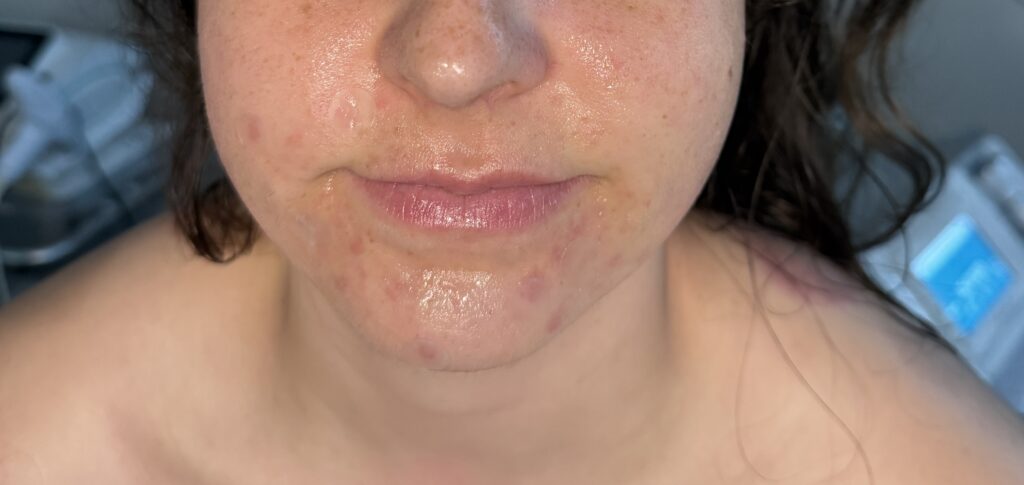
This patient completed a six-session acne treatment package over three months — one session every two weeks. After the first session, she noticed that her skin felt genuinely clean in a way it hadn’t after her home cleansing routine, and the inflammatory redness in her chin area reduced within 48 hours of treatment. By session three, the frequency of new breakouts had decreased substantially. By session five, the residual post-inflammatory marks from previous breakouts had faded significantly, and the overall texture of her lower face had improved. The final session addressed two persistent closed comedones and applied the full high-frequency protocol to consolidate the results. At our closing consultation, her skin was consistently clear — the chin acne that had defined her skin for two years was no longer a weekly occurrence but an intermittent event she now knew how to manage with her home care protocol.
CLINICAL CASE — BEFORE & AFTER
[Insert acne treatment before & after photo here]
Photo caption: Adult acne treatment series — chin and jawline, 6-session package result. Protocol: aqua peel (AHA/BHA), ultrasonic exfoliation, professional extraction, high-frequency antibacterial spot treatment, ice soothing, ice modeling mask, tea tree finish. Post-series: significant reduction in active breakouts, post-inflammatory hyperpigmentation, and comedone density. Actual clinical case, photographed in-clinic under consistent lighting.
CALLI’S TIP
Acne treatment packages produce cumulative results — the skin’s pore environment, microbiome, and inflammation cycle all improve progressively across sessions, not in a single appointment. The first session is a reset; the second and third are where the real structural improvement begins. Clients who commit to a full package series consistently outperform those who do one or two sessions and stop when they see initial improvement.
The Home Care Protocol That Makes Clinic Results Last
Daily Home Care for Acne-Prone Skin
Professional treatment creates a window of opportunity — a cleared, calmed skin environment. What the client does at home in the days between sessions determines whether that window produces lasting improvement or resets to baseline. The daily home care protocol I prescribe for acne-prone clients is specific: a mild acid-balanced cleanser or enzyme foam morning and evening, performed with the correct technique (pre-rinse, foamed cleanser, fingertip application, thorough rinse — never with scrubs or abrasive cloths); a targeted acne booster serum containing niacinamide and salicylic acid applied to active areas after cleansing; and a lightweight, non-comedogenic moisturizer. For clients who use prescription topicals, I coordinate application timing with their dermatologist to avoid counterproductive layering. An acne spot cream with sulfur or benzoyl peroxide is applied only to active lesions, not blanket-applied across the face.
Weekly Treatments, Diet, and the Scalp-Face Connection
In addition to the daily routine, I recommend a tea tree or kaolin clay mask one to two times per week — applied for ten minutes to the T-zone and chin area, never left to fully dry (which can over-strip the barrier). Diet is a variable I discuss honestly: the evidence linking high-glycemic foods and dairy to acne severity is consistent enough that I mention it, while being clear that this varies significantly by individual and is not a universal rule. What I do recommend consistently for every acne patient is scalp hygiene — because, as I covered in detail in the scalp-to-face breakout guide, an inflamed or congested scalp routinely contributes to hairline and chin breakouts that no facial product can resolve. The home care system only works when every contributing variable is addressed — not just the face in isolation.
CALLI’S CLINICAL NOTE
The cleansing technique correction alone accounts for a significant portion of the improvement I see in adult acne patients. In my practice, I spend ten minutes on cleansing education in every first acne consultation — more time than on any individual product recommendation — because the technique errors are nearly universal and their correction is free, immediate, and compounding. How you clean your skin twice a day, every day, matters more than which serum you use. Most acne patients are already using good products. They are not yet using them correctly.
THE BOTTOM LINE
Persistent adult acne is a multi-causal condition. Hormonal fluctuation, incorrect cleansing, congested pores, and disrupted microbiome all contribute. Clinical treatment — aqua peel, ultrasonic exfoliation, professional extraction, high-frequency antibacterial treatment, and ice cooling — addresses each of these layers in a single session and produces cumulative improvement across a package series. The home care protocol extends and consolidates those results. The combination works. Neither half works well alone.
SEE THE RESULTS & BOOK A FREE CONSULTATION
Before-and-after results from acne treatment series are on Instagram. If you’ve been managing breakouts on your own without seeing consistent improvement, DM me directly — a ten-minute intake conversation is usually enough to identify what’s actually driving the cycle.
RELATED READING
The Scalp Mistake That’s Making Your Face Break Out — if your chin and hairline breakouts come together, your scalp health is almost certainly part of the picture; this article covers the scalp-to-face inflammatory connection and the professional scalp treatment that addresses it.
COMING UP NEXT
Acne, Folliculitis, or Milia — You’re Probably Treating the Wrong One
Three different skin conditions that look almost identical on the surface — but have completely different causes and require completely different treatment. Calli explains how to tell them apart.
— Calli
DC, LE | Licensed Chiropractor & Esthetician
Heal from the spine out, glow from the barrier in.
This article is for informational and educational purposes only and does not constitute medical or dermatological advice. Persistent or severe acne — particularly with hormonal components, scarring, or cystic presentation — should be evaluated by a licensed dermatologist. Calli is a licensed chiropractor and esthetician; this content reflects her professional clinical observations and is not a substitute for personalized medical or esthetic care.