
The patient who changed how I think about thyroid disease was not the one whose labs came back obviously abnormal. She was the one whose labs came back completely normal — twice — while she sat across from me looking like someone who had not slept properly in two years.
She was 38. She had come in for neck tension and what she described as “a constant low-grade headache that lives right behind my eyes.” We worked on the neck, made real progress. But something in the overall picture kept bothering me. She moved slowly. Not injured-slowly — a different quality, like her body was running against some kind of resistance. Her eyebrows thinned on the outer third in a pattern I had noticed before. Her skin was dry in a specific way that I recognize from my esthetician training as different from ordinary dehydration. When I asked about fatigue, she laughed in the humorless way people laugh when exhaustion has stopped being noteworthy.
“My doctor checked my thyroid. It was fine.”
She went back. She asked for a more complete panel. It was not fine.
I have been a dual-licensed chiropractor and esthetician in Los Angeles for two decades. I do not diagnose thyroid conditions — that belongs with physicians, full stop. But I do see the patterns that precede the diagnosis, sometimes for months before anyone else connects the dots. This article is about learning to read those patterns for yourself, so that when you walk into a doctor’s office, you walk in asking the right question.
What the Thyroid Actually Controls (And Why “Off By a Little” Feels Like a Lot)
The thyroid is a butterfly-shaped gland sitting in the front of your neck, just below the Adam’s apple. It is about the size of two joined thumbs. From that small real estate it runs one of the most consequential operations in the human body: setting the metabolic pace of virtually every cell you have.
Thyroid hormone tells your cells how fast to burn energy. Too little, and everything slows — your heart rate, your digestion, your thinking, your ability to regulate temperature, your skin’s rate of renewal, your hair growth cycle. Too much, and everything accelerates — your heart pounds, you lose weight without trying, your hands shake, anxiety moves in as a permanent tenant.
The reason thyroid problems are so consistently missed early is that the symptoms do not cluster neatly. They spread across every system in the body simultaneously, each one mild enough to explain away. No single symptom is dramatic. But the collection of them, held up together, tells a very specific story to someone who knows what to look for.
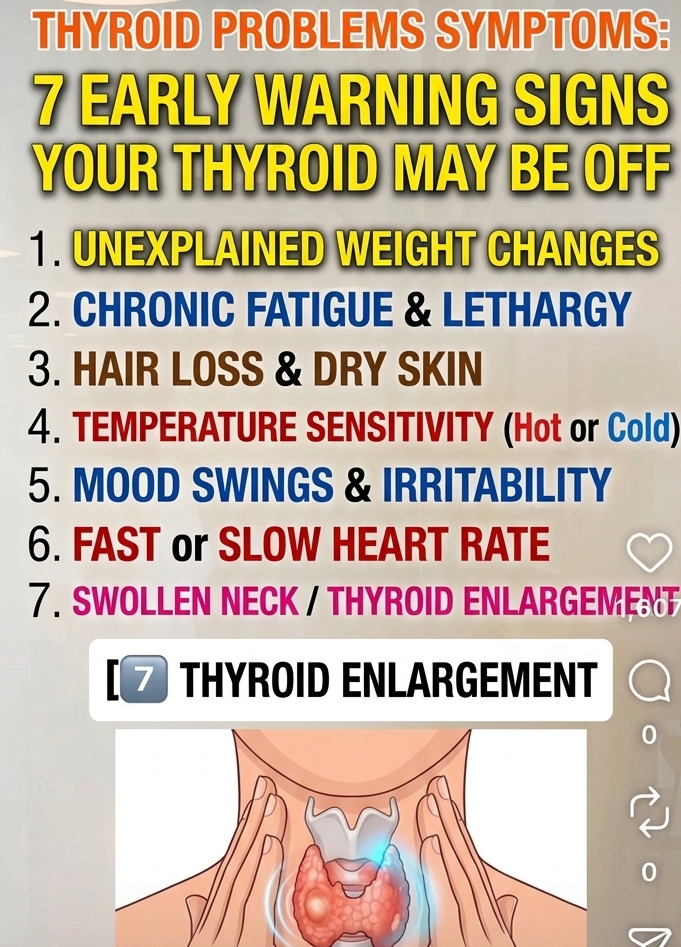
Seven Patterns Worth Paying Attention To
The Weight and Energy Equation That Does Not Add Up
This is usually the first thing people notice, and the first thing that gets blamed on aging, stress, or willpower. Weight that climbs steadily even though your eating habits have not changed meaningfully — or, in the opposite direction, weight that drops without any effort or explanation — deserves more than a shrug. Thyroid hormone is one of the primary regulators of resting metabolic rate. When it drops, calories that used to be burned efficiently start being stored instead. When it rises, the reverse happens.
The key word I listen for is unexplained. If weight changed alongside a clear life change, that is different from weight changing for no apparent reason.
Temperature Intolerance That Makes No Social Sense
You are cold when the room is comfortable to everyone else. Your hands and feet stay icy regardless of what you wear. Or the opposite: you are sweating in a room others find pleasant, always running hot, uncomfortable with warmth in ways that feel disproportionate. Temperature regulation is one of the clearest windows into thyroid function I know of, because the thyroid is so directly involved in how efficiently your body generates and conserves heat.
From my esthetician side, I notice the cold-intolerance version in a particular way: clients who are always slightly cool to the touch, whose skin takes longer to warm during facial treatments, who describe constantly feeling chilled no matter the season. It is a physical pattern with a physiological basis.
The Fatigue That Sleep Cannot Fix
Not the tired you get after a hard week. The tired that is still there on Monday after a full weekend of rest. The kind that makes a flight of stairs feel like a project. Hypothyroid fatigue — the slow-down version — has a specific quality that patients often describe as “weighted,” like they are dragging something. It is not about sleep quantity; it is about cellular energy production running below grade.
Hair, Skin, and Nail Changes — The Esthetician’s View
This is where my dual background gives me something specific to offer. In clinic, I watch hair, skin, and nails the way a cardiologist watches a patient’s color. Thinning hair, especially along the temples and the outer third of the eyebrows — that outer eyebrow thinning is practically a calling card for hypothyroidism — combined with skin that has gone dull, dry, and slightly puffy is a pattern I have learned not to ignore. Nails that have become brittle and slow-growing round out the picture.
These changes happen because thyroid hormone governs how quickly skin and hair cells turn over. When the hormone drops, renewal slows. The skin stops shedding dead cells efficiently. Hair follicles extend their resting phase. The whole integumentary system goes into a kind of low-power mode. As someone who has spent 20 years looking at skin and hair professionally, the change in texture and quality when someone’s thyroid is underactive has a distinctive look that I have trained myself to notice.
Mood, Memory, and the Cognitive Slow-Down
Brain fog, slowed recall, a flatness of mood that is different from clinical depression, low-grade anxiety — all of these can be early thyroid signals. Thyroid hormone directly affects the brain’s neurotransmitter environment, which is why thyroid problems are sometimes misidentified as purely psychiatric conditions. The clearest version I see in practice is a patient who describes “not being able to find words” or “feeling like I’m thinking through fog” alongside the physical symptoms — the cold hands, the fatigue, the hair thinning. When those stack together, it is a complete picture.
Changes in Bowel Habit That Are New and Unexplained
Constipation that arrives seemingly without cause — particularly slow-transit constipation, where things simply stop moving at the rate they used to — is a recognized feature of hypothyroidism. The thyroid influences gut motility through the enteric nervous system. When thyroid function drops, gut transit slows with it. On the overactive end, looser and more frequent stools can be part of the hyperthyroid picture. Either direction, a new change in bowel pattern that does not correspond to any change in diet or medication is worth including in a symptom list.
Menstrual and Reproductive Changes
Periods that have become heavier, more frequent, or more irregular without any obvious reproductive explanation can be an early thyroid signal, particularly in the hypothyroid direction. The thyroid has upstream effects on the hormonal axis that governs the menstrual cycle, and thyroid imbalance is one of the more common but underappreciated causes of cycle disruption. Women presenting with heavy cycles who also describe several other items on this list deserve a thyroid panel as part of the workup.
Why Two Tests Are Not Always the Same Thing
The most common thyroid screening test is TSH — thyroid stimulating hormone. It is a good test and a reasonable starting point. But it is not the whole picture. A TSH result within the “normal” range can still coexist with a patient who is genuinely symptomatic, particularly at the boundaries of that range, or in the presence of autoimmune thyroid disease (where the underlying attack on the gland may be ongoing even as TSH temporarily normalizes).
The more complete picture typically includes TSH, free T4, and sometimes free T3 and thyroid antibodies (TPO and TG antibodies), especially when autoimmune thyroid disease like Hashimoto’s is suspected. This is a conversation to have with your physician — not a reason to order a hundred dollars of self-pay tests from a lab, but a reason to come to the appointment with a specific request rather than a vague complaint about tiredness.
What to Do If This Pattern Sounds Familiar
Write down every symptom that fits, and write them all down together before your appointment. The most important thing you can do is not present these symptoms piecemeal across three appointments where each individual one gets explained away. Show your doctor the complete list at once. The cluster is the message.
Ask for a thyroid panel — TSH at minimum, and make a case for the fuller panel if you have multiple symptoms and a family history of thyroid or autoimmune disease. If your first round of results comes back normal but you remain symptomatic, advocate for a repeat test at a different point in time, or ask for a referral to an endocrinologist who can interpret borderline results in the context of your full clinical picture.
Do not self-treat with over-the-counter “thyroid support” supplements. Some contain iodine at doses that can actually worsen certain thyroid conditions. Some contain stimulants that create a false sense of energy without addressing the underlying problem. The only thyroid treatment worth having is one that is based on your specific, tested hormone levels under the guidance of a physician who knows your case.
A Note on What a Chiropractor Actually Does With This Information
In my practice, recognizing a possible thyroid pattern and mentioning it to a patient is not the same as diagnosing or treating thyroid disease. My role is musculoskeletal: the neck tension, the headaches, the shoulder and upper back dysfunction that often accompany thyroid-related changes in muscle tone and connective tissue. I treat those things. I do not treat the thyroid.
What I do — and what I think every good hands-on practitioner should do — is listen to the whole person who walks into the room. If the physical pattern on my table does not add up to a purely structural story, I say so. I suggest the patient bring the full picture to their doctor. That referral, made at the right moment, is sometimes the thing that finally gets someone tested.
The patient from the beginning of this article — the one with the “normal” thyroid levels who turned out not to be normal — is treating her thyroid condition now. She still comes in periodically for her neck. The hands-on work holds better now that the underlying hormonal environment is stable. Two tracks, addressed simultaneously, by the right people.
That is how it is supposed to work.
— Calli, DC, LE | Licensed Chiropractor & Esthetician, Los Angeles
Medical disclaimer: This article is for educational and informational purposes only. It does not constitute medical advice, diagnosis, or treatment. Chiropractors do not diagnose or treat thyroid disease. If you recognize the patterns described here, please discuss them with your physician and ask about appropriate thyroid testing.
Related Articles