
By Calli | Licensed Chiropractor & Esthetician | May 31, 2026
The difference between glass skin and just hydrated skin is not the number of products. It is the sequence of delivery, the state of the barrier receiving them, and — when the results go beyond what home care can achieve — the tools a licensed esthetician uses in the treatment room. Korean glass skin is a real clinical outcome. In my Los Angeles esthetic practice, it is one of the most requested results I treat, and the protocol that produces it looks very different from what you see in a 60-second social media video.
This article explains exactly what a professional K-glass skin facial involves: the assessment, the layering sequence, the devices used, and why the clinical environment produces results that home routines alone rarely sustain.
QUICK SUMMARY
A professional K-glass skin facial is a multi-layered esthetic treatment designed to produce the clear, luminous, mirror-like skin associated with Korean beauty. It combines barrier assessment, layered hydration infusion, and clinical devices — including ultrasonic, LED, and microcurrent — to achieve results that go beyond what home skincare can replicate.
IN THIS ARTICLE
1. What K-Glass Skin Really Means (and Why It Starts With the Barrier)
2. What Happens During a Professional K-Glass Skin Facial
3. Who Gets the Best Results — and Who Needs to Prepare First
4. How Long K-Glass Skin Results Last After a Clinical Treatment
WHY TRUST THIS ARTICLE
Written by Calli — a licensed Doctor of Chiropractic (DC) and Licensed Esthetician (LE) practicing in Los Angeles. Calli has performed K-glass skin protocols in her esthetic clinic for over a decade and has personally trained in Korean beauty layering methodology as applied to the clinical facial setting. Educational content, not a substitute for a hands-on consultation.
What K-Glass Skin Really Means (and Why It Starts With the Barrier)
The Optical Science Behind Glass Skin
K-glass skin refers to a complexion with such consistent surface smoothness and hydration that light reflects off it cleanly rather than scattering — the visual equivalent of looking through polished glass versus frosted glass. It is not a dewy look, not an oily look, and not achievable with a single product. The optical effect comes from the stratum corneum — the outermost skin layer — being fully hydrated, lipid-intact, and free of the micro-textural irregularities caused by dehydration, congestion, or barrier damage.
Why the Barrier Is the First Clinical Assessment
In my 20 years of treating esthetic clients in Los Angeles, the first thing I assess before any K-glass skin treatment is barrier integrity — not skin type, not hydration level. Barrier state determines everything: how deeply actives penetrate, how long hydration holds, and whether the luminous result will last hours or days. When I examine a new client under my magnifying lamp before beginning a treatment, I am looking at the texture uniformity of the corneocyte layer, the presence or absence of fine dehydration lines, and the skin’s rebound response after gentle traction. A client with a compromised barrier — from over-exfoliation, chronic sun exposure, or stress-driven cortisol elevation — needs a repair phase before the glass skin protocol begins, not during it.
How Clinical Treatment Differs From Home Layering
Many clients come in already doing a five-step routine at home — essences, serums, sheet masks. They are often surprised that they are not achieving glass skin results. The reason, in almost every case, is that home layering optimizes product delivery on the skin’s surface, while clinical treatment works at the level of the stratum corneum itself. Devices like the ultrasonic skin scrubber create a cavitation effect that opens the follicular pathway and allows hydrating actives to penetrate three to four times more deeply than manual application. That depth of delivery is what separates a clinical glass skin result from a home-care glass skin result. For a detailed look at how at-home devices compare, I’ve written about which at-home esthetic devices are actually worth using.
What Happens During a Professional K-Glass Skin Facial
Phase One — Cleanse and Barrier Prep
A clinical K-glass skin treatment begins with a double-cleanse protocol that I apply differently than the standard esthetic facial. The oil-phase cleanser is used with gentle emulsification massage to begin softening the sebaceous film and any residual SPF or makeup — not to strip, but to prep the surface for what follows. The second-phase foam cleanser is applied with controlled pressure and removed with a cool compress to bring surface vascularity down, which improves evenness of active absorption in the next phase. In my clinic I always complete this phase with a pH-balancing toner application by hand — not cotton pad — to preserve the acid mantle while resetting the surface to optimal absorption pH.
Phase Two — Ultrasonic Exfoliator Scaling: Water-Based, Zero Trauma
Before any hydration infusion, I perform ultrasonic exfoliator scaling — and this step is what separates a K-glass skin clinical facial from anything a client can replicate at home. The ultrasonic exfoliator uses high-frequency vibration combined with a continuous water mist to lift dead corneocytes, sebaceous debris, and surface congestion off the skin without a single abrasive particle contacting it. This is categorically different from a scrub, a diamond-tip facial, or any friction-based exfoliation. There is no physical trauma to the stratum corneum, no redness, no post-treatment sensitivity. The water acts as both medium and cushion — the ultrasonic frequency causes micro-cavitation in the water film, and it is that cavitation doing the work, not friction against the skin. In my 20 years of treating esthetic clients in Los Angeles, I have replaced all mechanical exfoliation methods with ultrasonic scaling for glass skin protocols because the surface it leaves is measurably smoother, more even, and critically barrier-intact. A freshly scaled surface absorbs what comes next at peak efficiency.
Phase Three — LDM Water Drop Ultrasound: The Science of Deep Structural Hydration
After scaling, I apply LDM — Local Dynamic Micro-massage, clinically known as water drop ultrasound. What makes LDM fundamentally different from conventional ultrasound devices is its dual-frequency protocol: it alternates between two distinct MHz settings (typically 3MHz for deeper dermal penetration and 10MHz for the superficial epidermal layer) within a single treatment pass. This alternating frequency oscillation creates mechanical micro-vibrations that physically agitate cell membranes at different tissue depths simultaneously — a process that regulates matrix metalloproteinases (MMPs), the enzymes responsible for collagen and elastin breakdown, while stimulating fibroblast repair activity.
In practical clinical terms: the 3MHz frequency reaches the dermis and subcutaneous junction, where it compresses and relaxes the extracellular matrix to draw fluid into the tissue. The 10MHz frequency works at the epidermis level, increasing corneocyte hydration and normalizing the skin’s natural moisturizing factor (NMF). The result is water being pulled into the skin from within — not coated on top of it. This is why clients see immediate glass skin luminosity after an LDM session: the dermis is physically holding more water, and that hydration expresses itself as reflectivity and plumpness at the surface. I apply LDM with a water coupling medium across the full face and neck, focusing additional time on the mid-face and jawline for structural lift. The session closes with a ceramide-and-squalane barrier balm to seal the treatment.
By Calli | Licensed Chiropractor & Esthetician | May 31, 2026
The difference between glass skin and just hydrated skin is not the number of products. It is the sequence of delivery, the state of the barrier receiving them, and — when the results go beyond what home care can achieve — the tools a licensed esthetician uses in the treatment room. Korean glass skin is a real clinical outcome. In my Los Angeles esthetic practice, it is one of the most requested results I treat, and the protocol that produces it looks very different from what you see in a 60-second social media video.
This article explains exactly what a professional K-glass skin facial involves: the assessment, the layering sequence, the devices used, and why the clinical environment produces results that home routines alone rarely sustain.
QUICK SUMMARY
A professional K-glass skin facial is a multi-layered esthetic treatment designed to produce the clear, luminous, mirror-like skin associated with Korean beauty. It combines barrier assessment, layered hydration infusion, and clinical devices — including ultrasonic, LED, and microcurrent — to achieve results that go beyond what home skincare can replicate.
IN THIS ARTICLE
1. What K-Glass Skin Really Means (and Why It Starts With the Barrier)
2. What Happens During a Professional K-Glass Skin Facial
3. Who Gets the Best Results — and Who Needs to Prepare First
4. How Long K-Glass Skin Results Last After a Clinical Treatment
WHY TRUST THIS ARTICLE
Written by Calli — a licensed Doctor of Chiropractic (DC) and Licensed Esthetician (LE) practicing in Los Angeles. Calli has performed K-glass skin protocols in her esthetic clinic for over a decade and has personally trained in Korean beauty layering methodology as applied to the clinical facial setting. Educational content, not a substitute for a hands-on consultation.
What K-Glass Skin Really Means (and Why It Starts With the Barrier)
The Optical Science Behind Glass Skin
K-glass skin refers to a complexion with such consistent surface smoothness and hydration that light reflects off it cleanly rather than scattering — the visual equivalent of looking through polished glass versus frosted glass. It is not a dewy look, not an oily look, and not achievable with a single product. The optical effect comes from the stratum corneum — the outermost skin layer — being fully hydrated, lipid-intact, and free of the micro-textural irregularities caused by dehydration, congestion, or barrier damage.
Why the Barrier Is the First Clinical Assessment
In my 20 years of treating esthetic clients in Los Angeles, the first thing I assess before any K-glass skin treatment is barrier integrity — not skin type, not hydration level. Barrier state determines everything: how deeply actives penetrate, how long hydration holds, and whether the luminous result will last hours or days. When I examine a new client under my magnifying lamp before beginning a treatment, I am looking at the texture uniformity of the corneocyte layer, the presence or absence of fine dehydration lines, and the skin’s rebound response after gentle traction. A client with a compromised barrier — from over-exfoliation, chronic sun exposure, or stress-driven cortisol elevation — needs a repair phase before the glass skin protocol begins, not during it.
How Clinical Treatment Differs From Home Layering
Many clients come in already doing a five-step routine at home — essences, serums, sheet masks. They are often surprised that they are not achieving glass skin results. The reason, in almost every case, is that home layering optimizes product delivery on the skin’s surface, while clinical treatment works at the level of the stratum corneum itself. Devices like the ultrasonic skin scrubber create a cavitation effect that opens the follicular pathway and allows hydrating actives to penetrate three to four times more deeply than manual application. That depth of delivery is what separates a clinical glass skin result from a home-care glass skin result. For a detailed look at how at-home devices compare, I’ve written about which at-home esthetic devices are actually worth using.
What Happens During a Professional K-Glass Skin Facial
Phase One — Cleanse and Barrier Prep
A clinical K-glass skin treatment begins with a double-cleanse protocol that I apply differently than the standard esthetic facial. The oil-phase cleanser is used with gentle emulsification massage to begin softening the sebaceous film and any residual SPF or makeup — not to strip, but to prep the surface for what follows. The second-phase foam cleanser is applied with controlled pressure and removed with a cool compress to bring surface vascularity down, which improves evenness of active absorption in the next phase. In my clinic I always complete this phase with a pH-balancing toner application by hand — not cotton pad — to preserve the acid mantle while resetting the surface to optimal absorption pH.
Phase Two — Ultrasonic Exfoliator Scaling: Water-Based, Zero Trauma
Before any hydration infusion, I perform ultrasonic exfoliator scaling — and this step is what separates a K-glass skin clinical facial from anything a client can replicate at home. The ultrasonic exfoliator uses high-frequency vibration combined with a continuous water mist to lift dead corneocytes, sebaceous debris, and surface congestion off the skin without a single abrasive particle contacting it. This is categorically different from a scrub, a diamond-tip facial, or any friction-based exfoliation. There is no physical trauma to the stratum corneum, no redness, no post-treatment sensitivity. The water acts as both medium and cushion — the ultrasonic frequency causes micro-cavitation in the water film, and it is that cavitation doing the work, not friction against the skin. In my 20 years of treating esthetic clients in Los Angeles, I have replaced all mechanical exfoliation methods with ultrasonic scaling for glass skin protocols because the surface it leaves is measurably smoother, more even, and critically barrier-intact. A freshly scaled surface absorbs what comes next at peak efficiency.
Phase Three — LDM Water Drop Ultrasound: Deep Hydration and Structural Lift
After scaling, I apply LDM — Local Dynamic Micro-massage, known clinically as water drop ultrasound. LDM delivers multi-frequency ultrasound waves — alternating between low and high MHz settings — deep into the dermal and subdermal layers while the skin surface remains completely undisturbed. The alternating frequencies create a controlled micro-massage at the cellular level: fibroblast activity increases, the dermis raises its water-binding capacity, and the structural firmness clients see as the glass skin glow develops from within the tissue rather than on top of it. Unlike devices that work only at the epidermis, LDM reaches the dermis where collagen and elastin live — so the lift and reflectivity after a session reflect real structural change, not surface hydration alone. I apply LDM with a water coupling medium across the full face and neck, focusing on the mid-face and jawline. The result is a complexion architecturally tightened and plumped from within. The session closes with a ceramide-and-squalane barrier balm to seal everything delivered during treatment.
Who Gets the Best Results — and Who Needs to Prepare First
Ideal Candidates for a K-Glass Skin Facial
Over two decades of treating esthetic clients in Los Angeles, the clients who see the most dramatic K-glass skin results after a single treatment share a specific profile: normal to combination skin with minimal active congestion, a reasonably intact barrier, and consistent SPF use. Age is not a limiting factor — I have performed this treatment on clients from their mid-twenties through their late sixties with excellent results. The key variable is not age; it is barrier health. A 45-year-old client with a well-maintained barrier will outperform a 25-year-old with chronic over-exfoliation damage in terms of how vividly the glass skin effect shows and how long it holds.
Clients Who Need a Repair Phase First
I do not perform the full K-glass skin protocol on clients who present with active rosacea flares, open acneic lesions, or clinically compromised barrier — visible redness, stinging on water contact, or chronic tight-after-cleansing sensation. In these cases, I run a 2–4 week barrier repair protocol first: a simplified home regimen of gentle cleanser, ceramide moisturizer, and SPF only, combined with one or two repair-focused in-clinic sessions using oxygen infusion and low-level LED before we layer the full glass skin protocol.
The Role of Consistent Home Care Between Sessions
A clinical treatment sets the barrier in an optimal state and delivers actives at depth that home care cannot match. But the home routine between sessions determines whether that state holds or degrades before the next appointment. I guide every K-glass skin client through a simplified maintenance protocol — the principles are the same ones I’ve outlined in my guide on the complete K-beauty hydration routine for glass skin. The goal at home is not to replicate the clinical result — it is to not undo it.
How Long K-Glass Skin Results Last After a Clinical Treatment
Immediate Results vs. Progressive Results
Clients leave a K-glass skin treatment with an immediate improvement in luminosity and surface evenness — visible within the first hour, peaking at 24–48 hours as the LED-stimulated cellular activity reaches its highest expression. This immediate effect can last 7–10 days in clients with well-maintained barriers and consistent home care. What is less visible immediately but equally important is the progressive structural benefit: the fibroblast stimulation from red LED, sustained over a series of monthly treatments, produces a cumulative increase in dermal thickness and surface regularity that compounds over three to six months.
What Shortens the Results
The two fastest ways to shorten the result of a clinical K-glass skin treatment are sun exposure without SPF and immediate reintroduction of aggressive exfoliants. I tell every client leaving my treatment room: the barrier is at its most permeable and responsive for the first 24 hours — do not use retinol, AHA, or BHA that evening, and apply SPF the following morning before any other step. UV exposure on a freshly treated and barrier-optimized skin will trigger the exact inflammatory cascade that degrades the corneocyte regularity we spent the treatment building.
Recommended Treatment Frequency
For clients beginning with a healthy barrier, I recommend monthly K-glass skin treatments for the first three months, then transitioning to every six to eight weeks for maintenance. Twenty years of esthetic practice in Los Angeles has reinforced one consistent finding: results are not linear. The jump between treatment one and treatment three is often more dramatic than between one and two, because the barrier itself is accumulating structural improvement over time, not just receiving a surface treatment.
CALLI’S CLINICAL NOTE
The clients in my practice who maintain the most sustained glass skin effect between appointments are not the ones doing the most steps at home — they are the ones who never skip SPF, sleep at least seven hours, and touch their face the least. When I perform a follow-up assessment using my magnifying lamp before a second treatment, the clients who have visibly preserved their result are almost always the ones who simplified their home routine after the first session rather than adding to it.
THE BOTTOM LINE
K-glass skin as a clinical treatment is a specific, sequenced facial protocol combining ultrasonic infusion, layered actives, LED therapy, and microcurrent — not a standard hydration facial with Korean product names. The result is achievable, measurable, and cumulative when the barrier is properly assessed and maintained between sessions. If you are not seeing glass skin results from your current home routine, the answer is rarely more products — it is usually a barrier that needs professional attention before it can hold the result you are after.
RELATED READING
Dermatologist vs. Esthetician: What’s Actually Different and Why the Best Skin Results Need Both — understanding which skin concerns belong in a medical office and which belong in an esthetic clinic helps you choose the right treatment for your glass skin goals.
REAL RESULTS — FROM SESSION ONE
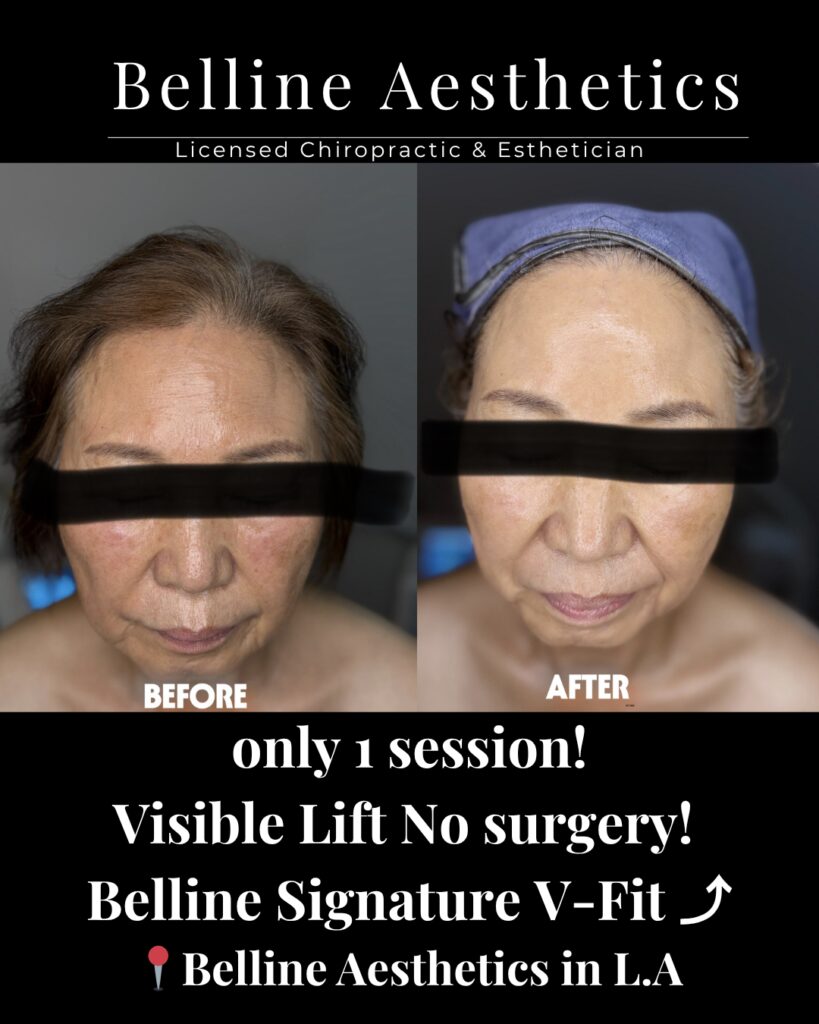
Most of my clients see a visible difference after a single K-glass skin session — enough that many book a package on the spot. Before-and-after photos from real sessions are on my Instagram. The glow is real, and so is the lift from the LDM water drop ultrasound.
Curious if this treatment is right for your skin? Free consultation via DM — I respond personally. 📸 Follow @belline.aesthetics on Instagram
BEFORE & AFTER — CLINICAL CASE NOTES
Photo caption: Water drop ultrasound (LDM) K-glass skin treatment — single session result. Immediately post-treatment: visible reduction in redness, barrier integrity restored, and hydration luminosity visibly increased. Pores appear minimized due to improved corneocyte regularity and surface tension from dermal water uptake. Actual clinical case, photographed in-clinic under consistent lighting.
COMING UP NEXT
V-Fit Jawline Lifting: The Real Lifting Signature Facial (No Botox, No Filler)
Calli’s signature V-Fit facial delivers visible jawline lift and facial contouring without injections — next, she explains exactly how it works and why clients see results from the very first session.
— Calli
DC, LE | Licensed Chiropractor & Esthetician
Heal from the spine out, glow from the barrier in.
This article is for informational and educational purposes only and does not constitute medical or dermatological advice. Individual skin responses vary. Calli is a licensed chiropractor and esthetician; this content reflects her professional opinions and is not a substitute for personalized care.
Related Articles