
By Calli | Licensed Chiropractor & Esthetician | June 7, 2026
She’d been trying to fix it with contouring makeup for three years. Every morning, the same routine: blending darker product along the left jawline to compensate for how much softer it looked compared to the right. When she finally came in, I assessed her cervical spine before I ever looked at her face. C1 was rotated right, the left masseter was chronically overloaded, and her pelvis had a posterior tilt on the left that had been there so long she’d stopped noticing it. None of that showed up in a mirror. All of it showed up in her face.
“I thought I needed filler on one side. Turns out I needed my neck adjusted. After three sessions, my makeup routine cut in half — the asymmetry I’d been chasing with a brush just… wasn’t as dramatic.”
— Clinic patient, Los Angeles
IN THIS ARTICLE
1. The Structural Causes of Facial Asymmetry That No Topical Treatment Can Fix
2. The TMJ and Upper Cervical Connection — What Is Actually Pulling Your Face Unevenly
3. The Signature Protocol: Structural Correction + Custom Skincare for Visible Facial Lifting
QUICK SUMMARY
Most facial asymmetry is structural, not skin-deep. Misalignment at C1-C2 (atlas-axis) and the temporomandibular joint creates uneven pull on the facial muscles and soft tissue. This clinic’s signature approach uses Activator Method upper cervical correction, myofascial release of the cervical and facial fascia, and personalized esthetic treatment calibrated to each client’s skin after the structural correction — producing jawline lifting and facial rebalancing that topical treatment alone cannot achieve.
WHY TRUST THIS ARTICLE
Written by Calli — a licensed Doctor of Chiropractic (DC) and Licensed Esthetician (LE) practicing in Los Angeles for over 20 years. Her dual clinical training means she assesses the cervical spine, TMJ, and pelvis before she designs an esthetic protocol — a perspective that is structurally unusual and clinically significant. This article reflects her professional observations, not a substitute for individualized evaluation.
The Structural Causes of Facial Asymmetry That No Topical Treatment Can Fix
Why Most Facial Asymmetry Is a Postural and Muscular Problem
The face sits at the top of a mechanical chain that runs all the way to the pelvis. When I take a postural photograph of a new patient in my Los Angeles clinic — standing, not seated — I can usually identify the source of their facial asymmetry before they tell me which side bothers them. A posterior pelvic tilt on the left causes a compensatory thoracic curve, which shifts the cervical spine, which changes the resting position of the skull, which loads the muscles on one side of the face unevenly. The masseter on the higher side works harder. The zygomaticus on the lower side is chronically elongated. The jawline on the underloaded side loses definition. This is not a cosmetic issue. It is a mechanical one, and it responds to mechanical correction.
The Fascial Chain from Pelvis to Jaw
The fascia — the connective tissue matrix that wraps every muscle, organ, and bone — is continuous. A restriction in the thoracolumbar fascia transfers tension upward through the posterior cervical chain, into the suboccipital region, and then forward into the temporalis and masseter muscles of the jaw. I use the McKenzie postural assessment alongside motion palpation of the cervical spine to map this pattern before any treatment begins. In over two decades of clinical practice, I have found that clients who present with a “heavier” lower face on one side, persistent masseter hypertrophy, or a jaw that visually sits lower on one side almost uniformly have a cervical or pelvic component that, when treated, produces visible facial change within three to five sessions.
CALLI’S TIP
Take a photo of yourself from the front with your head completely relaxed — no tucking the chin, no squaring the shoulders. Then take a side view. The degree of forward head carriage and whether one shoulder sits higher than the other will often predict which side of your face carries more visible asymmetry. This is a quick way to see whether your asymmetry is postural before spending money on topical solutions.
The TMJ and Upper Cervical Connection — What Is Actually Pulling Your Face Unevenly
C1 and C2: Why the Atlas and Axis Matter for Facial Symmetry
The atlas (C1) and axis (C2) are the two vertebrae directly beneath the skull. A rotational or lateral subluxation at C1 tilts the cranial base — the foundation on which every facial structure sits. When I perform upper cervical assessment using the Activator Method instrumented analysis, I can identify which direction C1 has drifted and what compensatory muscle tension has developed in response. In my clinical experience, a C1 rotation of even a few millimeters produces measurable asymmetry in the tension of the sternocleidomastoid, scalene, and posterior cervical muscles, and this asymmetry transmits directly into the temporal and masseter muscle tone above it. This is why adjusting C1 — not doing facial massage — is often the fastest path to visible facial rebalancing.
The TMJ-Cervical Spine Loop
The temporomandibular joint and the upper cervical spine are functionally linked. Dysfunction in one routinely creates compensation in the other. A patient who has ground their teeth for years develops masseter hypertrophy, which alters cervical muscle balance. Conversely, a C1 subluxation changes how the jaw closes by altering the resting position of the mandible — contributing to one-sided bite loading and the resulting muscular asymmetry. When I work on this pattern clinically, I address both structures in the same session: Activator Method upper cervical correction first, then soft-tissue myofascial release along the lateral pterygoid and masseter insertion, then intraoral muscle release if appropriate. The combined effect is a relaxation of the jaw musculature that clients often describe as the face “dropping” or “releasing” — the soft tissue literally settles into a more symmetric resting position.
CALLI’S TIP
If you notice that your jaw clicks, that you tend to chew predominantly on one side, or that one cheek is noticeably fuller at rest — these are signs of unilateral masseter loading, which almost always has a cervical component. Getting that assessed before pursuing volume-reducing esthetic treatments (like masseter Botox or contouring tools) will save you time and produce better results when esthetic work does follow.
The Signature Protocol: Structural Correction + Custom Skincare for Visible Facial Lifting
Why Chiropractic Correction and Skincare Are Sequenced, Not Parallel
The signature program at this clinic is not “chiropractic and facial on the same day.” It is a sequenced protocol where structural assessment and upper cervical correction come first, and esthetic treatment is designed specifically for what the skin and tissue look like after structural correction has been introduced. In my practice, I begin with a full postural and cervical assessment, perform Activator Method adjustments at C1-C2 and any relevant thoracic or pelvic fixations, follow with myofascial release of the cervical fascia, posterior occiput, and masseter, and then assess the facial tissue in its corrected state. Only then do I select the esthetic modalities for that session. For some clients, that means LED microcurrent to re-educate the relaxed musculature. For others, it means a lifting protocol targeting the newly accessible angle of the jawline. The point is that the esthetic work is calibrated to the corrected anatomy — not to the compensated one.
What the Skin Looks Like After Structural Release
After upper cervical correction and myofascial release, I consistently observe the following in my treatment room: the face appears wider and more “settled” — both sides of the jawline become more visible and defined because the dominant-side muscle bulk has begun to relax. The skin above the jawline feels less taut on the overloaded side and less lax on the underloaded side. Circulation improves almost immediately because cervical fascial release opens the drainage and vascular pathways through the anterior neck. This is the moment when esthetic treatment produces its best results — on tissue that is no longer fighting structural compensation. I choose skincare formulas and treatment modalities based on each client’s skin condition on that day, in that corrected state. The result is a jawline definition and overall facial lift that clients describe as looking “like themselves, but more even.”
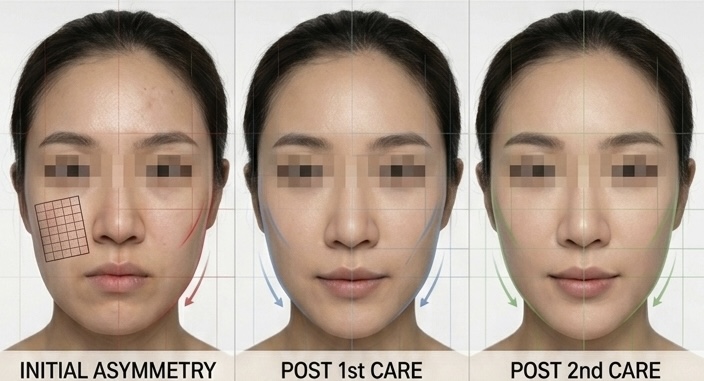
CLINICAL CASE — BEFORE & AFTER
[Insert structural facial lifting before & after photo here]
Photo caption: Structural facial lifting protocol — result across 5 sessions. Upper cervical (C1-C2) Activator correction, posterior occiput and masseter myofascial release, LED microcurrent esthetic treatment. Post-protocol: visible improvement in bilateral jawline definition and facial symmetry. Photographed in-clinic under consistent lighting. Results reflect structural and soft tissue change, not surface-only treatment.
CALLI’S TIP
The clients in my practice who see the fastest facial symmetry improvement are the ones who also address their sleeping position. Side-sleeping compresses the cervical spine and the facial tissue on the same side for 6-8 hours every night, undoing structural work during the day. Back-sleeping, even for three or four nights a week, meaningfully extends the results of upper cervical correction — and the facial tissue benefits are visible within a few weeks.
Who Benefits and What to Expect
The Best Candidates for This Protocol
This program is most effective for clients who have noticeable facial asymmetry — particularly in the lower face and jawline — that hasn’t responded to topical skincare, facial massage, or esthetic treatments alone. Ideal candidates include: people who clench or grind their teeth; those who carry the majority of their cervical tension on one side (a reliable indicator of C1-C2 asymmetry); clients with a history of orthodontic work, jaw surgery, or whiplash injuries; and anyone who sits at a desk for extended hours and has developed visible forward head posture. The asymmetry doesn’t have to be severe — even mild structural imbalance responds measurably to this protocol. In my two decades of clinical practice in Los Angeles, I have treated patients ranging from those with a just a slightly “off” jawline to those with significant post-surgical facial asymmetry, and the common thread is that structural work always produces better esthetic results than esthetic work alone.
Session Frequency and What to Expect Over Time
For new clients, I recommend starting with a series of six sessions — one per week — to establish structural correction and allow the cervical musculature to adapt to the new alignment before adding more intensive esthetic work. Significant changes in facial symmetry typically appear by session three or four, as the dominant-side muscle bulk begins to soften and both sides of the jawline start to equalize. After the initial series, maintenance at twice monthly is usually sufficient to hold the structural gains and continue progressing the esthetic work. This is not a one-session fix — structural compensation that has built up over years requires consistent correction. But the results are cumulative and durable in a way that cosmetic surface treatments simply aren’t, because they address the actual cause rather than the appearance of it.
CALLI’S CLINICAL NOTE
The most common response I hear after the first structural correction session, once clients have a chance to look in a mirror, is: “I didn’t know my face could look like this without anything.” That’s exactly the point. The structural asymmetry you’ve been compensating for with makeup or planning to treat with cosmetic injections often has a simpler mechanical explanation — and a more lasting mechanical solution. When I can correct C1 rotation and release the masseter-pterygoid complex in the same visit, the jawline change is visible before the client leaves the treatment table. That’s not something a serum or a facial device can replicate.
THE BOTTOM LINE
Facial asymmetry is most often a structural issue originating in the upper cervical spine, TMJ, and the fascial chain connecting them to the pelvis. Topical treatment, contouring, and even injectable approaches address the surface result of this problem — not the cause. Upper cervical chiropractic correction using the Activator Method, combined with myofascial release and sequenced esthetic treatment, addresses the actual mechanical driver of asymmetry and produces jawline lifting and facial rebalancing that is structurally grounded and durable.
SEE THE RESULTS & BOOK A FREE CONSULTATION
Before-and-after results from structural facial lifting sessions are on Instagram. If you’ve been trying to address facial asymmetry with topical treatments and want to understand whether there’s a structural component, DM me directly for a free consultation — I’ll tell you honestly whether this approach is right for your situation.
RELATED READING
Why Décolleté Massage and Lymphatic Drainage Matter in Professional Facial Esthetics — the structural asymmetry correction in this protocol works best when the lymphatic drainage pathway is also clear; this article explains why décolleté release is the first step in every facial at this clinic.
COMING UP NEXT
Theranova Body Treatment: What Heat, Microcurrent, and Decompression Actually Do to Body Tissue
The same structural thinking that guides facial correction applies to the body — Calli explains how Theranova’s four modalities work together to reshape what exercise and diet alone cannot reach.
— Calli
DC, LE | Licensed Chiropractor & Esthetician
Heal from the spine out, glow from the barrier in.
This article is for informational and educational purposes only and does not constitute medical or chiropractic advice. Facial asymmetry can have multiple causes — consult a licensed healthcare provider for individualized assessment. Calli is a licensed chiropractor and esthetician; this content reflects her professional clinical observations and is not a substitute for personalized care.