
By Calli | Licensed Chiropractor & Esthetician | June 7, 2026
He came in for his first men’s facial — early thirties, works in tech, mentioned dry skin on the intake form. But within the first two minutes of our consultation, what he really wanted to talk about was his scalp. He’d been dealing with dandruff for over a year, had tried several shampoos without lasting results, and had started noticing occasional breakouts along his hairline that he couldn’t explain. I see this combination regularly in my Los Angeles practice. The scalp and the face share the same skin, the same sebaceous gland architecture, and the same inflammatory pathways. When one is dysregulated, the other usually isn’t far behind.
“I’ve been using expensive shampoo. I didn’t know I was applying it wrong. Nobody ever explained this to me — not even a dermatologist.”
— Clinic patient, Los Angeles, age 32
IN THIS ARTICLE
1. Why Dandruff Forms — and Why the Scalp Is Just Facial Skin That Grows Hair
2. The Fungal Connection — Why Ketoconazole Works and When to Use It
3. What We Did That Day: Droplet Ultrasound Facial + Specialized Scalp Treatment
4. The Right Way to Shampoo — What Most People Get Wrong Every Single Day
QUICK SUMMARY
Dandruff is not a hygiene problem — it is most commonly a fungal and inflammatory response involving the scalp microbiome and sebaceous gland activity. The scalp is skin, and scalp dysfunction directly impacts facial skin health. This article covers the clinical cause of dandruff, why ketoconazole-based shampoos work, the correct shampooing technique that most clients have never been taught, and the specialized scalp treatment protocol we used in a real clinical consultation at this clinic.
WHY TRUST THIS ARTICLE
Written by Calli — a licensed Doctor of Chiropractic (DC) and Licensed Esthetician (LE) with over 20 years of clinical practice in Los Angeles. Calli treats the scalp as an extension of facial skin, combining professional esthetic assessment with clinical consultation to address the systemic causes of scalp and skin dysfunction. This article reflects a real patient case. It is educational content, not a substitute for medical evaluation.
Why Dandruff Forms — and Why the Scalp Is Just Facial Skin That Grows Hair
The Scalp Is Not Separate from Your Skin
One of the most consistent gaps I see in my esthetic practice is the mental separation clients make between their “face” and their “scalp.” In clinical reality, there is no such boundary. The scalp is continuous with the facial skin — same epidermis, same dermis, same sebaceous and eccrine glands. The only difference is follicle density. This matters clinically because scalp inflammation, excess sebum, or fungal overgrowth does not stay neatly above the hairline. In my treatment room, I routinely see clients with persistent forehead and hairline breakouts whose facial skincare is otherwise well-managed — and when I ask about their scalp, the answer almost always reveals the source. Dandruff flaking on the forehead. An irritated, warm scalp. Conditioner or hair product residue sitting on the skin at the hairline. The face is reacting to what the scalp is doing, and no cleanser or serum is going to fix a facial breakout that originates at the follicle line.
What Actually Causes the Flaking
Dandruff — clinically referred to as pityriasis capitis — is driven by a combination of factors: excess sebum production, disruption of the scalp’s microbiome, and an inflammatory response that accelerates keratinocyte turnover. The result is the rapid shedding of skin cells in clumped, visible flakes rather than the normal, invisible desquamation cycle. Seborrheic dermatitis, the more persistent and inflammatory form of dandruff, involves the same mechanisms at a greater degree of intensity — often accompanied by redness, scalp heat, and itching. In my experience treating patients in Los Angeles across two decades, the clients with the most refractory dandruff are usually those with high sebum production, significant scalp heat (which I assess by palpation before treatment), and a history of aggressive shampooing that has stripped the scalp’s protective acid mantle and created a cycle of over-compensation.
CALLI’S TIP
A warm scalp — one that feels noticeably hot to the touch, even when you haven’t been active — is a clinical sign worth paying attention to. Persistent scalp heat indicates chronic inflammation in the follicular tissue, which accelerates sebum overproduction and creates ideal conditions for the fungal imbalance that drives dandruff. If your scalp consistently feels warm or tight, address the heat before trying to address the flaking.
The Fungal Connection — Why Ketoconazole Works and When to Use It
Malassezia: The Yeast at the Root of Most Dandruff
The fungal component of dandruff is well-established in the dermatological literature. The primary organism implicated is Malassezia — a lipophilic yeast that lives naturally on all human scalps but becomes pathological when it overgrows. Malassezia metabolizes scalp sebum into oleic acid, a byproduct that penetrates the stratum corneum and triggers an inflammatory response in susceptible individuals. This inflammation accelerates cellular turnover dramatically — the scalp sheds cells in days rather than weeks — producing the visible flaking that characterizes dandruff. What makes this relevant clinically is that no amount of physical exfoliation or hydration alone resolves the problem if the fungal load isn’t addressed. The substrate — the Malassezia population — has to be reduced. This is why antifungal-active shampoos produce results where other formulations don’t.
Why I Recommend Ketoconazole-Based Shampoo for Persistent Dandruff
Ketoconazole is an imidazole antifungal that disrupts the fungal cell membrane by inhibiting ergosterol synthesis — effectively stopping Malassezia from maintaining normal cell function. In clinical trials, ketoconazole shampoo (most commonly known under the brand Nizoral) has consistently outperformed zinc pyrithione and selenium sulfide formulations for reduction of dandruff severity and recurrence rates. When a patient presents to me with dandruff that has not responded to conventional shampoo switching, ketoconazole is the ingredient I address first in the consultation. It does not need to be used daily — twice weekly during an active episode, then once weekly for maintenance, is the protocol I typically discuss. I always recommend consulting a dermatologist if the condition is severe, involves significant redness, or doesn’t respond within four weeks, because seborrheic dermatitis at that level may need prescription-strength treatment.
CALLI’S TIP
Look for “ketoconazole 1%” on the active ingredients panel — not in the marketing copy. Many shampoos advertise “dandruff control” using zinc pyrithione or coal tar, which are effective for mild cases but work through different mechanisms. If you’ve tried multiple over-the-counter dandruff shampoos without sustained improvement, the missing piece is likely antifungal activity, not the scalp-care routine itself.
What We Did That Day: Droplet Ultrasound Facial + Specialized Scalp Treatment
Addressing the Facial Skin First: Droplet Ultrasound for Deep Hydration and Lifting
This patient’s facial skin presented as significantly dehydrated — the kind of inner dryness that doesn’t respond to surface moisturizer because the lack of water is at the cellular level, not the stratum corneum. This is something I see frequently in men in their thirties who have functional skincare routines but no professional treatment history. The droplet ultrasound treatment I performed uses focused ultrasound energy to drive active hydrating ingredients deep into the dermis, simultaneously stimulating collagen production at the treatment depth and producing a visible lifting effect. The result, which is apparent immediately post-treatment, is what I describe to clients as “resetting the baseline” — the skin looks hydrated, luminous, and structurally tighter in a way that reflects real tissue-level change, not surface moisture. For a patient presenting with both inner dryness and early laxity around the lower face, the droplet ultrasound addresses both in a single session.
The Scalp Treatment: Exfoliation, Scaling, and CO₂ Cooling
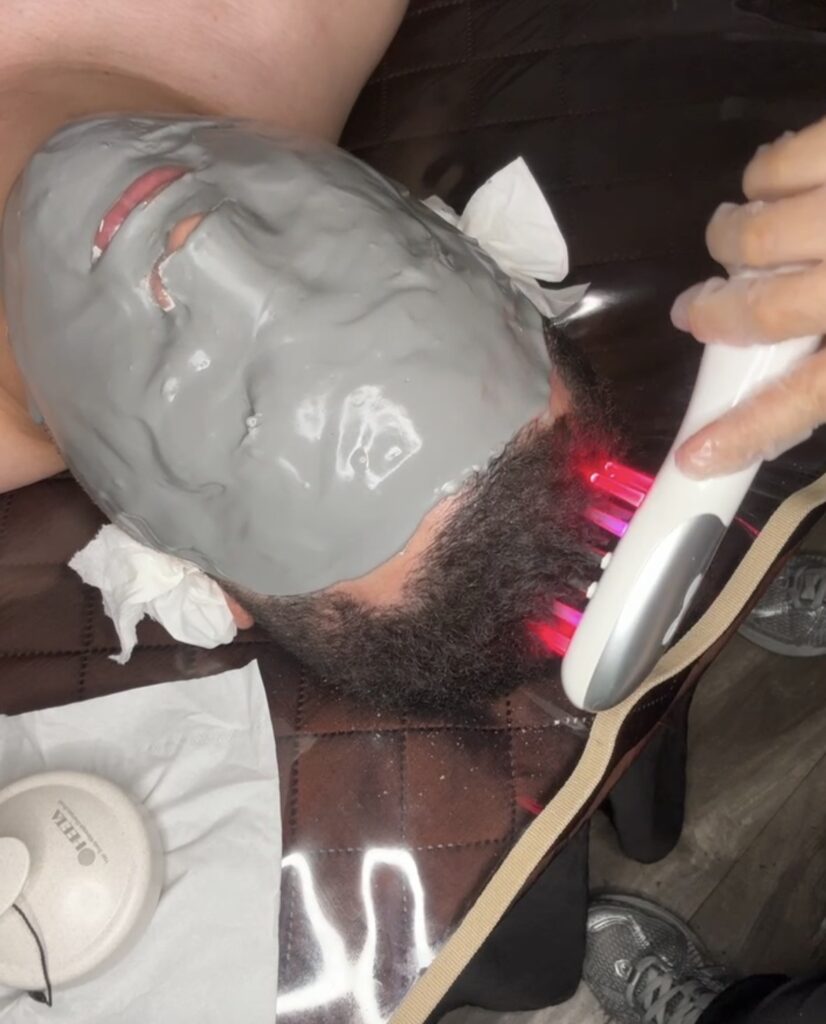
After the facial treatment was complete, I added a professional scalp protocol. The sequence is specific: it begins with a pre-cleanse exfoliation using a dedicated scalp exfoliating solution applied with specialized cotton-tipped scalp applicators. These allow me to work the solution directly into the follicular openings and along the scalp surface, lifting accumulated dead skin cells, product residue, and sebum without the mechanical friction of scrubbing, which would aggravate an already-inflamed scalp. The exfoliation phase is followed by a scalp scaling step with a specialized treatment solution that dissolves the keratin debris sitting in and around the follicles. Once the scaling is complete and the scalp has been thoroughly cleansed, I apply the final stage: a CO₂ cryogenic cooling treatment. The CO₂ gas is applied directly to the scalp surface, producing an immediate and intense cooling sensation as the gas evaporates on contact — clients consistently describe it as “ice sparking on the scalp.” This cooling phase dramatically reduces scalp heat and the associated inflammatory tone in the follicular tissue, calms redness, and closes the follicles after the exfoliation work.
CLINICAL CASE — BEFORE & AFTER
[Insert scalp treatment + droplet ultrasound facial before & after photo here]
Photo caption: Men’s combined facial and scalp treatment — single session result. Droplet ultrasound for deep hydration and facial lifting; scalp exfoliation, scaling, and CO₂ cooling for dandruff and scalp heat. Post-treatment: improved skin luminosity and texture; visible reduction in scalp redness and surface flaking. Actual clinical case, photographed in-clinic. Results reflect tissue-level hydration and scalp microenvironment normalization.
CALLI’S TIP
Professional scalp exfoliation is not the same as vigorous home scrubbing. The clinical tools and solutions used in a treatment room are designed to dissolve follicular debris biochemically — they do not require mechanical force. If you are scrubbing your scalp hard at home, you are damaging the follicular lining and stripping the acid mantle, which worsens inflammation and dandruff over time. The work needs to be gentle at every stage.
The Right Way to Shampoo — What Most People Get Wrong Every Single Day
The Four Habits That Damage the Scalp Before You Even Start
In over twenty years of treating clients in Los Angeles, four shampooing errors come up in virtually every scalp consultation I conduct — and this patient had all four. First: applying shampoo directly to a dry scalp without pre-rinsing. The scalp needs a thorough pre-rinse with lukewarm water to open the follicles and begin softening the sebum and dead cell buildup before any cleanser is introduced. Hot water directly from the showerhead compounds this problem — it strips the scalp’s acid mantle before the shampoo even begins working, and it triggers compensatory sebum production afterward. Second: pouring shampoo liquid directly onto the scalp. Shampoo should be emulsified in the palm first — worked into a foam before it contacts the scalp — so that it distributes evenly and the surfactants activate properly before application. Third: using fingernails to scrub. Fingernails create micro-abrasions on the scalp surface, disrupt the follicular epithelium, and spread bacteria. The correct contact point is the soft pads of the fingertips, applied with light circular pressure. Fourth: skipping the first wash. For oily scalps or anyone with seborrheic dermatitis, the first shampoo application is a pre-cleanse that lifts the surface oil load. The second application is where actual cleansing occurs. Running through two applications takes an extra ninety seconds and dramatically changes the effectiveness of the treatment.
Conditioner Placement and Rinsing — Two More Errors That Silently Perpetuate Scalp Problems
Conditioner is formulated for the hair shaft — the dead, keratinized fiber that extends from the follicle. It is not formulated for the scalp. Applying conditioner to the scalp deposits silicones, emollients, and film-forming agents directly onto the follicular openings, contributing to the sebum-congestion cycle and, in many cases, the flaking that clients mistake for dandruff. Apply conditioner from mid-shaft to ends only, and keep it away from the first two inches of root growth. Rinsing is equally important: shampoo and conditioner residue left on the scalp is inflammatory. I recommend rinsing for at least twice as long as clients think is necessary — thirty seconds of active rinsing after all lather has visibly disappeared from the hair. Residue buildup at the hairline is one of the most common triggers for the forehead and temple breakouts I see in clients who otherwise have clean skin habits. The face isn’t the problem. The rinse is.
CALLI’S CLINICAL NOTE
This patient left with two things that most dermatology or esthetic appointments don’t provide: a clear explanation of what was actually causing his scalp problem, and a shampoo technique he could change immediately with zero product cost. By the time we finished, the breakouts along his hairline had a source — and the source was fixable. The scalp consultation became the most valuable part of his appointment, not the facial treatment. I include scalp assessment in every men’s consultation now because the connection between scalp health and facial skin condition is almost always underestimated, and the corrections are almost always simpler than patients expect.
If the scalp’s inflammatory state has already progressed to active chin or jawline breakouts, that clinical picture is a separate condition with its own treatment sequence — covered in Chin Acne Won’t Stop? Here’s What a Clinician Actually Does.
THE BOTTOM LINE
Dandruff is primarily a fungal and inflammatory condition, not a cleanliness issue. The scalp is facial skin — what happens there reaches the forehead, temples, and hairline. Choosing a shampoo with ketoconazole for an active Malassezia overgrowth, correcting the shampooing technique, and addressing scalp heat with professional treatment resolves the majority of dandruff cases that “nothing has worked” for. The product is rarely the problem. The process and the underlying biology almost always are.
SEE THE RESULTS & BOOK A FREE CONSULTATION
Men’s skin and scalp consultations are available at this clinic. If you have persistent dandruff, hairline breakouts, or scalp heat that hasn’t responded to product switching, DM me directly on Instagram — I’ll tell you in five minutes whether what you’re describing is something a product change can fix or something that needs clinical attention.
RELATED READING
Why Décolleté Massage and Lymphatic Drainage Matter in Professional Facial Esthetics — scalp inflammation and facial congestion both trace back to drainage efficiency; this article explains why clearing the lymphatic pathway is the first step in any professional facial protocol at this clinic.
COMING UP NEXT
Acne-Prone Skin: How to Actually Manage Breakouts — What Works, What Makes It Worse, and What Happens in a Clinical Treatment Room
The scalp-to-face inflammatory connection that drives hairline breakouts is part of a larger picture — next, Calli explains how acne-prone skin is treated clinically and what most people fundamentally misunderstand about why they keep breaking out.
— Calli
DC, LE | Licensed Chiropractor & Esthetician
Heal from the spine out, glow from the barrier in.
This article is for informational and educational purposes only and does not constitute medical or dermatological advice. Persistent dandruff, seborrheic dermatitis, or scalp conditions accompanied by significant redness, itching, or hair loss should be evaluated by a licensed dermatologist. Calli is a licensed chiropractor and esthetician; this content reflects her professional clinical observations and is not a substitute for personalized medical care.