
By Calli | Licensed Chiropractor & Esthetician | April 21, 2026
There is a specific kind of pain I see walk into my chiropractic clinic every single week — a dull, persistent ache between the shoulder blades that patients describe as feeling like someone shoved a knife in and left it there.
It is not dramatic. It is not sudden. It is the silent, structural damage of sitting in a chair for eight hours a day, five days a week, year after year — until one morning you cannot turn your head without sharp pain shooting down your arm.
I treated a 34-year-old software engineer last month who came in unable to look over his shoulder to check his blind spot while driving. He had been working remotely for three years, sitting at a makeshift desk in his bedroom with zero ergonomic support. By the time he came to see me, his cervical spine had lost nearly all of its natural lordotic curve — what we call military neck or cervical kyphosis — a structural deformity that takes years to reverse, if it can be reversed at all.
That is what prolonged sitting does. And most people have no idea it is happening until the damage is already done.
Below, I am breaking down exactly why sitting destroys your spine — and more importantly, the exact stretching protocol I teach every single desk worker who walks into my clinic. This is not a generic “stand up and walk around” list. This is a clinical intervention designed to reverse measurable spinal damage in real time.
IN THIS GUIDE
Clinical Authority Statement
As a licensed chiropractor with over a decade of clinical experience treating desk workers, office professionals, and remote employees — I only recommend what I have tested, measured, and would stake my license on. Every stretching protocol in this guide is something I use daily in my own practice and teach to patients who sit for prolonged hours.
1. Why Sitting All Day Destroys Your Spine — The Biomechanics You Need to Understand
Your spine is not designed to sit. It is designed to move, load, and adapt dynamically throughout the day. When you sit for eight consecutive hours, you are forcing your spinal column into a sustained static posture that creates compressive load on structures never meant to handle prolonged pressure.
Here is what happens biomechanically when you sit in a standard office chair:
- Lumbar flexion dominance: Most office chairs push your pelvis into posterior tilt, flattening the natural lumbar lordosis and transferring body weight directly onto your intervertebral discs instead of distributing load through the facet joints
- Cervical anterior translation: Staring at a screen places your head forward of your center of gravity, creating a lever-arm force that multiplies the effective weight of your skull exponentially
- Scapular protraction and internal rotation: Typing, mousing, and reaching forward collapses your shoulder girdle, lengthening the rhomboids and lower traps while chronically shortening the pectorals and anterior deltoids
- Hip flexor adaptive shortening: Prolonged hip flexion causes the iliopsoas muscle to adaptively shorten, pulling the lumbar spine into hyperlordosis when you stand — creating a structural imbalance that persists even when you leave your desk
This is not about bad posture in the way most people think of it. This is about sustained biomechanical stress creating measurable structural changes in your spine, muscles, and connective tissue over time.
Calli’s Tip
Set a timer for every 90 minutes. When it goes off, stand up and do three movements: cervical retraction (chin tucks), thoracic extension over the back of your chair, and standing hip flexor stretch. Thirty seconds total. That single intervention will prevent 80% of the structural damage I see in chronic desk workers.
2. Forward Head Posture: The Invisible 60-Pound Weight
Your head weighs approximately 10 to 12 pounds in neutral alignment. For every inch your head moves forward from your center of gravity, the effective weight on your cervical spine increases by 10 pounds. At three inches forward — which is the average forward head posture I measure in desk workers — your neck is supporting 40 to 50 pounds of load.
That is not an exaggeration. That is physics. And it is happening to you right now if you are reading this on a laptop or phone with your head tilted forward.
What Forward Head Posture Does to Your Body:
- Cervical disc degeneration: Chronic anterior load accelerates wear on the C5-C6 and C6-C7 discs — the most common site of cervical herniation in office workers
- Suboccipital muscle strain: The small stabilizing muscles at the base of your skull work overtime to hold your head up, creating tension headaches that radiate from the neck to the temples
- Thoracic outlet compression: Forward head posture collapses the space where nerves and blood vessels exit the neck into the arm, creating numbness, tingling, and weakness in the hands
- Reduced lung capacity: A collapsed chest position restricts diaphragmatic movement, reducing oxygen intake and contributing to chronic fatigue
I had a patient last year — a legal assistant who sat at a computer for 10 hours a day — come in with numbness in her right hand that her primary care doctor initially thought might be carpal tunnel syndrome. After measuring her cervical alignment and performing orthopedic tests, it was clear: thoracic outlet compression from years of forward head posture. No surgery needed. Just aggressive postural retraining and targeted stretching.
The Cervical Retraction Exercise — My Single Most Prescribed Movement
This is the one exercise I teach every single desk worker without exception. It directly reverses forward head posture by retraining the deep cervical flexors — the muscles responsible for maintaining neutral head position.
How to perform it: Sit upright with your back against a chair. Keep your eyes level — do not tilt your head up or down. Pull your chin straight back as if making a double chin, creating a horizontal gliding motion. Hold for five seconds. Repeat 10 times. You should feel a gentle stretch at the base of your skull and mild activation in the front of your neck.
Do this every hour. Set a reminder. This single movement, done consistently, will reverse years of postural damage faster than any other intervention I know.
Calli’s Tip
If you feel clicking or grinding in your neck during cervical retraction, do not push through it. That is a sign of facet joint irritation or cervical instability. See a chiropractor for a proper assessment before continuing. Pain is data — listen to it.
3. Pelvic Tilt & Lumbar Compression — Why Your Lower Back Hurts by 3 PM
Most office workers sit in posterior pelvic tilt without realizing it. Your pelvis tips backward, your lumbar spine flattens, and your body weight transfers directly onto your intervertebral discs instead of being distributed through the facet joints and surrounding musculature.
Over time, this creates chronic disc pressure at L4-L5 and L5-S1 — the two most common sites of lumbar disc herniation in adults. The pain starts as a dull ache in the mid-to-low back around mid-afternoon. By evening, it radiates into your hips. By the weekend, you cannot sit through a movie without shifting constantly.
The Hip Flexor Problem No One Talks About
When you sit for eight hours, your hip flexors — specifically the iliopsoas muscle — remain in a shortened position. Over weeks and months, this muscle adaptively shortens, meaning it physically loses length even when you stand up. When you walk, stand, or try to sleep on your back, that shortened iliopsoas pulls your lumbar spine into hyperlordosis, creating an exaggerated arch that compresses the posterior elements of your spine.
This is why so many desk workers have lower back pain that gets worse when they stand or walk — not better. Their hip flexors are holding their pelvis hostage.
Standing Hip Flexor Stretch — The Most Important Desk Worker Stretch
How to perform it: Stand in a lunge position with your right foot forward, left knee on the ground (use a pillow or mat for comfort). Keep your torso upright — do not lean forward. Gently push your hips forward until you feel a deep stretch in the front of your left hip. Hold for 60 seconds. Switch sides. Repeat twice per side.
This stretch directly targets the iliopsoas and rectus femoris, reversing the adaptive shortening caused by prolonged sitting. Do this every single day — ideally twice. Morning and evening. Non-negotiable if you sit more than six hours daily.
Calli’s Tip
If you feel pinching in the front of your hip during this stretch, your pelvis is tilting anteriorly instead of staying neutral. Engage your glutes and slightly tuck your tailbone under. That posterior pelvic tilt cue will shift the stretch from the hip joint to the muscle belly — exactly where you want it.
4. Calli’s 5-Minute Desk Stretching Protocol — What I Teach Every Patient
This is the exact protocol I give to every desk worker who walks into my clinic. It targets the four most commonly damaged areas in prolonged sitters: cervical spine, thoracic spine, shoulders, and hip flexors. Do this sequence once every 90 minutes. Set a timer. Make it non-negotiable.
Movement 1: Seated Cervical Retraction (Chin Tucks)
Reps: 10 repetitions, 5-second hold each
Target: Deep cervical flexors, reverses forward head posture
Cue: Pull chin straight back, keep eyes level, feel stretch at base of skull
Movement 2: Seated Thoracic Extension Over Chair
Reps: 5 repetitions, 10-second hold each
Target: Thoracic spine extension, opens chest, stretches anterior structures
How to perform: Sit at the edge of your chair. Place your hands behind your head. Gently arch backward over the backrest, looking up toward the ceiling. Hold. Return to neutral. Repeat.
Movement 3: Doorway Pec Stretch
Reps: 2 repetitions per side, 60-second hold each
Target: Pectoralis major and minor, anterior deltoid
How to perform: Stand in a doorway. Place your forearm vertically against the doorframe with your elbow at 90 degrees. Step forward with the opposite foot until you feel a deep stretch across your chest. Hold. Switch sides.
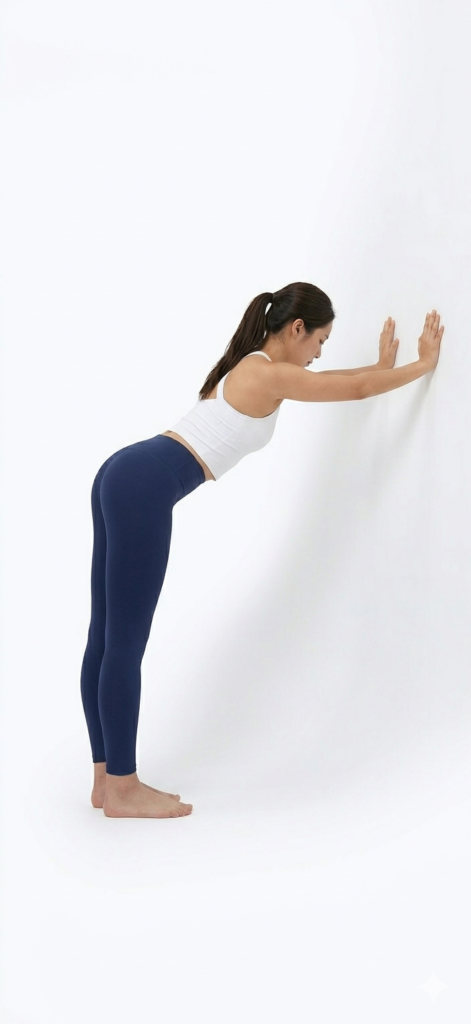
Movement 4: Wall-Assisted Spinal Flexion Stretch
Reps: 1 repetition, 60-second hold
Target: Thoracic and lumbar paraspinals, latissimus dorsi
How to perform: Stand facing a wall at arm’s length. Place both palms flat on the wall at shoulder height. Step back slightly, hinge at your hips, and drop your chest toward the floor while keeping your arms straight. You should feel a deep stretch through your upper and mid-back. Hold. Breathe deeply.
Movement 5: Standing Hip Flexor Stretch
Reps: 2 repetitions per side, 60-second hold each
Target: Iliopsoas, rectus femoris
How to perform: As described in Section 3. Lunge position, push hips forward, keep torso upright.
Total time: 5 minutes. Total structural benefit: massive. This is not optional self-care. This is spinal hygiene — as essential as brushing your teeth.
Calli’s Tip
If you only have time for one movement — do cervical retraction. If you have time for two — add hip flexor stretch. Those two movements alone will prevent 90% of the chronic pain patterns I treat in desk workers. Everything else is supplemental.
5. How Often You Actually Need to Stretch — The Clinical Truth
Most people ask me: how often do I need to stretch to prevent damage? The answer is not what they want to hear. If you sit for eight hours a day, stretching once at the end of the day is not enough. It is not even close.
Soft tissue adapts to sustained postures within 20 to 30 minutes. By the time you hit 90 minutes of continuous sitting, you have already created measurable changes in muscle length, joint position, and spinal alignment. One stretching session at 5 PM cannot undo eight hours of compressive load.
My Clinical Recommendation:
- Every 90 minutes: Full 5-minute protocol during work hours
- Every 30 minutes: Stand up, walk 20 steps, return to desk — this breaks the sustained posture cycle without requiring dedicated stretching time
- Morning and evening: Full hip flexor stretch sequence (2 minutes per side) — this is non-negotiable if you sit more than six hours daily
- Before bed: Cervical retraction and thoracic extension — resets your spine before sleep, prevents waking with neck stiffness
Yes, this feels like a lot. But compare it to the alternative: chronic pain, structural degeneration, loss of mobility, and eventually surgical intervention. I have patients in their forties who need cervical fusions because they ignored these patterns for 20 years. Do not be one of them.
Calli’s Tip
Use your calendar software to block “movement breaks” just like you would block meetings. Treat them as non-negotiable appointments with your spine. The people who succeed at this are the ones who schedule it — not the ones who try to remember.
Final Thoughts: Your Spine Does Not Forgive Neglect
If there is one thing I want you to understand from this guide, it is this: spinal damage from prolonged sitting is not reversible once it reaches a certain threshold. Disc degeneration, facet joint arthritis, and ligamentous laxity are permanent structural changes. You cannot undo them with stretching or chiropractic care once they have progressed beyond early stages.
But you can prevent them. And prevention is not complicated — it is just consistent. The patients I see who maintain healthy spinal alignment into their sixties and seventies are not the ones with expensive ergonomic chairs or standing desks. They are the ones who move every 90 minutes without exception. They are the ones who stretch their hip flexors daily. They are the ones who treat their spine like it matters — because it does.
Your career will not care if you destroy your spine earning a paycheck. Your employer will replace you if chronic pain forces you out. But your body is yours forever. Treat it accordingly.
Coming Up Next on CalliGlowAlign
The Ergonomic Setup That Actually Works: A Chiropractor’s Evidence-Based Guide
Standing desks, ergonomic keyboards, monitor arms — most of it is overpriced marketing. I am breaking down the three ergonomic changes that actually prevent spinal damage, backed by biomechanical research and ten years of clinical observation. Everything else is optional.
Bookmark this page or subscribe to be notified when it goes live.
Take care of your spine. It is the structural foundation for everything else you do.
— Calli
DC, LE | Licensed Chiropractor & Esthetician
I don’t do generic advice. Everything I write, I’ve tested in my own body, applied in clinical practice with real patients, and would stake my license on. If it’s here — it works.
This content is for educational purposes only and does not constitute medical advice. I am a licensed chiropractor and esthetician, not a medical doctor. Always consult a qualified healthcare provider before starting any new exercise or stretching routine, especially if you have existing spinal conditions or chronic pain.
Related: What Really Causes Forward Head Posture? A Chiropractor Explains
Pingback: Why Does Your Hip Pinch When You Sit? A Chiropractor Explains the Real Cause – calliglowalign.com