
Los Angeles gets roughly 284 sunny days a year. It is one of the sunniest major cities in the United States. And yet, in 20 years of running a chiropractic practice here, low vitamin D is one of the findings I see most consistently when my patients finally get blood work done — including patients who work outdoors, who exercise outside, who would describe themselves as “always in the sun.”
This is the paradox I have come to call the LA vitamin D problem: a city full of sunshine and a patient population that is still, very often, running low. Understanding why that happens explains a lot about vitamin D that the simple “go get some sun” advice leaves out — and it explains why low vitamin D is worth taking seriously even if you live somewhere that seems like deficiency should be impossible.
I am a licensed chiropractor and esthetician, and I have spent two decades watching vitamin D’s fingerprints show up in complaints that often seem unconnected: aching that does not localize cleanly, fatigue that does not track with sleep, muscle weakness that does not respond to training the way it should. None of these is a diagnosis in my office — I refer for blood work, not for vitamin D treatment. But the pattern is consistent enough that I want to explain it clearly so you know what to look for and what to actually do about it.
The Sunlight Myth — Why Southern California Is Not a Shield
Here is the part that surprises almost everyone: your skin makes vitamin D from UVB radiation, not from total sun exposure. UVB is the short-wave radiation that also causes sunburn. And UVB reaches your skin at adequate levels only when the sun is high enough in the sky — roughly between 10 a.m. and 3 p.m., and only when you are outdoors without significant sunscreen coverage.
Now think about how most people actually move through a Los Angeles day. They drive — windows mostly blocking UVB. They work indoors. They wear SPF 30 or 50 (which blocks approximately 97–98% of UVB). They exercise in the morning or evening when the sun angle is too low for effective synthesis. They are sitting in beautiful California sunlight behind glass, through tinted car windows, under shade structures, on covered patios — receiving plenty of light, but not the specific radiation their skin needs to produce vitamin D.
Add to this: darker skin tones require significantly more sun exposure to produce the same amount of vitamin D as lighter tones, because melanin acts as a natural UV filter. Older adults produce vitamin D less efficiently from the same UV exposure. Higher body weight means vitamin D gets sequestered in fat tissue and is less available to circulating blood. People who cover their skin for religious or cultural reasons. People whose gut absorption is compromised by celiac, Crohn’s, or post-bariatric surgery.
Sunny city. Real and common deficiency. The two coexist easily once you understand the mechanism.
What Vitamin D Actually Does in the Body
The name is misleading. Vitamin D is not really a vitamin in the way that vitamins C and B12 are. It is a prohormone — a compound your body converts into an active hormone that regulates hundreds of genes. Vitamin D receptors exist in nearly every tissue type: muscle, bone, immune cells, brain, skin, hair follicles, cardiovascular tissue. This is why low levels produce such a scattered, multi-system picture rather than a single, clean symptom.
In my clinical training, I learned the bone-health version: vitamin D is essential for calcium absorption, bone mineralization, and preventing rickets and osteomalacia. That is true, and it is the reason vitamin D supplementation became standard. But the downstream effects are broader than bone. Immune regulation, muscle function, inflammatory signaling, mood, and even the skin’s barrier integrity all have meaningful vitamin D dependencies.
As an esthetician, I find the skin connection particularly interesting. Vitamin D plays a role in keratinocyte differentiation — the process by which skin cells mature and become the protective outer layer. Low vitamin D is associated with conditions involving disrupted skin-cell turnover and barrier function. Clients who come to me with persistently dry, reactive, slow-healing skin and who later turn out to have low vitamin D are not a coincidence I have seen once; I have seen it regularly enough that I always ask.
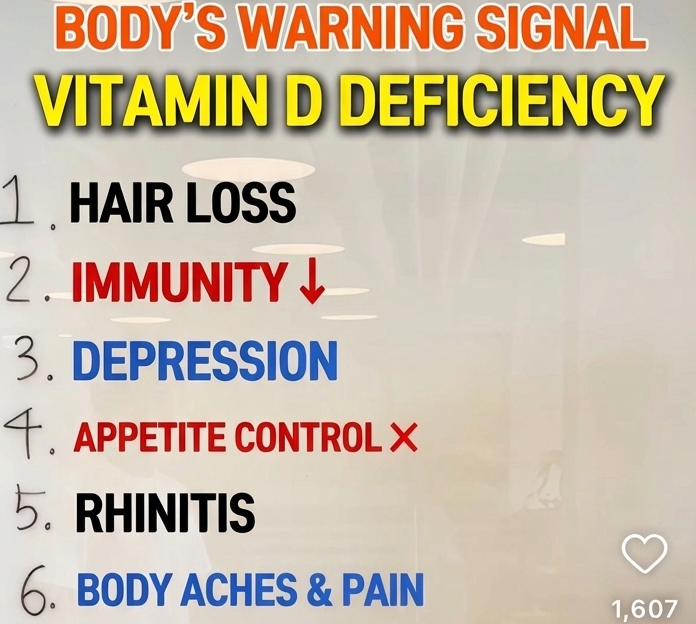
Six Patterns I Take Seriously in Practice
Fatigue That Does Not Track With Sleep
The fatigue of low vitamin D is not dramatic. It is a background dimness — energy that never quite comes up to full, a need for more effort than the task logically requires, an inability to sustain the normal pace of a normal day. Vitamin D is involved in mitochondrial function, and when mitochondria are running below potential, this subdued quality of energy is exactly what it looks like. Patients often describe it as “just not feeling right” rather than “exhausted,” which is part of why it gets written off.
Bone and Muscle Aching Without a Clear Structural Cause
This is the one I find most directly relevant to my chiropractic work. When a patient presents with diffuse aching — not the sharp, localized pain of a disc issue or a joint injury, but a dull, widespread discomfort that moves around and does not respond cleanly to mechanical treatment — I think about metabolic contributors. Low vitamin D affects bone mineral density and muscle function simultaneously, which can produce exactly this diffuse, non-mechanical aching pattern.
I have had patients whose low-back and hip aching, which I had been working on structurally with reasonable but incomplete progress, resolved significantly after their physician found and corrected low vitamin D. The structural work still mattered — but the terrain it was trying to fix was depleted, and correcting the deficiency changed what the tissue was capable of.
Frequent Respiratory Infections or Slow Recovery
Vitamin D has a well-documented role in modulating the innate immune response — the fast, first-line defense against respiratory infections. People with chronically low levels tend to get more colds, take longer to clear them, and feel run-down after minor illnesses in ways that seem disproportionate. If you find yourself the designated sick person in your household, catching whatever goes through and then sitting with it for two weeks, vitamin D is on the list of things worth checking.
Low Mood, Particularly in Lower-Light Periods
The relationship between vitamin D and mood is more complex than “low D, low mood” — other mechanisms, including circadian rhythm disruption and reduced light-driven serotonin signaling, are also in play during darker months. But the association is consistent enough that if your mood reliably dips between October and February and returns with the brighter months, vitamin D is part of the conversation worth having with your doctor.
Hair Thinning or Changes in Growth Rate
Hair follicles are among the most vitamin D-receptor-dense tissues in the body. Certain forms of hair loss, particularly alopecia areata and the diffuse thinning associated with telogen effluvium, have been linked to lower vitamin D levels in research populations. As an esthetician who sees scalp and hair condition regularly, I treat this as a clue to ask about, not a diagnosis to offer. Persistent, unexplained thinning alongside several other items on this list is a reason to include vitamin D in a blood panel.
Slow Recovery From Minor Injuries
Vitamin D is involved in muscle repair, inflammatory regulation, and the tissue remodeling that follows injury. Patients who tell me their body “just doesn’t bounce back the way it used to” — not dramatically injured, just persistently slow to recover from workouts, travel, or minor physical stress — sometimes turn out to have chronically low vitamin D. Combined with other signals, it is part of the picture worth examining.
The Specific Problem With Self-Treating
Vitamin D is fat-soluble. Unlike water-soluble vitamins that flush out when you take too much, vitamin D accumulates. Vitamin D toxicity — hypervitaminosis D — is real, and it causes elevated calcium levels that can affect kidney function, cardiovascular tissue, and bones in ways that are not trivially reversed. It is not common, but it happens most often in people who supplement high doses long-term without monitoring their blood levels.
The correct approach is genuinely simple: ask your primary care doctor for a 25-hydroxyvitamin D test. A fasting blood draw, often covered by insurance as part of routine labs. Get your baseline level. If it is low, your doctor determines an appropriate supplementation dose for your specific situation — your weight, your baseline level, and any other relevant factors. You take that dose for the recommended period. You re-test. You adjust as needed.
This takes about four minutes of conversation with your doctor and costs significantly less than a year’s supply of random-dose supplements bought without knowing your level. It is also the approach that actually works, because you know whether the intervention moved the number.
The Food Question
Yes, vitamin D is found in some foods: fatty fish (salmon, mackerel, sardines), egg yolks, and fortified dairy and plant milks. No, food alone is realistically not enough to correct a true deficiency, and it is usually not enough to maintain optimal levels in people who cannot make adequate amounts from sun exposure. The food sources are worth including in your diet, but they are not a substitute for knowing your actual blood level.
Putting It Together: What to Do Next
If you recognize several of the patterns described above — particularly in combination, and particularly if you spend most of your day indoors, wear sunscreen consistently (which I still recommend for skin health reasons), have a darker skin tone, or have any of the gut or metabolic conditions that reduce vitamin D absorption — ask your doctor for a 25-hydroxyvitamin D level at your next appointment. You do not need symptoms severe enough to justify the test. Being in a high-risk group is justification enough.
If your level comes back low, follow your physician’s correction plan. Vitamin D3 is the standard supplementation form, often taken with vitamin K2 in many protocols to support proper calcium direction. The timing and dose matter — your doctor’s recommendation, based on your actual number, is the relevant guide, not the dose on a bottle at the health food store.
And if your level comes back normal — which is also a genuinely useful outcome — you can stop wondering about vitamin D and look elsewhere for the explanation.
Either way, you will have an answer instead of a guess.
— Calli, DC, LE | Licensed Chiropractor & Esthetician, Los Angeles
Medical disclaimer: This article is educational and does not constitute medical advice or diagnosis. Chiropractors do not diagnose or treat vitamin D deficiency. Any suspected deficiency should be evaluated with a 25-hydroxyvitamin D blood test ordered by a qualified healthcare provider. Do not begin supplementation without knowing your baseline level.
Related Articles