
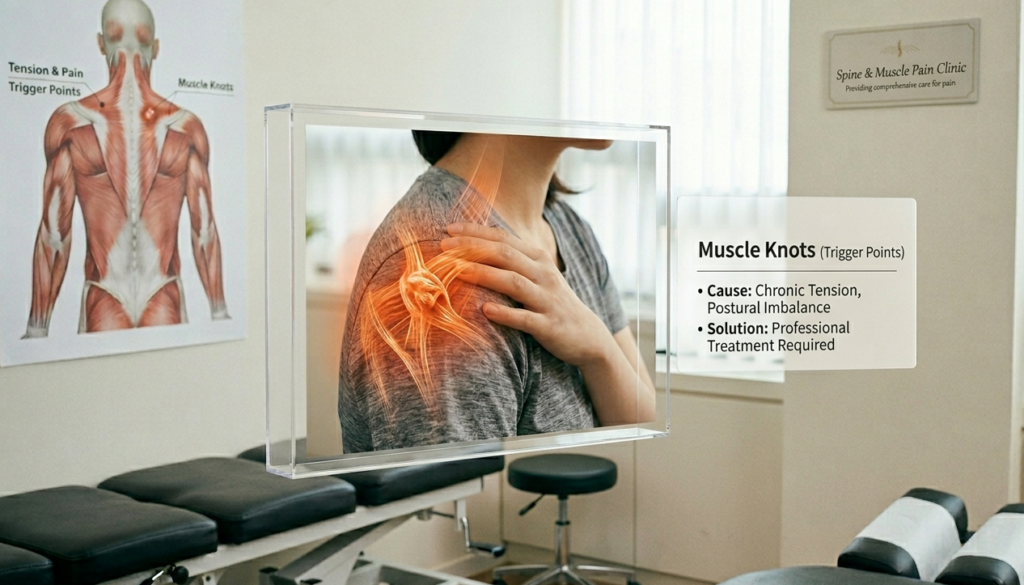
She had named it. Not the way people name pets — more the way people name a problem they have accepted as permanent. She called it “the knot,” always with the definite article, as if there were only one and everyone would know which one she meant. It lived between her right shoulder blade and her spine, at roughly the level of her mid-back, and it had been there for so long she had stopped expecting it to leave.
She was a graphic designer in her early forties. She had tried, by her own count: two different massage therapists (regular sessions, six months with one, four months with the other), a massage gun she used nightly, a foam roller she used every morning, a standing desk, a new office chair, a new pillow, two rounds of physical therapy for an unrelated shoulder issue during which she mentioned the knot and was given a set of stretches that helped for a few days and then stopped. She had good body awareness and she worked hard at this. It did not matter.
When she came to me, she expected more of the same. What she got instead was a different question: “Has anyone actually assessed what that tissue is doing — not just treated the symptom?”
The answer was no. We spent the first session doing exactly that. What I found was not a hypertonic muscle fiber that needed to be released. It was a region where the tissue layers barely moved relative to each other at all — where the glide between planes of connective tissue had become so restricted that the muscles wrapped inside those layers were essentially imprisoned. Treating the muscle without addressing the wrapping was like trying to smooth a shirt that is still inside a too-tight jacket. The shirt was fine. The jacket was the problem.
That conversation — about what fascia is, what it does, and why it is the missing piece in most chronic knot conversations — is what this article is about.
What You Are Actually Feeling When You Press a “Knot”
The sensation is real. The popular explanation for it is not quite right.
When most people press on a sore, ropey spot and call it a muscle knot, they are imagining something like a tangled rope — muscle fibers that have physically knotted together and need to be untangled. That image is intuitive and satisfying, which is probably why it has stuck. The actual tissue biology is more interesting, and understanding it is the difference between chasing the same problem forever and actually resolving it.
Muscle fibers do not knot in the way rope knots. What happens is more layered than that. Each muscle is wrapped in a connective tissue casing called fascia — a continuous, three-dimensional web that surrounds not just muscles but every nerve, blood vessel, and organ in the body. Healthy fascia is slippery, hydrated, and mobile. Layers slide over one another with minimal friction, and the nerves and blood vessels threaded through those layers have adequate room to function.
When fascia loses its hydration and glide — through sustained poor posture, repetitive strain, immobility, dehydration, or simple accumulated physical stress — those layers begin to adhere to each other. Researchers call this fascial densification: a loss of the lubricating substance (rich in a molecule called hyaluronan) that normally keeps layers mobile. The result is a zone where tissues that are supposed to slide freely are now stuck together, where nerves are compressed in corridors that have grown too narrow, where circulation is reduced in a region that depends on it.
That is what you are pressing on. Not a knotted muscle fiber — a compressed, under-circulated, adhesion-restricted zone whose nerves have run out of patience.
Why Every Treatment You Have Tried Has the Same Time Limit
This reframe explains something that frustrates almost every patient who walks into my office with a chronic knot: why massage helps for a few hours and then the knot comes back. Why the foam roller loosens things up in the morning and by evening nothing has changed. Why stretching provides relief right after and then the same tightness returns by the next morning.
All of those interventions — massage, foam rolling, stretching — work by adding mechanical force to the tissue. That force temporarily disrupts the adhesion, improves local circulation, and moves fluid through the region. For an hour, or a few hours, or sometimes a day, the area feels better. Then the conditions that caused the adhesion reassert themselves, and the problem resets.
None of those approaches addresses the underlying problem, which is that the connective tissue architecture in that region has a chronic, structural deficit of space and glide. Restoring space requires more than compression or stretch. It requires the kind of specific, layered work that first assesses which tissue planes are adhered, then addresses them in the right sequence — usually by restoring fascial glide before loading the tissue with movement, not the other way around.
The sequence matters more than most people realize. Movement applied to a region that has not had its space restored first tends to create friction against the restriction rather than through it. The tissue complains louder. People assume they need more force. More force creates more irritation. The cycle becomes self-perpetuating.
The Nervous System Layer Most People Do Not Think About
There is a dimension to this that goes beyond the local tissue, and it is worth including because it explains why chronic knots affect people’s overall state in ways that seem out of proportion to a small patch of tight muscle.
Your nerves have to physically travel through fascial corridors. When those corridors are compressed and sticky, nerves get mechanically irritated — not dramatically, not in a way that produces numbness or radiating pain (usually), but enough to generate a constant, low-level signaling burden. The nervous system registers this as a chronic, low-grade threat, which keeps it tilted toward the sympathetic, vigilant mode rather than the parasympathetic, recovery mode.
This is part of why patients often report feeling calmer and sleeping better after the kind of hands-on care that genuinely restores tissue space — because we relaxed a muscle, but because we reduced the mechanical irritation to the nerves that had been running their complaint signal for months. The body literally gets quieter. Restoring space in the tissue is also restoring space for the nervous system that has to live inside it.
A Practical Sequence for Stubborn Knots — What Actually Works
For patients managing this at home between visits, I give the same sequenced approach: restore space and circulation before adding force. Here is what that looks like practically.
Start with heat, not force. Warm tissue glides better. A warm shower, a heating pad, or a warm bath for 10 to 15 minutes before any self-care work changes the tissue’s receptivity significantly. Do not start with a cold, stiff back and immediately drive a massage gun into it.
Use sustained, gentle pressure instead of aggressive percussion. A soft rubber ball, a yoga tune-up ball, or even just your own hand held at moderate pressure on the tender area for 60 to 90 seconds often produces a release that hammering with a massage gun never achieves. You are not trying to break the adhesion by force — you are inviting the tissue to release by holding space consistently. The physiological mechanism involves the mechanoreceptors in the fascia responding to sustained, moderate pressure by initiating a local softening response. Percussion works differently and tends to add stimulation rather than facilitate release in densified tissue.
Move gently through full range after the release, not before. After the tissue has been encouraged to release with sustained pressure and heat, gentle movement — slow, controlled, not maximal — keeps the space you just created from closing back down. This is the correct order. Many people do the stretches first and the release work second, which is backward.
Address position, not just the symptom. If you spend eight to ten hours a day in a position that loads&�he tissue zone repeatedly — neck forward, shoulder rounded, ribs collapsed — the knot is going to return regardless of what you do in your ten-minute morning routine. Small, frequent position resets throughout the day (gentle shoulder-blade retraction, chin-tuck, deep breath into the lower ribs) done every 45 to 60 minutes interrupt the cumulative postural stress before it fully reasserts.
Hydrate consistently. Connective tissue is approximately 70 percent water by composition. Chronic mild dehydration measurably increases fascial viscosity. It is not dramatic and it is not the whole story, but it is consistently underappreciated.
When the Knot Is Not Just a Knot
Most chronic tightness responds to the approach above, and most of what people call muscle knots are genuine fascial issues that improve with the right kind of attention. There are a few situations, however, where the presentation warrants professional evaluation rather than continued self-treatment:
Pain that is consistently worsening rather than variable. A stubborn knot that does not change much over time is almost always a soft-tissue story. A knot that is steadily getting worse despite reasonable care needs to be assessed in person. Pain accompanied by numbness, tingling, or weakness traveling into an arm or leg suggests nerve involvement that needs proper workup. Pain that is present at rest and at night, unprovoked by movement, can sometimes indicate something other than a musculoskeletal cause. And pain following a specific injury — a fall, an accident, an awkward lift — should be evaluated rather than self-managed.
For everything else: the reframe matters. Stop trying to break the knot. Start asking what that tissue needs that it has not been getting — usually space, circulation, and a sequence of treatment that addresses the connective tissue architecture before it loads the muscle. The muscle knot you have been fighting is almost certainly not the problem. It is the symptom of a problem one layer deeper. Go there first, and the knot finally has somewhere to go.
— Calli, DC, LE | Licensed Chiropractor & Esthetician, Los Angeles
Medical disclaimer: This article is for educational purposes and does not substitute for an in-person clinical evaluation. Pain accompanied by numbness, tingling, weakness, fever, unexplained weight loss, or symptoms that followed a specific injury should be evaluated by a qualified healthcare provider.
Related Articles