
By Calli | Licensed Chiropractor & Esthetician (DC, LE) | May 3, 2026
You spend a third of your life in one position. Most people choose that position by accident — whichever side they happened to fall asleep on as a kid — and then wonder for the next forty years why their back hurts more in the morning than it did at bedtime. The mattress gets blamed. The pillow gets blamed. After 20 years of asking new patients in my LA office how they sleep, the truth is usually simpler: the position is wrong, and the spine has been quietly held in a stressed shape for seven hours straight.
The right sleeping position can quietly rebuild your back overnight. The wrong one can re-injure it every single night, no matter how careful you are during the day. There is genuinely a best answer for most patients, and there is also a clear worst position that almost everyone with back pain should stop using immediately.
I am Calli, a licensed chiropractor in Los Angeles. This is the same conversation I have with patients on their second visit — once their back pain has started to settle and we need to keep it from coming back overnight.
TABLE OF CONTENTS
Quick Summary
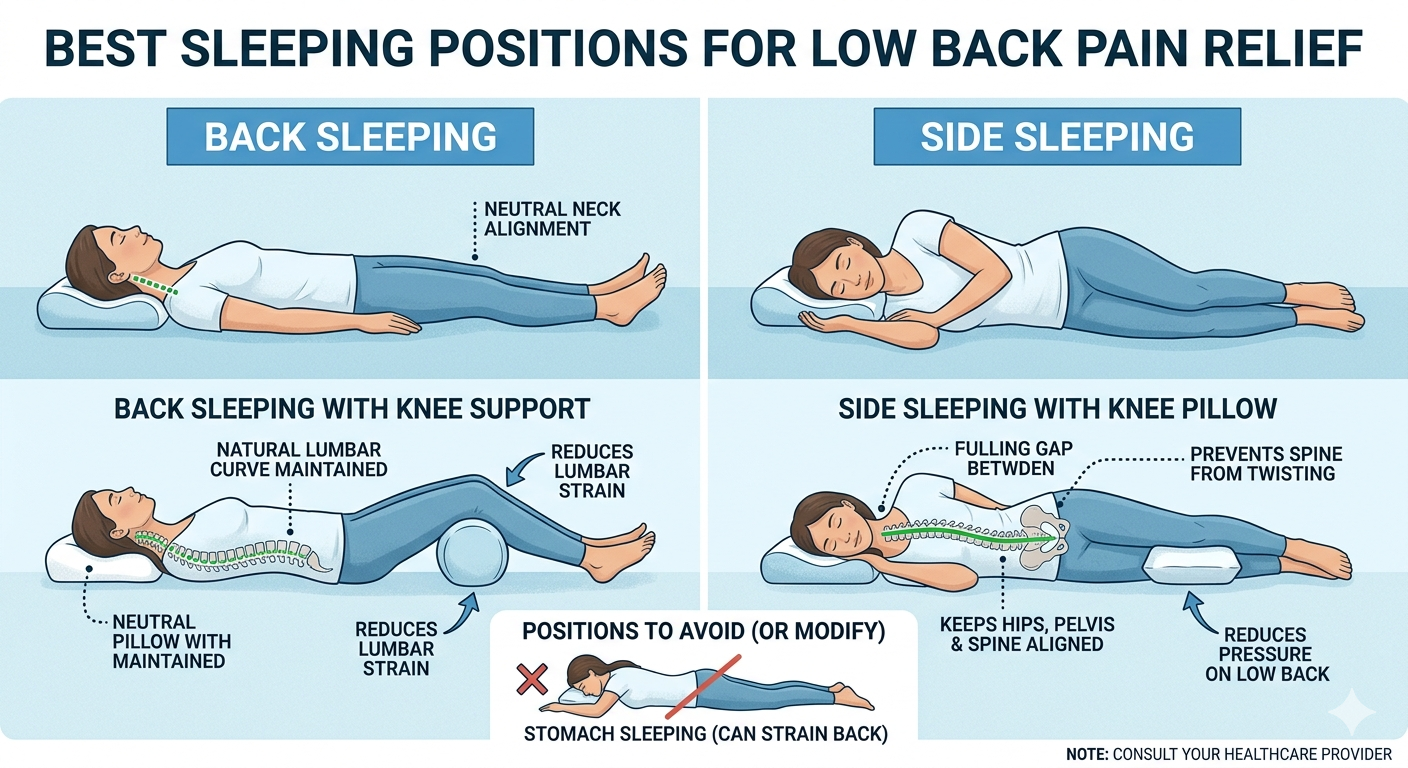
For most patients with back pain, the best sleeping position is on your side with a pillow between your knees and your top knee bent forward slightly. The worst position is stomach sleeping, which forces your neck into rotation and your lower back into hyperextension for hours. Back sleeping is fine if you place a pillow under your knees. The position has to match your specific condition — sciatica, disc, and stenosis each respond to slightly different setups, which I break down below from 20 years of clinical experience.
WHY TRUST CALLI
I am a licensed Doctor of Chiropractic and licensed Esthetician with 20 years of practice in Los Angeles. Sleep position is one of the highest-yield, lowest-cost changes I make with new patients — often the difference between a back that flares every morning and a back that quietly heals overnight. This article is educational and is not a substitute for a clinical exam.
The Worst Sleeping Position for Back Pain (Stop This First)
Stomach sleeping. If your back hurts and you sleep on your stomach, this single change will probably do more than any stretch I can give you. After 20 years of treating LA patients, the percentage of new back pain intakes who turn out to be stomach sleepers is staggering — and the percentage of those who feel better within a single week of switching off it is even more striking.
Why Stomach Sleeping Damages Your Spine
When you sleep on your stomach, two things happen at once for the entire night. First, your neck has to rotate ninety degrees so you can breathe — that puts the upper cervical spine in extreme rotation for hours. When I palpate the upper neck on a chronic stomach sleeper during an exam, the suboccipital muscles are almost always knotted and asymmetric. Second, your lower back collapses into the mattress, holding your lumbar spine in maximum extension. The hip flexors get stuck shortened. The neck and shoulder get pinned. By morning, you have a stiff neck, an aching low back, and tight hips, and you cannot figure out why.
How to Stop Stomach Sleeping (When You Cannot Help It)
If you wake up on your stomach despite trying not to, the trick is not willpower — it is geometry. The setup I prescribe to my LA stomach-sleeper patients: sleep with a body pillow hugged in front of you, with your top knee bent up over the pillow so your hip is rotated forward. This puts your body in a half-stomach, half-side position that mimics your old habit but takes the load off the spine. Most of my patients transition fully off stomach sleeping in about two weeks doing this.
The Best Sleeping Position for Lower Back Pain
Side sleeping with proper alignment is the most universally back-friendly position. It works for most disc cases, most muscle strain, and most pregnant patients I treat. But “side sleeping” is not enough on its own — and that is the part patients get wrong. The alignment underneath you is what matters.
How to Set Up the Ideal Side-Sleeping Position
This is the exact setup I walk my patients through, often with a demonstration on the treatment table. Lie on your side. Pillow under your head should be thick enough that your nose stays in line with your sternum — not tilting down toward the mattress, not tilting up toward the ceiling. Your top knee should be bent slightly forward of your bottom knee. A pillow between the knees keeps the top hip from rolling forward and twisting your lower back. A small towel roll tucked into the curve of your waist (between your ribs and hip) supports the gap that opens when the mattress is too soft. When my patients send me a photo of their sleep setup before bed, this is the configuration we are aiming for.
Right Side or Left Side: Does It Matter?
For low back pain alone, in my clinical experience, either side is fine. For acid reflux, left side is better — gravity helps keep stomach contents down. For pregnancy, left side improves blood flow to the placenta. If one side feels significantly worse than the other, sleep on the side that does not flare your symptoms — that is your body telling you which direction the irritation is, and I trust that signal more than any general rule.
The Pillow Between Knees Trick That Actually Works
This is the single highest-impact, lowest-cost change I give my back pain patients. It is shocking how often this one adjustment alone resolves morning low back stiffness, and after 20 years it is still the recommendation I have to repeat most often because patients keep underestimating it.
Why a Pillow Between the Knees Helps
When you side-sleep without a pillow between the knees, your top leg falls forward, dragging your top hip with it. That hip rotation cascades up into your pelvis and twists your lumbar spine for the entire night. Hours of low-grade rotation produces exactly the kind of asymmetric joint stiffness patients walk into my LA clinic with — sore on one side of the low back, fine on the other. When I run motion palpation on these patients, the SI joint on the dependent side is almost always restricted.
What Kind of Pillow to Use Between Your Knees
A standard bed pillow is fine. A small dedicated knee pillow holds shape better. The key is that it is thick enough to keep the top knee at hip height — not collapsed downward. If you do not have a pillow handy tonight, fold a bath towel three times. The point is not the pillow itself. It is the height between your knees, and that is the cue I drill with my patients.
Best Sleeping Position by Condition: Sciatica, Disc, Stenosis
Generic advice plateaus. The right position for your specific condition will help noticeably more than the average answer — and in my LA practice, matching position to diagnosis is one of the small details that meaningfully shortens recovery time.
Best Sleeping Position for Sciatica
For my sciatica patients, side sleeping on the side opposite their sciatica with a pillow between the knees is what I prescribe most often. This keeps the irritated nerve root from being compressed under their body weight. If the sciatica is bilateral, back sleeping with a pillow under both knees is usually better. Avoid lying on the painful side. For more on what is actually causing the nerve pain, see what causes sciatica pain.
Best Sleeping Position for a Herniated or Bulging Disc
Most disc cases I treat do best in slight extension at night — meaning back sleeping with a small rolled towel under the lumbar curve, or side sleeping with knees only slightly bent (not curled tightly toward the chest). The fetal position feels protective but it actually loads the back wall of the disc, which is why I steer my disc patients away from it on their first visit. Read more in herniated disc vs bulging disc.
Best Sleeping Position for Spinal Stenosis
The opposite of disc cases. My stenosis patients do better with slight flexion — back sleeping with a pillow under the knees, or side sleeping in a more curled position. The same forward bend that relieves them when they walk is the position that lets their spinal canal rest at night. The reasoning behind this lives in what is spinal stenosis.
Best Sleeping Position for Hip Pain or Hip Impingement
If one hip is the problem, my prescription is to sleep on the opposite side with a thick pillow between the knees so the painful hip is on top, supported, and not dragged into rotation. Avoid sleeping directly on the painful hip until the impingement settles — this is part of the picture I cover in why your hip pinches when you sit.
Does Your Mattress or Pillow Actually Matter for Back Pain?
Yes — but probably less than you think, and in a different way than the marketing claims. After 20 years of fielding “should I get a new mattress” questions on intake, my honest answer is: only after we have fixed the position you sleep in.
The Mattress Firmness Question
The research on mattress firmness for back pain is muddier than most ads imply. The general finding from studies on chronic low back pain is that medium-firm tends to outperform very soft and very firm. A mattress that is too soft lets the heavier parts of you (hips and shoulders) sink in, twisting the spine. A mattress that is too firm refuses to accommodate those curves at all, leaving the lower back unsupported in mid-air. My clinical recommendation for most LA patients in body types around the average range: medium-firm splits the difference.
When You Actually Need a New Mattress
Replace the mattress when you can see a visible body-shaped indentation, or when you consistently wake up worse on it than on a hotel bed — the hotel bed test is one I run with patients all the time. Mattresses do not last forever — even high-end ones generally need replacement around 8 to 10 years. If yours is older than that and your back pain is worst in the morning, the mattress is part of the equation.
The Pillow Question
Pillow height matters more than pillow brand. The right pillow keeps your head in line with your spine — not pushed up, not falling down. Side sleepers usually need a thicker pillow than back sleepers. Stomach sleepers should ideally use no pillow at all, but again — stomach sleeping is the position to leave behind, and that is what I tell my patients first.
The Bottom Line
For most back pain, side sleeping with a pillow between the knees is the safest default. Stomach sleeping is the highest-yield habit to change. The right position depends on your condition — disc cases prefer slight extension, stenosis cases prefer slight flexion, sciatica cases prefer the unaffected side. Mattress and pillow matter, but only after you have fixed the position underneath. If you wake up worse than you went to bed for more than two weeks despite trying these changes, get a clinical exam — there is a structural piece your body is asking you to address.
Calli’s Clinical Note
In 20 years of practice in Los Angeles, I ask every back pain patient one question on their first visit: how do you sleep? More than half describe stomach sleeping or side sleeping with no pillow between the knees. Just changing those two things — before any adjustment, before any exercise — meaningfully reduces morning pain in most cases. The reason this works is that we are removing seven hours of repeated injury, every single night. The body cannot heal what it is being re-stressed for a third of every twenty-four hours. Fix the night, and the day starts taking care of itself.
Tension Headache vs Migraine: What’s the Difference? →
If you have ever wondered whether you have a tension headache, a migraine, or something else, the next post breaks down how to tell them apart in under a minute — and which one is being driven by your neck.
— Calli
DC, LE | Licensed Chiropractor & Esthetician | The position your spine sleeps in is the position it heals in.
Medical disclaimer: This article is for educational purposes only and is not a substitute for evaluation by a qualified healthcare provider. If your back pain is sudden, severe, accompanied by fever, unintended weight loss, or new neurological symptoms, seek medical evaluation promptly.