
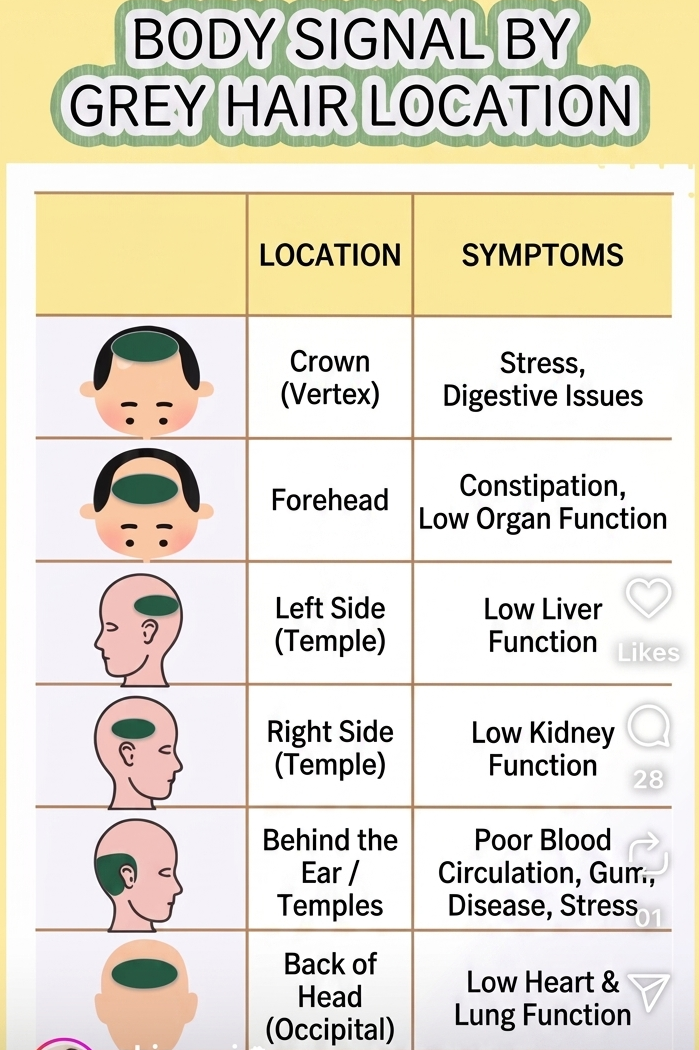
She held her phone up toward me mid-appointment and showed me a chart. It was one of those diagrams that circulate endlessly on wellness social media — a cartoon head divided into zones, each one color-coded and labeled: gray at the crown means digestive stress, gray at the temples means liver or kidney issues, gray at the hairline means bowel problems. She had been going gray at her temples for about a year. She was 34. She had been quietly worried about her liver for months.
“Does this mean something is wrong with my organs?”
In 20 years of practice — as a chiropractor who works with the musculoskeletal system and as a licensed esthetician who has looked at thousands of scalps — I have seen that chart, or a version of it, probably two dozen times. My answer is always the same: no. The chart is not science. But the question underneath it — does early graying tell you something about what is happening in your body? — is more nuanced than a straight dismissal.
This article is my attempt to give you the honest, complete version of that answer.
Where the Charts Come From — And Why They Keep Spreading
The scalp-zone charts mapping gray hair locations to specific organs trace back to traditional face- and scalp-reading practices, most prominently from certain branches of traditional Chinese medicine and Ayurveda, which map body regions to organ systems through meridian-based theories. These traditions have their own internal logic and some practitioners use them meaningfully. The problem is that the viral social media versions strip out all of that context and present the organ-zone maps as if they reflect modern anatomy and physiology — which they do not.
Hair follicles are distributed across the scalp by developmental and genetic patterning. They do not have anatomical lines of communication to specific internal organs. A gray follicle at your left temple is not receiving a distress signal from your liver any more than a gray follicle at your crown is relaying messages from your stomach. The melanocytes in each follicle respond to their own local biochemical environment — influenced by your overall physiology, yes, but not by an organ map.
The reason these charts spread so relentlessly is that they offer something genuinely appealing: a feeling of decoding, of having a readable map to your own body. The instinct underneath them — that your body’s visible changes reflect its internal state — is not entirely wrong. The specific map they draw is what falls apart.
What Actually Causes Hair to Go Gray
Each hair follicle contains melanocytes — cells whose sole job is producing the pigment that gives hair its color. As those cells age, divide, and eventually exhaust their replication capacity, they stop producing pigment, and the hair that grows from that follicle comes in white or colorless. Mixed with remaining pigmented strands, this reads as “gray” in the mirror.
The timing of this process is primarily genetic. The age at which your follicles start losing their melanocytes is largely inherited, set long before anything you do or eat or stress about. If your parent went noticeably gray at 32, you have a good chance of following a similar timeline. This is, for most people with premature gray hair, the complete explanation — and it is one that no supplement, protocol, or organ-zone interpretation changes.
But genetics is not the only factor. Several others have real, evidence-backed connections to early graying:
Oxidative stress. Melanocytes are particularly sensitive to oxidative damage — an imbalance between cell-damaging reactive oxygen species and the body’s capacity to neutralize them. Chronic stress has a demonstrated mechanism here: research published in the last decade has shown that the sympathetic nervous system’s stress response depletes melanocyte stem cells, accelerating the point at which follicles lose their color. Smoking is among the strongest modifiable risk factors for premature graying, largely through oxidative mechanisms. Poor sleep, which impairs the body’s nighttime antioxidant reset, also contributes.
Vitamin B12 deficiency. This is the nutritional connection with the clearest evidence base, and it is worth explaining in detail because it has real implications. B12 is essential for the production of myelin (the sheath protecting nerve fibers), red blood cell synthesis, and DNA repair — including the DNA repair activity that keeps melanocyte stem cells functional. Low B12 is genuinely associated with premature graying, and critically, it is a deficiency that is common, often silent in its early stages, and correctable.
Groups at highest risk of B12 deficiency: strict vegetarians and vegans (B12 is found almost exclusively in animal products), older adults (stomach acid production decreases with age, impairing B12 absorption), people on long-term metformin or proton pump inhibitors, and anyone with malabsorption conditions like celiac or Crohn’s disease.
Thyroid dysfunction. Both hypothyroidism and hyperthyroidism are associated with changes in hair — including premature graying — because thyroid hormone regulates the metabolic rate of hair follicle cells, including the melanocytes. Thyroid disease is common (particularly autoimmune thyroid disease like Hashimoto’s, which affects women disproportionately) and is frequently underdiagnosed in its early stages.
Certain autoimmune conditions. Conditions like vitiligo and alopecia areata involve immune system attacks on melanocytes; premature graying can be part of the clinical picture. These warrant proper medical evaluation rather than self-management.
What I Look For as an Esthetician
From the skin-and-scalp side of my practice, I notice things about graying clients that go beyond the hair. The scalp’s condition — its sebum balance, the hair follicle density visible under magnification, the texture and porosity of the gray strands themselves — tells a parallel story to what is happening with the follicle’s biology.
Gray hair has lost more than pigment. The melanin granules that give hair its color also contribute to the hair shaft’s structural integrity. Gray and white hair tends to be coarser, more porous, and more prone to frizz and dryness — not because of the graying itself necessarily, but because the structural protein balance in the shaft changes as melanocytes decline. This is why gray hair often requires a different care approach: more moisture, more protein-based conditioning, gentler processing if color is applied.
From a scalp perspective, the patients who seem to maintain the best follicle health and density as they gray tend to share a few things in common: consistent scalp circulation (regular gentle massage or exfoliation), adequate protein intake, and normal or well-managed thyroid status. Whether any of those factors actively slow graying is not something I would promise. But follicle health and pigmentation share the same foundational requirements, and supporting one tends to support the other.
The Honest Summary: What You Can and Cannot Change
Genetic graying is not reversible. Full stop. No serum, supplement, or dietary protocol overrides inherited melanocyte timing in any way the current science supports. Anyone selling that promise is not selling science.
What is actually within your reach:
Stop smoking, if you do. It is one of the clearest modifiable risk factors, not just for graying but for skin aging, hair quality, and a dozen other things your body would prefer you address.
Get a B12 level tested if you are in a risk group — vegetarian, vegan, older adult, on certain medications, or with a gut condition. If testing confirms deficiency, correct it under your doctor’s guidance. B12 supplementation in someone who is actually deficient is one of the cleaner stories in nutritional medicine: the deficiency is real, the correction is effective, and the ripple effects on energy, cognition, and nerve health are significant beyond whatever it does or does not do for your hair.
Ask your doctor to check your thyroid, particularly if graying is arriving alongside other symptoms — fatigue that sleep does not fix, cold intolerance, hair thinning beyond just graying, mood changes, weight changes that do not correspond to anything you have done. Thyroid disease is common, measurable, and treatable. It deserves to be ruled in or out properly rather than through a scalp chart.
Manage chronic oxidative load through the boring basics: adequate sleep, a diet built substantially around vegetables and fruit, regular movement, and stress that is addressed rather than sustained indefinitely.
And take care of the gray hair you have. It is not a medical problem. With the right moisture, the right conditioning, and ideally the input of an esthetician or colorist who understands the structure of gray strands, it can be beautiful. The goal is not to fight the gray — it is to make sure the pattern that produced it does not also mean something else is going unaddressed.
When to Go to a Doctor
A few scenarios specifically warrant a proper medical conversation rather than lifestyle adjustments and monitoring:
Gray hair that arrives suddenly or progresses unusually rapidly in a short period of time, rather than the gradual spread over years that characterizes genetic graying. Graying alongside a constellation of other symptoms — fatigue, cold intolerance, weight change, mood shifts, heavy or irregular periods — which together point toward thyroid or nutritional issues worth testing. Patchy loss of color in the skin alongside hair changes, which may point toward autoimmune conditions like vitiligo. Any strong family history of autoimmune disease or early-onset thyroid problems, which should prompt routine monitoring rather than waiting for symptoms.
For everything else: the chart on the phone of that patient in my office was wrong about the organs, but she was right that her body was sending a signal. The signal just was not coming from a scalp map. It was coming from the full pattern of how she felt — the fatigue she had normalized, the cold she always was, the periods that had been getting heavier. Those things told a real story. The gray hair was a prompt to listen more carefully, not a diagnostic atlas.
That is the most useful thing I can offer on this subject: when your body is trying to get your attention, pay attention to all of it — not just the part that makes the most visually striking chart.
— Calli, DC, LE | Licensed Chiropractor & Esthetician, Los Angeles
Medical disclaimer: This article is for educational purposes and does not constitute medical advice or diagnosis. Chiropractors do not diagnose or treat the causes of premature graying. If you have concerns about sudden or rapid gray hair changes, or lecognize the associated symptoms described here, please consult your physician for appropriate evaluation and testing.
Related Articles