
By Calli | Licensed Chiropractor & Esthetician (DC, LE) | May 13, 2026
You have probably been told your forward head posture is a neck problem. Tuck your chin, change your pillow, sit up straight. You do all three, hold it for thirty seconds, and your head drifts right back out over your keyboard. That is not a willpower failure — it is a sign you are treating the wrong body part.
I am Calli, a licensed chiropractor in Los Angeles, and forward head posture — what most people now call “tech neck” — is one of the most common patterns I assess. After 20 years in practice, here is the single most useful thing I can tell you: your head is not drifting forward because your neck is weak. It is drifting forward because the structures underneath it — your mid-back, your rib cage, your breathing — quietly collapsed first. Fix the foundation and the head follows. Fight the head alone and you will lose every time.
TABLE OF CONTENTS
QUICK SUMMARY
Forward head posture is not caused by a weak neck — it is the visible end of a chain reaction that starts lower down. A stiff, rounded mid-back (thoracic kyphosis) tightens the rib cage, shallows your breathing, quiets your deep core, and lets the shoulder blades and even the pelvis drift out of position. That is why chin tucks and new pillows feel good for a minute and then stop working. Real correction means restoring thoracic mobility, rebuilding your breathing, improving fascial glide, and re-teaching your nervous system where “upright” actually is.
WHY TRUST CALLI
I am a licensed Doctor of Chiropractic and licensed Esthetician with 20 years of practice in Los Angeles. Postural complaints like forward head posture and rounded shoulders are part of my caseload every single week, and I work them up with orthopedic testing, thoracic mobility screening, and breathing-pattern analysis. This article is educational and not a substitute for a hands-on examination — but it is the same plain-language explanation I give my own patients in office.
What Forward Head Posture Actually Is
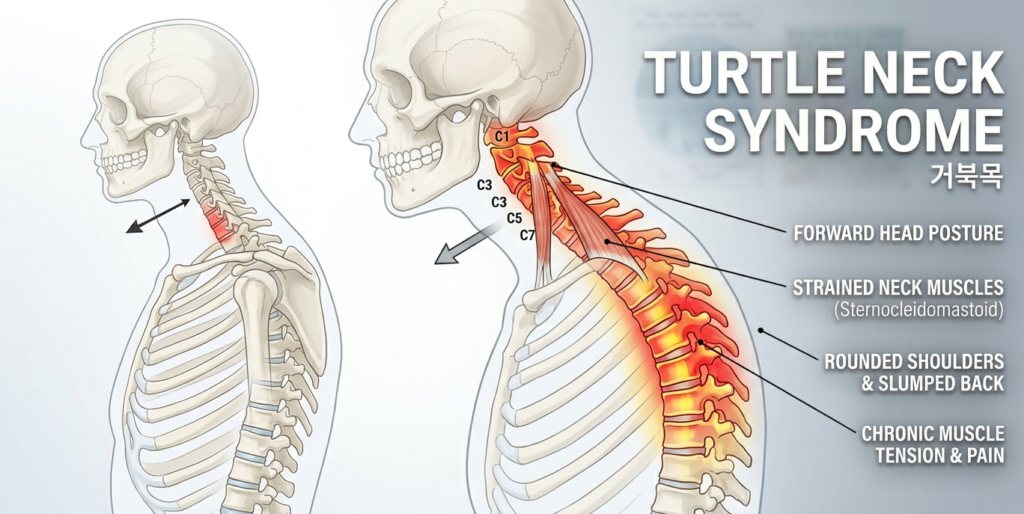
In a well-stacked posture, your ear sits roughly over your shoulder, and your shoulder over your hip — a clean vertical line. Forward head posture is what happens when that top segment slides out of line: the head translates forward of the body instead of balancing on top of it. In my 20 years of practice in Los Angeles, the patient I see most often for this is a 30-to-55-year-old who spends six or more hours a day at a screen and first noticed the problem in a side-profile photo, where the head clearly juts ahead of the shoulders.
How Far Forward Is “Too Far”?
Your head weighs roughly ten to twelve pounds when it is balanced over your spine. As it drifts forward, the leverage against it multiplies, and the muscles at the base of your skull and along your upper back end up working overtime all day just to keep your eyes level. When I screen posture in my exam room, I am not looking for a ruler-straight spine — nobody has one. I am looking at how far the ear has drifted in front of the shoulder, and, more importantly, whether the person can actively correct it and actually hold the correction without strain.
Forward Head Posture vs. “Tech Neck” — Same Thing?
Tech neck is just the casual name for the same pattern, usually blamed on looking down at phones. The label does not matter much; what matters is that this is not a purely cosmetic issue. Over two decades of LA practice, I have seen this exact posture sit underneath ongoing upper-back aching, jaw tension, and a large share of the tension headaches I evaluate. It also quietly changes how the shoulder works. So it is worth correcting — but only if you correct the right thing.
Why Your Head Position Is a Whole-Body Signal
Here is the reframe I give every patient on their first visit: your head position is the last domino, not the first. By the time the head is visibly forward, several things below it have already shifted. That is why I never assess a forward head in isolation — if I only treated the neck, I would be polishing the tip of a problem whose root is two or three regions lower. Understanding that chain is the whole game, so let us walk through why the popular fixes miss it.
Why Chin Tucks, New Pillows, and “Sitting Up Straight” Don’t Last
These are the three things almost everyone tries first. None of them are wrong, exactly — they are just incomplete, and the relief they give is mostly temporary. In two decades of LA practice, I have lost count of how many patients have arrived frustrated that they have been doing chin tucks religiously for months with nothing lasting to show for it.
Why Chin Tucks Feel Productive but Rarely Hold
A chin tuck is a perfectly good movement. The problem is what you are tucking onto. If you draw your chin back over a mid-back that is stiff and rounded, you are stacking a correction on a broken foundation — and the moment you stop actively holding it, gravity and that rigid thoracic spine win the argument. When I watch a patient perform a chin tuck in my office, I can usually see it: the head moves, but the upper back never changes. A chin tuck done that way is a rep, not a fix.
New Pillows and Posture Braces Treat the Symptom
A better pillow can absolutely make sleep more comfortable, and the right setup matters — I get into that in my guide to the best sleeping position for back pain. But comfort at night does not restore the mobility you lost during the day. The same goes for posture braces. A brace can be a useful cue for an hour or two, but worn all day it can actually let the supporting muscles switch off further. In my clinical experience, both belong in the “helpful reminder” category, not the “correction” category.
Why Forcing Your Neck Straight Backfires
The instinct to crank your head back into a rigid, military-straight position is understandable, but it usually just trades one strain pattern for another — over-arching the base of the neck and gripping hard with the upper trapezius. Your body is not asking for “straight.” It is asking for “stacked and mobile.” When I see a patient white-knuckling a tall posture in my exam room, I already know it will not survive the drive home, because effortful posture is not sustainable posture.
What Really Causes Forward Head Posture (It’s Not Your Neck)
If the popular fixes all fail for the same reason, it is worth understanding the chain they are missing. Forward head posture is the visible end of a sequence that usually starts well below the collar.
It Starts in the Mid-Back: Thoracic Kyphosis and a Stiff Rib Cage
Hours of sitting let the thoracic spine — your mid-back — settle into increased flexion, a deepened forward curve called thoracic kyphosis. As that curve increases, the rib cage gets pulled down and in, the chest muscles at the front shorten, and the rib cage loses its natural spring. This matters because your head can only stack over your shoulders if the mid-back underneath is tall enough to hold it there. When I run a thoracic mobility screen on a forward-head patient in my LA office, the mid-back almost always barely extends — and that, not the neck, is the real starting point. It is also why I point patients to the desk habits that quietly drive it.
Then Your Breathing Changes — and Your Core Goes Quiet
A closed, stiff rib cage cannot expand well, so breathing slowly becomes shallow and upper-chest dominant. The diaphragm — your primary breathing muscle and a key part of your deep core — starts to under-work. And when the diaphragm checks out, the deep core that depends on it loses its anchor, leaving the spine without a stable base to organize around. I check breathing on nearly every postural patient I see. When someone is breathing high into the neck and shoulders instead of expanding the lower ribs, I know the diaphragm is not doing its job, and the core will not be either.
Finally the Shoulder Blades and Pelvis Drift
With a collapsed rib cage and a quiet core, the shoulder blades lose the stable platform they are supposed to sit on. They wing outward or slide forward, the shoulder joint becomes less stable, and the pelvis often tilts to compensate for the whole arrangement. At that point this is a whole-body pattern, not a neck pattern. If you want to see where your own shoulders land, I built a checklist for whether your shoulders have actually drifted forward. By the time I am assessing a patient’s head position, I have usually already found the real problem three regions lower.
How to Fix Forward Head Posture: The 4 Keys That Actually Work
If the cause is a chain, the fix has to rebuild that chain from the bottom up. After two decades of working these cases in Los Angeles, this is the four-part order I give my own patients — and the order genuinely matters.
Key 1: Restore Thoracic Spine Mobility
Nothing above a frozen mid-back can stack properly, so this is always step one. The goal is to get the thoracic spine extending and rotating again — foam roller extensions over the mid-back, open-book rotations, and slow, intentional cat-cow movement are the home staples I assign most. In clinic, I add hands-on thoracic spine mobilization and drop-table work to restore motion segment by segment. When the mid-back can hold itself tall again, the head finally has somewhere to sit.
Key 2: Rebuild Your Breathing — Diaphragm, Ribs, and Fascia
Once the rib cage can move, you have to teach it to move with each breath again. Diaphragmatic breathing retraining is one of the first home drills I assign — five quiet minutes, twice a day, breathing low and wide so the lower ribs expand in all directions rather than the chest and shoulders heaving upward. This re-springs the rib cage, wakes the diaphragm, and re-engages the deep core that stabilizes everything above it. It is unglamorous work, and it is also the step that changes the most.
Key 3: Improve Fascial Glide
Fascia is the connective-tissue webbing that wraps your muscles and lets them slide against one another. Held in one collapsed shape for years, the fascia around the chest, front of the neck, and mid-back gets sticky and loses its glide, so tissues tug instead of slide. In my treatment room I use myofascial release and instrument-assisted soft tissue mobilization (IASTM) to restore that glide directly. At home, slow self-massage and gently moving each region through its full range accomplishes a working version of the same thing — the point is to make the tissue supple enough that your new mobility is not constantly fighting friction.
Key 4: Neuromuscular Re-Education
The final step is teaching your nervous system that the new, stacked position is the default — not a pose you have to consciously perform. This is neuromuscular re-education, and in practice it means brief, frequent posture check-ins throughout the day rather than one long corrective session. The brain has to remap “upright” until it stops feeling like effort. This is the step most people skip, and it is exactly why mobility work alone tends to regress. In my experience, the patients who actually hold their correction are the ones who do many small, low-effort resets, not one heroic session a week.
CALLI’S CLINICAL NOTE
In 20 years of running a Los Angeles practice, the single biggest predictor of who actually corrects their forward head posture is not how strong their neck is — it is whether they rebuilt their breathing. The patients who stall are almost always still breathing high into the neck and shoulders, which keeps the rib cage locked and the deep core switched off no matter how many chin tucks they grind out. When I get someone breathing low and wide into the lower ribs again, the head position often starts improving on its own — before we have done a single dedicated “neck” exercise.
THE BOTTOM LINE
Forward head posture is the visible end of a chain that starts in your mid-back, not your neck. A stiff thoracic spine tightens the rib cage, shallows your breathing, quiets your deep core, and lets the shoulders and pelvis drift — which is why chin tucks, new pillows, and “sitting up straight” only ever buy you a few minutes. The fix is to rebuild the chain in order: restore thoracic mobility, retrain your breathing, improve fascial glide, and re-educate your nervous system. Do that, and your head stops being something you have to hold up — it simply stacks where it belongs.
RELATED READING
Shoulder Impingement Syndrome: Why Medical Treatment Alone Will Never Fix It → — the same posture chain that drives forward head posture is often what is quietly pinching the shoulder, too.
COMING UP NEXT
Why You Can’t Take a Full, Deep Breath — and What Your Rib Cage Has to Do With It →
If “just breathe deeper” never seems to work, the problem usually is not your lungs — it is a rib cage that has lost its spring. Next up: how to actually restore full, easy breathing, and why it is the quiet engine behind good posture.
— Calli
DC, LE | Licensed Chiropractor & Esthetician | Your head does not drift forward on its own — the foundation moves first.
Medical disclaimer: This article is for educational purposes only and is not a substitute for evaluation by a qualified healthcare provider. If you have neck pain accompanied by numbness, tingling, or weakness in the arms or hands, dizziness, or pain that followed an injury, please seek an in-person medical evaluation.
Related Articles